


BY RITA OYIBOKA
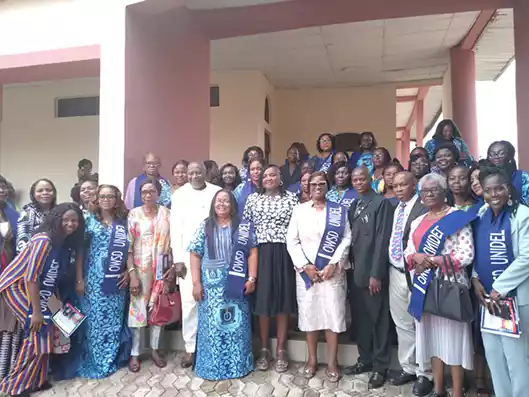
The Organisation for Women in Science for the Developing World (OWSD) has formally inaugurated its University of Delta (UNIDEL), Agbor branch, marking a significant step toward strengthening women’s participation in science, research, and innovation.
The inauguration, held at the university’s 1,000-seater hall, drew academics, researchers, students, and key stakeholders from across the South-South region and beyond.
The inaugurated branch executives were the Branch Coordinator, Dr Clara Moemeke, Secretary, Dr Doris Nwachukwu, Financial Secretary, Dr Rita Chukwuka, Technical Director, Dr Ese Mughele, Treasurer, Dr Loveth Igumbor and Public Relations Officer, Dr Ifeanyi Oyem.
Speaking at the event, the National Chairperson of OWSD, Prof. Folasade Olajuyigbe, represented by the South-South Zonal Coordinator, Dr Nkolika Nwazor, described the inauguration as more than a ceremonial milestone, calling it “the beginning of new opportunities and transformative possibilities.”
She emphasised that the establishment of the UNIDEL branch signals a firm commitment to advancing women in science, strengthening research capacity, and fostering innovation to address societal challenges.
Olajuyigbe outlined three strategic pillars for the branch’s success: visibility, collaboration, and impact, urging members to showcase their work, build strong partnerships, and ensure their research addresses real societal needs.
In her remarks, the Vice Chancellor of UNIDEL, Prof. Stella Chiemeke, described the event as a historic moment for the institution.
“We are writing history. This university has consistently seen women at the forefront of its achievements, and this organisation will further deepen that legacy,” she said, expressing confidence that the OWSD branch would record significant accomplishments.
Delivering her inaugural address, the Branch Coordinator, Dr Clara Moemeke, framed the launch as both a responsibility and an opportunity to drive meaningful change.
“This is not just the beginning of leadership; it is the strengthening of a collective vision to empower and elevate women in science, technology, engineering, and mathematics,” she said.
Moemeke acknowledged persistent challenges faced by women in science, including limited access to resources, underrepresentation in leadership, and societal constraints. She, however, pledged that the branch would focus on mentorship, research collaboration, capacity building, and advocacy for gender equity.
In a keynote address titled “Bridging Gaps and Expanding Opportunities: Pathways for Early-Career Women Scientists in Low- and Middle-Income Countries,” Dr Nwazor highlighted systemic barriers confronting women in science, describing them as “opportunity gaps, not talent gaps.”
She identified three major challenges: infrastructure limitations, structural inequalities, and lack of visibility, urging participants to leverage global networks, build relevant skills, and strengthen mentorship systems.
The highlight of the event was the presentation of awards to the Vice Chancellor of UNIDEL, Prof. Stella Chiemeke, the Registrar of UNIDEL, Barr. Richmond Omagbemi, Prof. Eunice Igumbor, among others.
While appreciating the organisation for the awards, Prof. Stella Chiemeke revealed that the UNIDEL OWSD branch commenced with over 80 registered members, well above the minimum requirement, describing the turnout as a sign of strong institutional buy-in.
“This is just the beginning. The numbers will grow, and the impact will multiply,” she said, encouraging wider participation across faculties.

