


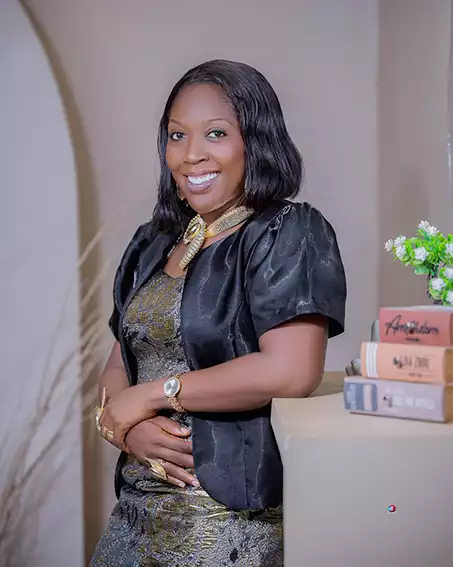
Today, we’re honoured to host Dr Ifeanyi Oyem, a passionate microbiologist, a rising academic force, and a scientist who measures success not by publications alone, but by impact. From her unexpected journey into microbiology, after a twist of fate in the JAMB journey, to becoming an Associate Professor at the University of Delta, Agbor, she now dedicates her work to pressing realities: safer water, a cleaner environment, healthier foods, and the bridge between the lab and the community. In this interview with Rita Oyiboka, she speaks about building impact in academia, bridging the gap between lab and community, and creating space for women to rise.
Who is Dr Ifeanyi Oyem?
I’m just a simple, passionate young woman. I would say young, because even when I’m 50, I’m still very young at heart. I’m an academic. I’m an Associate Professor of Microbiology at the University of Delta, Agbor.
When did the passion for this career path start?
I didn’t set out for microbiology. I wanted to study medicine, but you know, the usual JAMB issues. Rather than sit there and keep trying, I went for microbiology.
As time went on, even when there were opportunities to change course, I didn’t take them. I fell in love with the course, so much so that I graduated as the best student in Biological Sciences back then at the University of Calabar, Cross River State. That was in 1998.
After my degree in microbiology, I served in Yobe State. I came back, and the job-hunting phase was rigorous. My dad, of blessed memory, thought it wise for me to go for my master’s. That took me into academics. After my master’s, I got a job in the then College of Education, Agbor. There, I worked and got to the zenith of my career as a Chief Lecturer. When the university came on board that same year, we all transitioned in 2021.
I came in here as a Senior Lecturer, and today, by the grace of God, I’m an Associate Professor of Microbiology, believing that in no distant time, my full chair professorship will come on board.
Going through your profile, there is a lot on water treatment, plastic pollution, and the rest. So far, how much of your work has been adopted? Let’s start with the state. How much has been adopted at that level?
We have ideas. My husband is my number one research collaborator. My passion, which is also his, is groundwater and environmental sustainability. If you look very closely, you’ll see that we (citizens) are not conscious about our environment. We litter not knowing that these things bring about a plethora of environmental issues, from degradation to pollution, to even affecting our health.
In my area, a road was constructed for us, and we were all joyous. Within three to four years, if you go there now, environmental degradation has taken over the entire environment (waterways, the roads). Why? They dump refuse into the gutters. You know that’s the bane of Agbor. Once it starts raining, they push it into the waterways.
So I am already working on it. I have submitted a proposal for a National Research Fund (NRF) grant, awaiting approval. When I get the grant, I will start with my immediate environment, Agbor, turning waste into wealth. We don’t achieve much because academia, government, and policymakers operate in isolation; there’s no town–gown synergy. Even with the organisation for Women in Science for the Developing World (OWSD), UNIDEL Branch now being inaugurated, we all work together to see that our environment is not degraded, but is sustained, to the SDG developmental goal of sustainable environments.
Still on the environment, especially water, Nigeria’s water supply model has effectively collapsed into a free-for-all, with households drilling boreholes at will. Experts say this is quietly depleting the water table and posing environmental risks. In practical terms, what should citizens do, because waiting for the government supply is not exactly a viable strategy?
SDG 6 talks about clean water and sanitation. And it is very important for our everyday activities. So, I don’t want to indict the government, but they are actually failing us. On a good day, you shouldn’t dig your own borehole. We should have a central municipal system. I remember as a kid, we used to pay water rates. The water board supplied water around Agbor when I was a child.
But one day came, we opened the tap, and there was no water. I’m talking about the late 80s, early 90s. That was when this individual’s borehole digging came up, but I still believe that a day will come when the government will get it right, and those individual boreholes will just be there to function as maybe an additional water supply.
Beyond your work in environmental research, you’ve also examined the edible oil space, particularly palm oil, where concerns about adulteration with dyes, additives, and unsafe preservatives are growing. Why does there seem to be a persistent disconnect between laboratory research, regulatory enforcement, and what actually reaches the market?
At present, I am the Director of the Intellectual Property and Technology Transfer Office. One of our key roles is to bring our research endeavours and activities into the public space.
It seems like academia is working on its own, government policymakers are on their own, and the public is on its own. But that synergy is what we are driving at; that is what we need.
When that happens, we will be out there, taking what we have from the laboratory into the public space, to the market. We commercialise our products, our services, and all our research discoveries.
The additives they put in palm oil just to give it shine, yes, they will make it attractive, but they are deleterious to human health. Some of those chemicals are even carcinogenic.
Recently, I even stopped buying fufu in the market. The reason, I heard, though I didn’t investigate it, is that they use detergents to make the fermentation faster. So I buy my cassava, take my sieve, sit with my girls, and we filter, so that we eat healthily.
So our passion, what we want to achieve as scientists, as microbiologists, is to make this space safe. Because microorganisms are everywhere. Chemicals are deleterious.
Even the ones we use on farms to grow crops, some of these things, in the end… because it is what is referred to as bioaccumulation, the plant takes them in from the soil, and we eat the plants. Animals that we eat eat the plants. And over time, these harmful, toxic chemicals accumulate.
You notice the incidence of cancer is on the rise. It is attributable to some of these things. Back in the day, our fathers didn’t have all of this. Because they ate directly from the farm.
But now we eat genetically modified food, and all these things are coming to us through civilisation; diseases are coming. Many of these are organic.
This week, the UNIDEL branch of OWSD was inaugurated. I believe one of the visions is to give women more visibility, to platform women in science. As a woman in science, do you believe there are still limitations? And what would this organisation do to promote more women in science?
To be frank, it is not the way it used to be. More women are coming up, both in politics and in science.
The limitations are there, no doubt. You can be shut down. You know, they feel your place is in the kitchen, your place is in “the other room”. But there are men, my husband is one of them, who believe in women. And with that belief, many of us are picking up, taking up the gauntlet, and we are moving both in research, teaching, and community development. Because that is one area where I see we have not really gotten it right, that impact, translating what we do in the lab to the community, for them to feel our impact.
That is what differentiates us from developed countries like the US and the UK. In those places, academia takes centre stage. Research is funded by the government and the public. So academia feeds the town.
And you see that these countries are moving faster than us. But we will get there. I still believe we will get there. So with more women, with this inauguration, I am hopeful that more women, especially the younger ones, will rise.
I clocked 50 on April 16th. I am not saying I cannot do more, but you can’t compare me with someone who just got a PhD at 25, or 30, or 35. That person has a longer stretch to make an impact.
So OWSD focuses on early researchers, early women scientists. There are lots of grants and awards available for them. Those with PhDs, those with master’s degrees, especially those under 40, many in their 30s.
Ours is basically to mentor, to collaborate, and to further our research. Because we have made quite some strides along the line. To build on that, bring in more collaboration and mentor the younger ones so that they, too, can find their space.
For challenges, funding is an issue. This NRF application that I made, I’m still expecting a response. But across universities, I won’t be surprised, they have over 2,000 applications. Globally, when organisations like UNESCO come up with opportunities for Africa, mainly South Africans will be selected. Before you see Nigerians come up, those will be the exceptional ones.
Then there is also this barrier in terms of gender. I was in Abuja for a TETfund-sponsored programme. When it was time, I was one of the plenary speakers. They asked us to represent our zones.
When it was time to take pictures, something very funny happened. One of the men just pushed me aside. I said, “Sir, please, why are you pushing me?” He said, “Madam, go there.” I said, “No! No, this is where I want to stand.”
That was pure intimidation. Thankfully, by the grace of God, I’m not the type that can be easily pushed aside. If it were someone else, she might have stepped aside quietly. So that is a limitation, gender.
We are sometimes viewed as, “What can she do?” But thank God, today it is obvious the narrative is changing. Women are coming up. But we still need more representation, especially in places where policies are made. Because until we have a voice, we cannot be seen.
So I pray that someday I will be that voice.
Let me also add, we have this challenge within ourselves. Women don’t support women. I should support you. I should not prioritise supporting a man over you. But somehow, I don’t know what it is with us. As the pioneer Dean in this faculty, I stood for women, even for the female students. I recall in one of the meetings I said: If any man sexually harasses or assaults you, come to my office and report, we will take up the matter.
So we should support one another. Women should not pull others down.
You just clocked 50. What would you say you are most grateful for? And for the next decades you will be on this planet, what would you like to be remembered for?
I’m grateful for life. You know, before now, I used to think life is just something you have, it’s normal. But I’ve come to realise that life has a source, and that source is the Almighty God. He is the giver of life. I am grateful for my physical and spiritual life. For what I want to be remembered for, I want to be remembered for impact, showing people the way. Because to tell you the truth, this generation… many of them are confused. They don’t even know where to head. So they need someone to point the torch and say, “This is the way, go ahead.”
How do you unwind?
I love spending time with my husband and children and also going to the mission field to preach Christ. Left to me, I would have left everything behind to preach the gospel but my husband said every podia is an opportunity to preach Christ, that I should make the classroom my pulpit added to what I do already at Church.
You mentioned your mission, especially spiritually. What are your goals in academia?
Impact. As I said, I don’t just want to be remembered as “that professor.” No. A professor without a portfolio is no professor.
So I want to be, by the grace of God, I believe, I hope, and I pray that someday I become a full professor. Amen. But beyond the title, I want to be remembered as that professor who made an impact, not just someone with a hundred publications or thousands of citations, but someone who affected lives.
Because, like I told you, the directorate I head now is about impact, putting something out there that generations to come will benefit from. It could be an idea, a product, a service, an innovation, or something you will be remembered for.
As I said, it is a tall order. It looks big, almost impossible. But I am looking forward to a day when it will rain in Agbor, and we will not have the kind of mess we see now, debris everywhere.

