


BY RITA OYIBOKA
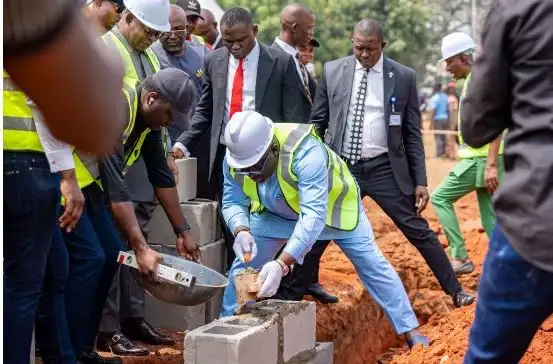
Delta State is not earning its reputation as a construction hub by accident. The evidence is everywhere, from the Agbor flyover to the Ughelli (Otovwodo) flyover, and the massive Warri flyover project being executed by Julius Berger Nigeria Plc.
These headline-grabbing structures tell only part of the story. Beneath them sits an expanding web of newly constructed and rehabilitated roads, upgraded Primary Health Care centres, drainage systems, and community infrastructure that collectively make the state feel more like an economy under active reconstruction.
To the casual observer, it may appear like a government singularly obsessed with asphalt and concrete, another administration chasing visible legacy projects. But that interpretation misses the underlying strategy. Beneath the noise of construction equipment lies a calculated economic thesis: build infrastructure while attracting investment, and allow jobs and economic boom follow as a natural consequence.
It is a model rooted in a simple logic; businesses do not move into promises; they move into systems that work. Roads reduce logistics costs. Health facilities stabilise communities. Urban connectivity attracts real estate development, retail expansion, and small enterprise growth. What looks like construction on the surface is, in reality, a stellar attempt to engineer economic confidence from the ground up.
That philosophy formed the backbone of a media engagement led by the Commissioner for Economic Planning, Hon Sonny Ekedayen, who laid out, in plain terms, why the administration believes roads, power reforms, agricultural industrialisation, and transport restructuring are not separate policies but parts of a single economic engine.
In his words, “We have deliberately taken steps to ensure that Delta State moves beyond dependence and begins to operate as an investment-driven economy. As a government, which all of us represent, we have been doing a great deal in infrastructure, healthcare delivery systems, education and the economic sector.”
The commissioner noted that much of the criticism revolves around a single recurring question: why roads again?
According to him, “Most times you hear people say: why is this government always concentrating on infrastructure and roads? The last administration did roads, and this one again is doing roads. They ask whether the government is only about roads. Then they ask about jobs and say our economy has become a POS and keke economy. I understand their concerns, but many are speaking from a position of limited information. We will not join issues; we will simply explain.”
That explanation, he argued, begins with understanding Delta State’s geography and demographics.
Unlike states dominated by one metropolitan hub, Delta operates as a multi-city ecosystem, a structural reality that shapes government spending.
“Delta is a peculiar state, a multi-town, multi-city state, unlike places where development in one major city easily spreads its impact. Delta is like Nigeria itself. You have several major towns spread across ethnic nationalities, and whatever infrastructure you provide in one location must also be replicated elsewhere. Otherwise, citizens will rightly ask why they are excluded from development.”
This, he explained, means infrastructure demand never truly ends.
“Even in the next ten years, there will still be roads, hospitals and facilities to build because development must be balanced. You are effectively working across about ten capital-like locations simultaneously. That is why significant resources will continue to go into infrastructure so people everywhere can feel the dividends of democracy.”
This distribution of the dividend of democracy mirrors the governing blueprint of Governor Sheriff Oborevwori, whose MORE Agenda prioritises Meaningful Development, Opportunities for All, Realistic Reforms, and Enhanced Peace and Security.
Across the state, projects ranging from the Warri–Effurun flyovers to urban road expansions, drainage upgrades, healthcare rehabilitation, and education infrastructure have become defining markers of the administration’s first years. The governor has repeatedly expressed, in multiple inspections and interviews, that economic diversification cannot occur without physical connectivity enabling the movement of goods, labour, and capital.
During one inspection tour, Oborevwori stressed that infrastructure spending was essential to lowering business costs and encouraging investment expansion, urging contractors to accelerate delivery so economic benefits could materialise faster.
Building on that, the commissioner pushed back strongly against the idea that infrastructure spending is cosmetic.
“It is impossible for any serious government not to prioritise infrastructure. You cannot have too much of it. Even Lagos still spends massively on transport systems, roads, rail and sea links. Infrastructure deteriorates; it must be maintained and upgraded continuously. Government spending in this area is not optional; it is foundational.”
The administration’s strategy reflects a widely accepted economic principle: private capital follows predictability. Roads reduce logistics costs. Reliable transport improves labour mobility. Urban upgrades increase property investment. Security infrastructure lowers investor risk.
And nowhere, Ekedayen argued, is that more visible than in Asaba.
“You can see how Asaba has transformed in recent years. People are relocating here from neighbouring states and across the Niger. Real estate prices have risen because families and businesses now see stability and opportunity. If the environment were hostile, investors would not come. Capital moves only where conditions are right.”
Perhaps the most striking portion of the engagement came when the commissioner directly addressed job creation, dismantling a common expectation that government employment should absorb graduates.
“Government is not primarily in the business of providing jobs. The civil service is already filled. Meanwhile, the number of graduates increases every year. Anywhere in the world, large-scale employment comes from businesses, not government offices.”
He argued that government-run enterprises historically collapse because political decision-making conflicts with commercial discipline.
“Business decisions are economic. Government decisions are often political. That mismatch destroys sustainability. Many state-owned businesses fail after a change of administration. We want initiatives that survive beyond any government, and only the private sector provides that continuity.”
One of the administration’s most significant economic gains lies in the revived Kwale-Koko Free Trade Zone, originally conceived years earlier but largely dormant before renewed government intervention.
According to the commissioner, “When this administration came in, we revived the project by clearing outstanding renewal licence fees. Two years ago, only two or three companies were operating there. Today, we have 11 companies, with more showing interest. The government demonstrated seriousness by expanding road access and infrastructure into the zone.”
The zone is strategically positioned near maritime routes, making it attractive for manufacturing, petrochemical processing and logistics operations. The commissioner affirmed that investor interest is now expanding into fertiliser and refinery-linked industries.
“Economic transformation does not happen overnight. You lay the foundation first. Infrastructure attracts investment gradually. Much is already happening quietly.”
Recognising that access to finance remains a major obstacle for entrepreneurs, the state partnered with the Bank of Industry to create a low-interest funding window.
“Commercial bank loans can attract interest rates of 30 per cent or more, which makes profitability nearly impossible. Through this scheme, qualified businesses can access loans at about nine per cent interest. Applications go directly through the Bank of Industry; no ministry official controls the process.”
Manufacturers and distributors across fast-moving consumer goods sectors are among expected beneficiaries, with expansion expected to translate into employment growth.
The administration is also repositioning agriculture from small-scale survival farming into commercial agribusiness.
“Many local farmers operate at the subsistence level, which limits productivity. Through a partnership with Median Ville Agro Ventures, the government has cleared about 3,500 hectares for mechanised farming. Cassava and vegetable cultivation are already ongoing across multiple locations.”
Greenhouse farming, producing cucumbers, tomatoes and bell peppers, is targeting urban consumption markets and hospitality industries.
“Employment opportunities exist for agronomists and agricultural graduates. Recruitment is ongoing through the Ministry of Agriculture based on qualifications and the number of personnel needed.”
Importantly, local communities are integrated into profit-sharing arrangements.
“It is not a case where outsiders take over land. Indigenous farmers are part of the production system and share in profits. That creates ownership and protects community interests.”
Electricity, the commissioner stressed, remains the single biggest economic enabler.
“Electricity is a big enabler of business. The Delta State Electricity Law has been passed and assented to. We have engaged a top-rate consultant to conduct a comprehensive assessment of energy gaps across the state.”
The consultants are mapping demand patterns, infrastructure needs and industrial energy requirements, with plans to establish a Delta State Electricity Commission.
“We want a system guided by data, not trial and error. With our natural gas advantage, our goal is to deliver the cheapest electricity per kilowatt hour in Nigeria. Affordable power will attract investors.”
To tackle rising transportation costs, the state is deploying compressed natural gas (CNG) buses.
“Only recently, I was privileged to attend a committee set up by the Governor to examine this particular issue. What the government is trying to do now is to deploy CNG buses. CNG has been proven to be cheaper; I mean, the costs have been calculated to provide a lower cost per passenger, and that is what most advanced countries, and even some megacities within our own country, are doing. When we also consider petrol (PMS) and diesel, these have proven to be expensive, costly, and, most times, unsustainable.
“If you notice, somewhere around Summit Junction, there is something like a gas station. That alone tells you the direction the government is taking. We have one in Warri and then a third one.
“If you want to roll out a mass transit system, you must also build the enabling infrastructure so that what happened with previous attempts does not repeat itself. The next stage is to identify a reputable transport owner who can deploy these buses under a Public-Private Partnership arrangement, applying designated rules, allowing people to access clean, affordable, safe, and reliable transport services. The state has recognised that a lot of planning is required.
“One thing I can assure you is that it is very strong on the Governor’s mind to establish something sustainable. That is why we began with infrastructure development. Between now and the end of the year, there will be significant movement in this area. A private-sector operator will have been identified, and the necessary roads and routes will be prepared for the buses, so that services can operate within the state at a lower cost. While it may not be subsidised, it will definitely be cheaper than what we have now,” he said.
In an unconventional move, Delta State is entering the global carbon credit market through the Azura Mangrove Project.
“This initiative allows us to monetise environmental assets sustainably. Mangroves absorb carbon, and international polluters purchase carbon credits to offset emissions. Similar models exist in Brazil and Indonesia.”
The initiative is expected to generate long-term revenue while creating livelihoods in coastal communities.
Beyond that, on the Delta State Job and Wealth Creation Bureau, which has become inactive for some time now, the commissioner had this to say:
“The government is aware and is planning something bigger. We can agree that the government has trained enough persons with skill sets, so empowerment will now take a different approach to benefit businesses. However, empowerment must be meaningful and of high quality. This time, whatever the government provides will be durable, qualitative, and sustainable. Just watch that space, significant announcements will be made soon.”
Taken together, Delta State’s strategy reveals a shift from government-led employment toward ecosystem-building, infrastructure, energy reform, industrial zones, agriculture modernisation, financing access and environmental monetisation.
Ultimately, the State’s unfolding development story is less about cranes and concrete and more about deliberate economic engineering. What is emerging is a governance model that recognises a hard truth often ignored in public discourse: sustainable prosperity is not declared; it is constructed, layer by layer, through infrastructure, policy alignment, and investor confidence.
“The whole idea,” Ekedayen stressed, “is to build systems that attract investment and sustain growth beyond any administration. Much progress is already underway, and in the coming years, the full impact will become increasingly visible.”
As these initiatives mature and private investment deepens, expectations will naturally shift from visible construction to measurable economic outcomes, more businesses, stronger local industries and expanded employment opportunities, positioning Delta State on a trajectory that, if consistently maintained, could redefine subnational economic governance and set a compelling benchmark for sustainable development across Nigeria.

