


BY RITA OYIBOKA
It is said that when “the people speak, it is the voice of God,” a timeless assertion often attributed to Alcuin of York. In the riverine heartlands of Delta State, the voice of the people did not whisper, it echoed across creeks, mangroves, and bustling waterfronts, carrying with it a message both deliberate and unmistakable.
It was not the noise of agitation or the tension of unmet expectations; it was the calm confidence of a people who feel seen, considered, and included in the larger story of governance.
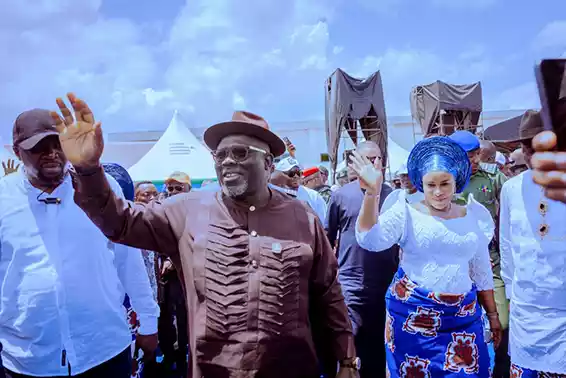
The atmosphere on that remarkable Wednesday on the 16th of April, 2026, told its own story long before the speeches began.
There was something unmistakably organic about the Ijaw gathering in Bomadi. This was not the rigid choreography of political obligation or rented enthusiasm; it was the natural convergence of a people who had taken stock, weighed the evidence, and arrived at a position.
At the centre of it all was a grand reception organised in honour of the Delta State Governor, Rt. Hon. Sheriff Oborevwori, hosted by the Ijaw National Congress (INC) worldwide. But as the day unfolded, it became clear that the event had evolved beyond ceremony. It had become a moment of collective assessment, an informal audit of governance from the grassroots.
The high point came with the formal endorsement of President Bola Ahmed Tinubu and Governor Sheriff Oborevwori for re-election in 2027. Yet, to reduce that moment to mere politics would be to miss the broader narrative. What played out was more about a community responding to what it perceives as tangible progress.
The process itself followed a familiar democratic cadence. A motion was moved by Julius Pondi, representing Burutu Federal Constituency, calling for the endorsement and continued support of both leaders. It was seconded by Oboro Preyor, and subsequently subjected to a voice vote by the speaker of the Delta State House of Assembly (DTHA), Rt. Hon. Emomotimi Guwor. The response was unanimous.
But unanimity, especially in a setting like this, often reflects something deeper than consensus, it signals satisfaction, or at the very least, a willingness to stay the course of the current administration.
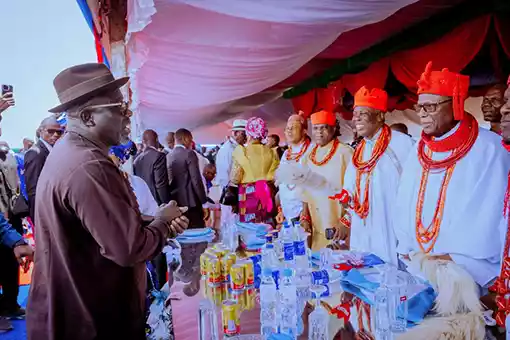
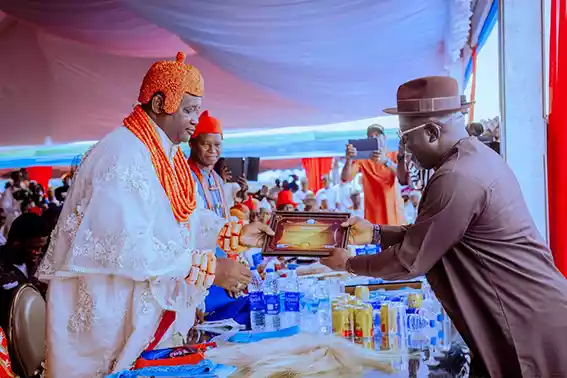
That sentiment found further expression in one of the day’s most symbolic and politically loaded moments, the conferment of the traditional title Izonebimiewei (“the man that does good”) on Governor Sheriff Oborevwori by the Delta Ijaw Traditional Rulers Forum. This was not ceremonial decoration for optics or political theatre dressed in cultural attire. It was a calibrated endorsement, carefully earned, publicly affirmed, and firmly rooted in the lived realities of the people it seeks to represent.
Titles in traditional spaces are not dispensed like souvenirs at a public event. They are interrogations of character, assessments of delivery, and verdicts on leadership performance over time. In this case, the forum of revered Ijaw monarchs did not merely honour a governor; they issued a statement of confidence grounded in observable outcomes, not rhetoric.
But what exactly did they see? This is where the numbers begin to speak for themselves and as Oborevwori would say in local parlance, “nur be cho cho cho.”
According to the governor in his speech, his administration has so far expended over N400 billion on infrastructural development across Ijaw communities. Roads, bridges, schools, and healthcare facilities are abstract achievements; they are visible, touchable interventions in places that have historically struggled with access and connectivity.
Projects such as the Bomadi–Gbaregolor Road, the Ohoror–Bomadi Road, the Oporoza township roads, and internal road networks in Patani and Ogulagha have been spotlighted as part of a deliberate strategy to open up the Delta’s riverine belt and integrate long-neglected communities into the wider economic grid.
These interventions, however, are not being presented as isolated wins. According to the governor on multiple occasions, they are the tangible dividends of closer alignment with the centre. He has repeatedly framed the current development push as a product of “enhanced collaboration with the Federal Government,” insisting that Delta State is now better positioned within the prevailing political structure to attract federal attention, intervention funding, and critical infrastructure support.
It is from this political framing that the endorsement narrative draws its weight among the Ijaw stakeholders, who say they are not guessing but observing developments as they unfold on the ground. Their growing alignment of support for Governor Sheriff Oborevwori and President Bola Ahmed Tinubu for a second term is not being driven by sentiment or routine political loyalty, but by what they describe as a pragmatic reading of ongoing realities.
From this perspective, continuity is seen as more than a slogan, it is a working arrangement that appears to be producing visible linkages between Delta State and the federal centre in Abuja. Thus, sustaining this current federal-state configuration could help deepen Delta’s access to federal decision-making channels, where funding priorities and project approvals are shaped.
Within that broader context, the Ayakoromo Bridge project stands out, not just as infrastructure, but as symbolism. It reflects an administration attempting to do more than connect roads and waterways; it is, in effect, trying to bridge entrenched developmental gaps that have defined the riverine landscape for decades.
There is, however, a subtle but significant shift embedded in this approach. For years, difficult terrain was routinely cited as justification for stagnation in riverine communities. Geography became the convenient explanation for policy inertia. What is now emerging is a different narrative altogether: that with deliberate planning, sustained investment, and political will, even the most challenging environments can be systematically opened up and integrated into the development mainstream.
Opening up riverine areas is not just about infrastructure, it is about opportunity. It is about reducing isolation, improving access to markets, education, and healthcare, and ultimately, elevating the quality of life.
Perhaps, this is where governance earns its most genuine applause, not in policy documents, but in the everyday experiences of the people.
Addressing the crowd, Governor Oborevwori did not shy away from acknowledging the significance of the moment. He described the honour as one of the highest recognitions he had received.
He reaffirmed his administration’s commitment to inclusive governance, emphasising that no ethnic nationality in Delta State would be left behind. It is a promise often made, but in this context, it resonated differently, perhaps because it was being made in front of a people who could point to ongoing projects as evidence.
The governor also took a moment to reflect on the past, particularly the 2023 governorship election and the legal battles that followed. His acknowledgment of the Ijaw nation’s dogged support during those periods added a layer of continuity to the relationship, one built not just on present gains, but on shared history.
“I remain grateful for the unwavering support of the Ijaw people, which strengthened me through challenging times,” he said. “This endorsement is deeply appreciated and will not be taken for granted.”
It was a statement that subtly reinforced a reciprocal dynamic, support given, support acknowledged, and, ideally, support sustained through continued performance.
Also lending his voice was the Governor of Bayelsa State, Senator Douye Diri, who praised the developmental strides recorded, particularly in riverine communities. His remarks cut through a long-standing narrative, asserting that terrain should no longer be seen as a barrier to infrastructure.
That assertion carries weight. If it can be done now, the excuse of impossibility begins to lose credibility.
Diri also emphasized unity among the Ijaw people, noting that a collective front enhances political relevance and ensures that their voices are heard at all levels of governance. It is a point that cannot be overstated. In a system where numbers and cohesion often translate into influence, unity becomes both a shield and a lever.
From an institutional perspective, the President of the Ijaw National Congress (INC), Benjamin Okaba framed the event as a platform for appreciation and collaboration.
He acknowledged several landmark projects executed by the administration, while also calling for the prioritisation of additional infrastructure, roads, bridges, healthcare facilities, and educational institutions.
This dual approach, commendation paired with constructive expectation, is perhaps the most pragmatic stance any community can take. It recognizes progress without losing sight of the work that remains.
Earlier, the Speaker of the DTHA , Rt. Hon. Emomotimi Guwor reinforced this narrative, describing the endorsement as a reflection of visible achievements across Ijaw communities. He cited multiple road projects and institutional developments as clear indicators of the administration’s commitment.
And then there was the crowd.
A large turnout of political leaders, traditional rulers, youth groups, and women organisations highlighted what is evidently a tangible unity of purpose within the Ijaw nation. But beyond the numbers, it was the mood that stood out, a sense of optimism, a willingness to bank on the belief that governance who has before will indeed again, deliver on all-inclusive development.
A highlight of the event was the captivating display by the Bayelsa State arts and culture troupe, which added colour, rhythm, and a rich cultural flair to the occasion. Their performances, steeped in tradition and expressive storytelling, infused the gathering with energy and pride, serving as a potent reminder of the shared heritage and cultural identity that bind the Ijaw people. The music, dance, and coordinated artistry turned the event into a celebration of both governance and culture.
To the casual observer, it may pass for another routine political gathering. But to the discerning eye, what unfolded in Bomadi was not just an endorsement; it was a reflection. A reflection of how people respond when they begin to see themselves in the outcomes of governance. It was a reminder that development, when it reaches the grassroots, does more than improve infrastructure, it reshapes perception, builds trust, and, occasionally, earns loyalty.
For the Ijaw nation, the message was clear and it is that progress, however gradual, is being noticed. For the government, the takeaway is even clearer, that delivery remains the most effective campaign strategy.
The drums did not beat in anger that day; they resonated with approval. And in a political landscape supply often dominated by discontent, that is no small feat. Whether this rhythm can be sustained will depend not on speeches or ceremonies, but on the consistent work of governance.
For now, though, Bomadi and indeed the Ijaw nation has spoken, not in whispers but in a confident, unified voice; a voice echoing from the creeks to the corridors of power, clear in its conviction and deliberate in its choice that President Bola Ahmed Tinubu and Governor Sheriff Oborevwori shall remain, to consolidate the gains, sustain the momentum, and carry forward a development story the people can already see and feel.

