


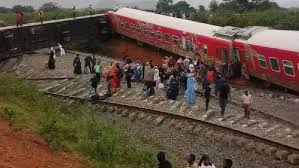
Between 2019 and August 2025, a period of six years, there have been a total of 188 train derailments in the country, according to the National Bureau of Statistics (NBS). The most recent incident occurred on Saturday, November 1, 2025, at the Agbor axis of the Warri-Itakpe rail corridor, raising the number of derailments to 189. The accident, sadly, happened barely four days after the route, which had been suspended since August, was opened for business. No life was lost, but it affected two of the seven coaches of the train.
Infuriated by the development, which had assumed an ugly trend in the rejuvenated rail system, the Senate has instituted an ad hoc committee to probe the train derailment at Agbor, to be chaired by Senator Adams Oshiomhole (Edo North). This followed a motion to that effect by Senator Ede Dafinone (Delta Central), calling for urgent investigation, rehabilitation and enhanced safety measures to protect passengers and national infrastructure.
The terms of reference of the committee are to conduct comprehensive investigation into the persistent derailments of the country’s rail lines; hold public hearing to uncover the root causes of recurring derailments; assess the condition of rail infrastructure; and determine the state of imported materials used in the sector. The committee will also investigate the loan from China. It has six weeks to complete and submit its report.
The prompt action of the Senate to probe rail derailments in the country is a positive development. Gratifying, it shows the lawmakers’ concern for the collective safety of train users, firstly, and the national rail assets in the country’s transportation system. We commend the Senate for the move.
For now, the incidents of train derailments have been attributed to vandalization of the rail tracks, substandard construction materials, geo-structural elements, inadequate maintenance, and poor surveillance of the rail infrastructure. The ad hoc committee may yet find more causative factors.
We hope the committee pays diligent attention to its terms of reference. With Senator (Comrade) Oshiomhole heading the panel, we have no doubt the committee will deliver a robustly quality job.
Honestly, yet sadly, the incidents of rail derailments nationwide have dire implications for the country, including loss of precious lives and property. That hundreds of passengers that are left stranded when they occur is a huge burden in terms of social and economic opportunities as well as man-hours lost. The current trend, which already blights the management of the Nigerian Railway Corporation (NRC), could scare consumers from taking advantage of the rather cheaper means of transportation to travel or move goods from one point to another.
Moreover, the cost implications of replacing vandalized or damaged parts could be high, bearing in mind that most of the needed materials are imported. Painfully, resources that could have been channeled to improve the rail services are used for rehabilitation of damaged facilities. Imagine the awesome cost of fixing the damages caused by the 188 derailments reported by the NBS. What about the immense cost imposed by the suspension of operations on routes affected by derailments, which of course impair the revenue generation capacity of the NRC?
The seemingly proactive action of the Senate may help avert the kind of tragedy that befell the country’s railway system some 68 years ago. On that day, September 29, 1957, a train bearing 700 passengers derailed at Lalupon, near Ibadan, killing 200 passengers including 33 students of the Nigerian College of Arts, Science and Technology, Zaria. The British Colonial Government then attributed the accident to flooding of the rail track, weakening it.
The track buckled under the weight of the locomotive, causing seven of the 16 coaches to derail. Much as we do not pray for a repeat of the 1957 kind of tragic occurrence and the recent derailments, we believe the ball is in the court of the Federal government to ensure that necessary preemptive measures are taken to safeguard the rail tracks across the country. We are gratified to note that the Senate has initiated a strategic policy thrust in that direction. We implore the relevant authorities and the general public to cooperate with the Senator Oshiomhole-led committee to probe the train disasters, which we believe will proffer credible recommendations to end or minimize the train derailments.

