


BY AMAYINDI YAKUBU
“Today, the Nigerian armed forces stood gallantly as a defender and protector of constitutional order in the Republic of Benin on the invitation of the government.”
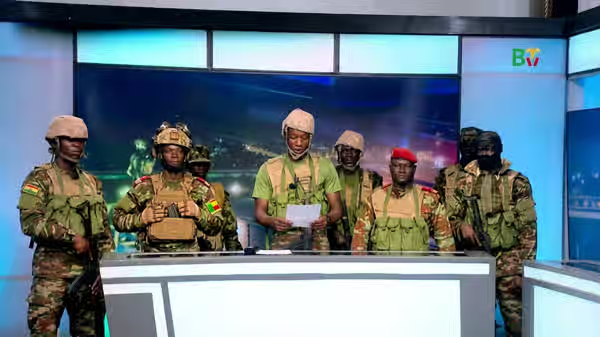
Those were President Bola Tinubu’s words after Nigerian troops crossed into Benin to help put down an attempted military takeover on December 7. But behind that single sentence lies a deeper story about a region unsettled.
For years, West Africa has been drifting toward a dangerous pattern in which armed men in fatigues decide the fate of nations. From Mali to Guinea, Niger to Burkina Faso, and most recently, Benin, the idea of democracy, once celebrated across the region, has been eroding under the weight of insecurity, weak institutions, and public frustration.
What happened in Cotonou did not emerge from nowhere. It is part of a wider wave of coups that began in 2020, a wave that has slowly carved a corridor of instability across the region. Each overthrow has chipped away at the hard-won democratic gains of the past two decades, leaving citizens disillusioned and governments increasingly fragile. The attempted seizure of power in Benin merely brought the danger closer to the coastline, revealing how quickly a stable state can be pushed to the brink when trust in governance erodes.
And so, Nigeria moved first with jets, then with ground troops, invoking regional protocols that obligate West African states to defend constitutional order. It was a move rooted in law, but also in fear: fear that if one more government falls, the dominoes may spread further south, threatening the political and economic anchor of the region. The intervention may have stopped the coup, but it did not stop the question now hanging over West Africa: how many democracies are left standing on solid ground?
The Nigeria Governors’ Forum, in response, has praised President Bola Tinubu for ordering a swift military intervention in the Republic of Benin after the failed coup attempt, calling the move essential to safeguarding Nigeria’s security and reinforcing regional stability. The Chairman, Nigerian Governors Forum (NGF) and Kwara State Governor AbdulRahman AbdulRazaq said the President’s action was both timely and necessary.
“Apart from admirably acting in support of democracy in the subregion, the President acted in the best interest of our country and West Africa with the intervention. With the Sahel in disarray and dire security conditions, and a significant portion of Benin, especially the W-forest, already infested by the militants, a successful coup would have had devastating effects on our own country due to our proximity to the Benin Republic, which shares a border with many of our states,” he noted.
Senate President Godswill Akpabio, addressing senators after lawmakers gave unanimous approval to President Tinubu’s request to deploy troops to Benin, stressed the regional stakes of the crisis. “An injury to one is an injury to all,” he said, framing the deployment as part of Nigeria’s duty under ECOWAS to defend neighbouring democracies and to prevent instability from spilling across borders (Business Post). ECOWAS Commission President Dr Omar Alieu Touray echoed that urgency at the bloc’s 55th ordinary session in Abuja, warning that the region was now “in a state of emergency” as leaders sought coordinated measures to protect constitutional order (The Nation).
Defence Minister General Christopher Musa (retd.) praised the armed forces’ “professionalism and rapid action,” saying the operation underscored the need for constant readiness and joint planning; “we must be ready 24/7 to protect both the nation and its allies,”. Lieutenant-General Waidi Shaibu, the Chief of Army Staff, likewise reaffirmed that Nigeria’s security is intertwined with that of its neighbours and pledged the army’s continued support for efforts to secure borders and uphold democratic governance across the region.
Speaking on behalf of President Patrice Talon’s administration, Benin’s Minister of Foreign Affairs, Shegun Adjadi Bakari, thanked Nigeria and ECOWAS for their swift intervention. “On behalf of the government and people of Benin, I would like to thank President Bola Tinubu, the people of Nigeria and the entire ECOWAS community for the support given to my country, and for our collective decision to halt the spread of coups in our sub-region,” Bakari said, emphasising that regional solidarity remains critical as West Africa confronts repeated threats to democratic stability.
However, one of the most prominent critics of the intervention was Professor Wole Soyinka, who addressed the matter at the Wole Soyinka Centre for Investigative Journalism Awards in Lagos. Soyinka described Nigeria’s involvement as “another unnecessary military entanglement next door,” urging that the episode should serve as a lesson for Nigeria to focus on strengthening democratic institutions at home rather than reflexively deploying troops abroad.
He warned that instability in neighbouring states reverberates back into Nigeria, saying, “What happens in Benin inevitably affects us. Instability anywhere in the region echoes across our own sense of security.” Soyinka also expressed broader concerns about governance and the use of force, arguing for restraint and clarity of purpose in security responses.
Human rights lawyer Inibehe Effiong questioned the priorities reflected in the operation, writing on social media: “I just read that the Nigerian Air Force launched precision strikes against fleeing coup plotters in the Benin Republic to ‘save democracy’. If only precision strikes could be launched against terrorists in Nigeria.”
His remarks echo a broader public sentiment that Nigeria’s overstretched security forces should focus first on tackling insurgency, banditry, and mass abductions within its borders before committing troops to external missions.
Reactions
The Pointer Newspaper, while sampling Nigerians’ reactions to the recent Coup attempt in the Benin Republic and Nigeria’s swift government response, interviewed some respondents to hear their opinions.
In an interview, a lecturer at the Nigerian Army School of Public Relations and Information, Mr Bilal Ishaq, shared his thoughts on the Senate’s approval of the military deployment to Benin and concerns about potential spillover effects from the coup attempt.
According to him, “It’s a political move for Nigeria to save herself and her democracy. It is no news that a country shares in the problems of its bordered nations and most times, gets affected by the same problem. The Senate and Presidency are only concerned about the tendency of what happened (the coup) in Burkina Faso, which has spread to Niger and now the Benin Republic. Coups and their perpetrators have their way of luring their brother agencies to want to do the same in other countries. There was already an alleged attempt at a coup in Nigeria back in October, so to prevent the real show, Nigeria has to make sure that Benin does not join the bandwagon of military governance.”
He continued, “Of course, the spill-overs are already visible, and we can see the effects already. What seems to be a restoration aid for Benin is turning into a regional rift among nations. The fact that some of the coup plotters are at large and the involvement of ECOWAS and Nigeria have spurred narrative and interest. With some of the coup plotters still at large, we cannot say that the coup is over, meaning that Democracy in Benin is still very fragile, and this is why the Nigerian Presence in the country is defended by the Nigerian government.
“Meanwhile, Burkina Faso, Mali and the Niger Republic do not enjoy these involvements (of course, Military governments trying to support their kind) and have started issuing warnings. Burkina Faso claims that the Nigerian military aircraft currently in Burkina Faso is a threat to their sovereignty, Niger Republic has ordered that all goods coming from Nigeria must be properly scrutinized before entry, remember that sometime ago, Niger Republic had closed its airspace for any flight going into Nigeria, so this issue has spurred regional rift will affect political and economic stability of all the parties involved. ECOWAS should employ diplomatic means to settle the rift and be seen to be non-partisan.”
The lecturer further noted that there are tendencies for it to affect the internal security in Nigeria because, before now, the number of security personnel in the country did not match the security concerns that we currently have.
In his words, “Having to deploy more troops out of the numbers that are not enough to go outside for outside missions, we will focus on effectively handling Nigeria’s internal security. Already, all hands are supposed to be on deck to affect Nigeria’s internal security.
“However, I won’t blame the government. They also need to protect their own interests. They also need to protect their own democracy. And this is the reason why the government was mined, you know, to send out troops to, you know, the country. Send out troops to the Benin Republic, you know, to fight out the coup and the plotters.”
However, a law graduate of Taraba State University and former National Director of Students’ Rights, Law Students Association of Nigeria (LAWSAN), Mr Omanga George, shares a different perspective, saying “Senate’s approval of the deployment of troops to Benin wasn’t necessary, it was just a busybody action. This is what Noki Tobi of blessed memory will refer to as a meddlesome interloper. Though Section 5(4) of the 1999 Constitution (as amended) is clear: the President must seek National Assembly approval before deploying troops in combat outside Nigeria. The Senate’s after-the-fact approval under the guise of “emergency” sets a dangerous precedent.
“No doubt the Senate rubber-stamped it under emergency powers (Section 5(5) of the 1999 Constitution), but that to me is just an executive overkill without prior debate, when it unanimously gave retroactive approval. I watched the proceedings with disbelief. With all due respect, this decision is indefensible, immoral and dangerous. Charity, security and governance must begin at home. This wasn’t necessary, it was reactive posturing to avert a hypothetical spillover, but we can’t secure the neighbourhood if our streets are war zones.”
He continued: “If the coup in Benin had already been crushed by Benin’s own forces, as reported in their local media, where was the imminent threat to Nigeria that justified bypassing prior legislative consent? Legally, we may say it’s defensible as self-preservation (shared threats), but ethically? It prioritises optics over orphans. How do we justify airlifting troops and jets to Benin for a foiled coup when our own security forces can’t (or won’t) mount a full rescue for these vulnerable kids? It’s not just negligence, it’s a betrayal of the social contract.
“Should we approve our troops to go rescue a sovereign and independent state, when over 150 of our schoolchildren and their teachers from St. Mary’s Catholic School in Papiri, Niger State, remain in the dens of kidnappers? We read that about 100 pupils have been rescued or escaped. The rest are somewhere in the forests, hungry, terrified, and at the mercy of armed criminals who have turned kidnapping into an industry. Yet the same military that claims it lacks the manpower and intelligence to storm those camps found helicopters, jets and elite troops to fly to Cotonou within 48 hours. We are fighting too many fires with too little water.
“Boko Haram and ISWAP are resurgent in the North-East. Bandits have rendered the North-West and North-Central ungovernable. Farmers can no longer go to their fields. Travellers are slaughtered or kidnapped daily on our highways. Over 7.6 million Nigerians remain internally displaced. In 2025 alone, terrorists overran at least 15 military bases. Our armed forces are overstretched, under-equipped and losing men every week. How then do we justify opening a new front in a foreign country?”
Mr Omanga, sharing his concern about the deployment of troops to the Benin Republic and how it might affect Nigeria’s internal security, added, “Nigeria has played the role of West Africa’s policeman for decades, in Liberia, Sierra Leone, Gambia, and now Benin. Each time we are quick to send troops and treasure, but our neighbours rarely reciprocate when we bleed. “This latest adventure will cost billions that could have purchased drones, armoured vehicles, night-vision equipment and rapid-response units for our own territory. We are exporting security on credit while importing insecurity in bulk. Until the last child in captivity is brought home, until the last bandit camp is dismantled, until a Nigerian can travel from Lagos to Maiduguri without fear, any deployment of our troops outside our borders is not leadership, it is abandonment.”
In the final analysis, Nigeria’s intervention in Benin has become more than a rescue mission; it is a stress test of a state already stretched thin. The operation may have reinforced Abuja’s credentials as the region’s default stabiliser, but it also exposed uncomfortable gaps at home: a security architecture fighting on too many fronts, institutions losing public confidence, and a democracy that must prove its strength not just abroad but to its own citizens.
As West Africa confronts yet another democratic fault line, Nigeria now faces a hard-edged reality: regional leadership is only sustainable if the house is in order. Anything less, and every external deployment becomes a gamble the country can no longer afford to lose.

