


Budget in governance structure or institutional management, no doubt, plays a crucial role in the operational activities of any government or organisation. It is, indeed, a roadmap outlining projected income and expenditure of any government, organisation/association or an individual within a given financial year.
Globally, governments prepare annual budgets to plan and allocate resources effectively; achieve development goals and priorities; manage finances transparently and accountably; attract investments and stimulate economic growth; and deliver public services and infrastructure to citizens.
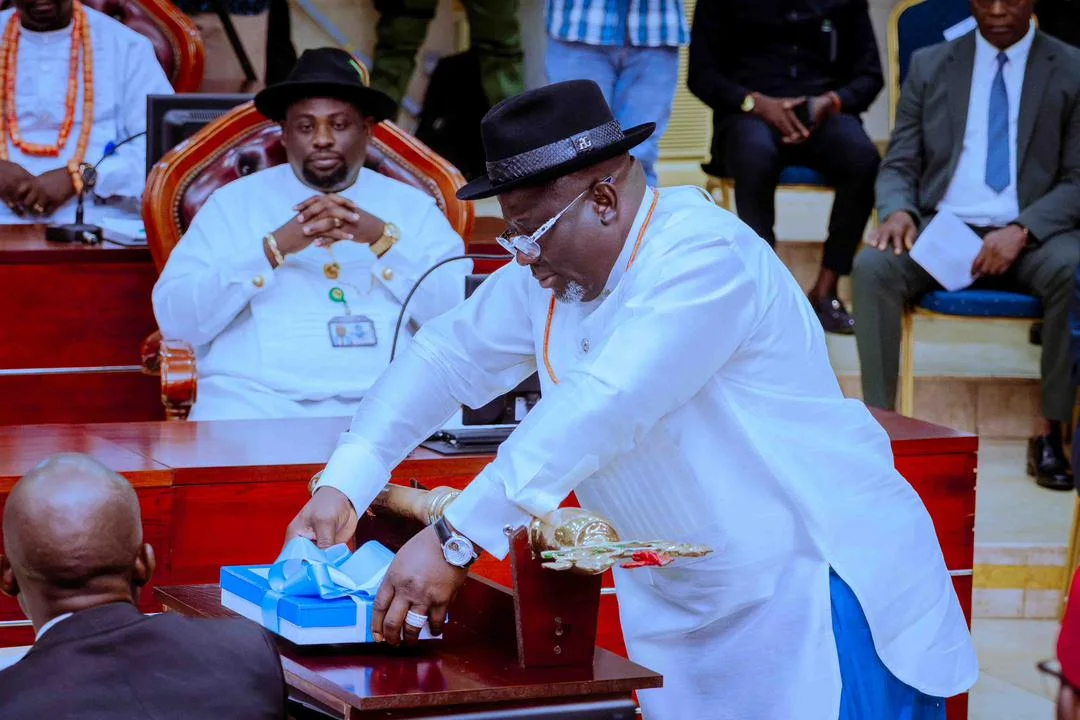
Only recently, Delta State Governor, Rt. Hon. Sheriff Oborevwori presented a budget proposal of N1.664 trillion for the state’s 2026 fiscal year to the State House of Assembly for consideration and approval. Giving a breakdown of the budget christened ‘Budget of Accelerating the MORE Agenda,’ Governor Oborevwori said N499 Billion, representing 30 per cent of the total budget, was for recurrent expenditure, adding that N1.165 Trillion, representing 70 per cent of the total budget, was for capital expenditure.
He disclosed that the 2026 budget size indicates an increase of N685 billion or 70 per cent over the 2025 Appropriation, pointing out that the budget as proposed, would be mainly funded from Statutory Allocation, Internally Generated Revenue, Mineral Derivation, Value Added Tax, Other Capital Receipts and Savings and Oil Revenue Recoveries.
The Governor pointed out that N720 billion, or 43.28 per cent of total projected revenue, was expected from statutory allocation, which, he said, was boosted by post-subsidy FAAC inflows and improved oil production stability in the Niger Delta, adding that Internally Generated Revenue was projected at N250 billion, representing an 86.5 per cent increase over 2025.
While saying that the projected increase in the state’s IGR was driven by ongoing reforms to plug leakages and widen the tax net, he pointed out that VAT receipts were expected to rise sharply to N120 billion, buoyed by improved federal administration of the tax.
“Capital receipts, however, have been deliberately cut down to N25 billion, a 73 per cent reduction as the government pushes toward a zero-borrowing fiscal strategy. Savings and oil revenue recoveries are projected to contribute N489 billion. This is a testament to prudent and disciplined financial management,” the Governor added.
According to him, the proposed recurrent expenditure estimates for 2026 of N499 billion are made up of personnel costs of N185 billion, representing 37 per cent of the proposed recurrent budget, stressing that N204 billion, representing approximately 41 per cent, was earmarked for overheads. He pointed out that the balance 22 per cent or N110 Billion was accounted for by social contributions, benefits, and grants, emphasising that the personnel cost of N185 Billion anticipates the annual increments and allowances, while the overhead cost mirrors the inflationary trend in the country.
Giving insights into the proposed capital expenditure estimate of N1.165 Trillion, Governor Oborevwori noted that the proposal was N535 billion, or 85 per cent higher than the 2025 capital budget of N630 billion, saying “this is largely accounted for by the larger budget size of N1.664 trillion, as against the 979.2 billion of 2025.”
Highlighting the priority sectors of the budget, the Governor said N450 billion was budgeted for road infrastructure, N105.086 billion for education, N50.067 billion for health, N20 billion for the Delta State Capital Territory Development Agency and N20 billion for Warri, Uvwie and Environs Development Agency.
According to him, N16 billion was budgeted for Power and Energy, N10 billion for Agriculture, and N20 billion for Social Protection, adding that the sum of N100 billion was budgeted for local government intervention in the 25 local government areas in the state (N4 billion per local government).
Reviewing the performance of the 2025 Budget themed “Budget of Fiscal Consolidation,” where ₦979,228,818,719 was approved for funding both capital and recurrent expenditures, the Governor said the performance of the budget was encouraging.
“From January to October 2025, the actual revenue receipts from the Federation Account Allocation Committee and Internally Generated Revenue stood at N738.640 billion, representing 90.5 per cent of the proportionate budget of N816,024,015,599.
“The recurrent expenditure for the period under review was N340,554,006,448, as against a proportionate amount of N290,639,798,863.50, representing 117 per cent performance. The sum of N509, 780, 336,370 was expended during the period under review, as against a proportionate amount N525, 384, 216, 736, representing 97 per cent performance.
“It is pertinent to appreciate this stellar performance. It is also gladdening to note that the bold and reformist policies of the Federal Government have started to yield the desired result and the country is beginning to turn the corner,” the Governor added.
While highlighting the importance of peace and security in promoting sustainable development, he said his administration had worked closely with security agencies to tackle crime, including kidnapping and cultism, with a view to ensuring sustainable peace and security in communities across the state.
“We will continue to strengthen the security architecture in the state to better protect our citizens from all threats. This administration has invested heavily in security infrastructure upgrades and will continue to do so for enhanced peace and security.
“We are looking at deploying cutting-edge technology, including drones, sophisticated intelligence gathering capabilities and surveillance equipment. All these are in addition to the prompt payment of personnel emoluments and allowances, as well as the provision of covert logistics,” he added.
With the budget envelope of N1.165 trillion for capital expenditure, which is N535 billion or 85 per cent higher than the 2025 capital budget of N630 billion, it is crystal clear that the Oborevwori administration is irrevocably committed to expanding the frontiers of sustainable socio-economic growth and development of the state.

