


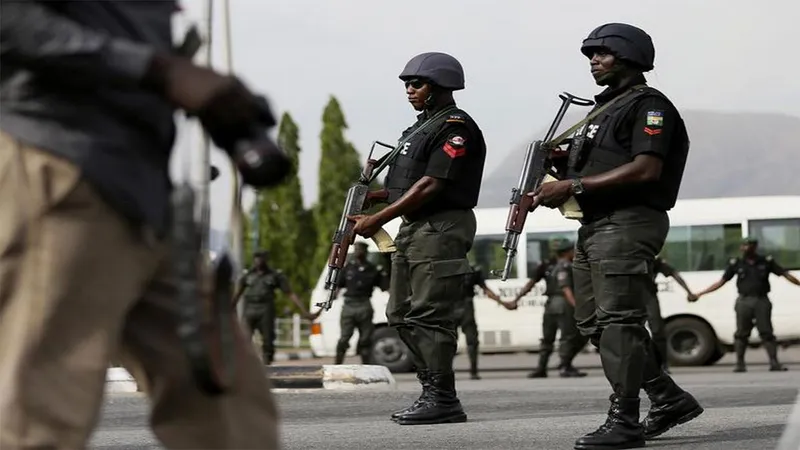
FOR the first time in a long while, Nigeria appears poised to confront one of the most embarrassing distortions in its policing architecture, the allocation of thousands of police officers to protect private individuals and undeserving VIPs at the expense of public safety. President Bola Ahmed Tinubu’s recent directive ordering the withdrawal of all police personnel attached to VIPs and their redeployment to core policing duties marks a pivotal moment in the country’s security discourse.
According to his Special Adviser on Information and Strategy, Bayo Onanuga, VIPs who legitimately require protection will now rely on armed operatives from the Nigeria Security and Civil Defence Corps (NSCDC), freeing police officers for duties they were trained to perform. The President also approved the recruitment of 30,000 new officers, in addition to a previous mandate during the declaration of an emergency on security to recruit 20,000 more, bringing the total to 50,000 fresh policing personnel.
This policy has been widely praised, particularly for demonstrating the political will necessary to tackle an entrenched problem that past administrations attempted to reform but ultimately failed to implement.
Nigerians remember vividly the 2009 directive under President Umaru Musa Yar’Adua, which sought to drastically reduce police escorts attached to private persons but fizzled out almost immediately due to political pushback. President Goodluck Jonathan’s administration also made similar pronouncements, most notably in 2012, when then Inspector-General of Police (IGP), Mohammed Abubakar, ordered the withdrawal of police officers from VIPs and announced stiff regulations, but the reforms were quietly reversed within months as political elites resisted limitations. In 2015, during President Muhammadu Buhari’s first year in office, the then IGP Solomon Arase again declared that police officers would be recalled from VIP security assignments, yet the order barely survived beyond the press briefing. In all these instances, the directives became mere rhetorical exercises, drowned by elite influence, institutional resistance and lack of sustained political backing.
It is this historical pattern of failed enforcement that makes Tinubu’s approach, backed by a structured redeployment plan, ongoing recruitment and an alternative security arrangement for VIPs, significantly more consequential than previous attempts.
Already, the Inspector-General of Police, Kayode Egbetokun, has confirmed that 11,566 operatives have been withdrawn and will undergo retraining before being deployed to divisions across the country. This is an encouraging start, especially considering the alarming shortage of police officers relative to Nigeria’s population. While the United Nations recommends a ratio of one police officer to between 400 and 450 citizens (or 220–250 officers per 100,000 people), Nigeria operates at an estimated ratio of one officer to about 600 people. With roughly 370,000 officers in service, security analysts estimate the country requires an additional 155,000 to 190,000 personnel to approach global standards, or even as much as one million officers in total to adequately police its vast urban, rural and conflict-prone areas. The redeployment of officers formerly guarding VIPs, combined with the recruitment of 50,000 additional officers, therefore represents a strategic opportunity to close this dangerous manpower gap.
However, while we commend this bold move by President Tinubu, it is imperative to note that the success of this reform will depend not only on numbers but on credibility. For decades, the relationship between Nigerians and the police has been marred by mistrust, fear, and a reputation for extortion, particularly against young people who are often profiled based on appearance or occupation.
If the withdrawal from VIP protection is to have a real impact, the police must seize this moment to rebuild public confidence. They must work closely with communities, respect human rights, and demonstrate professionalism in their interactions. Effective policing is impossible without public cooperation, and public cooperation is impossible without trust.
The President’s directive offers the police a chance to redeem themselves, regain relevance and show the country what a properly deployed, properly trained and community-focused police force can achieve. More importantly, it signals a long-overdue shift in priorities: from elite protection to citizen protection, from political convenience to public safety and from symbolic declarations to measurable action. If sustained and insulated from the pressures that derailed previous attempts, this reform could become one of the most consequential policing interventions in Nigeria’s democratic history.
The police cannot continue to be a force spread thin, misallocated and mistrusted. They must become the frontline defenders they are meant to be.

