


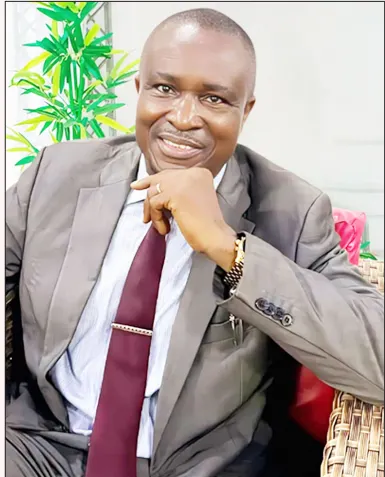
ON our Platform this week, we present to you Dr. Raph Onyemekeihia, a passionate medical doctor with 37 years’ experience. He is a Consultant Physician, a Nephrologist, and the Medical Director/Chief Executive Officer, CEO, Mount Horeb Clinic and Dialysis Centre, Warri – the first private Dialysis Centre in Delta State, Bayelsa, and part of Edo State. It is also the first private Dialysis Centre to successfully carry out Kidney transplant in Delta State. He is from Agbor, in Ika South Local Government Area, and an ordained Reverend with the Church of God Mission International.
In this interview with him, he spoke on a number of issues, ranging from how he got to read Medicine in the University, why he chose to specialize in Kidney transplant, his passion and commitment to save the lives of those with kidney diseases, how, with the dedication of him, and a team of medical experts from within and outside of the country carried out the first successful kidney transplant in a private Dialysis Centre – Mount Horeb Clinic and Dialysis Centre, Warri; the urgent need for the Delta State Government to assist privately owned dialysis centres, and very importantly the second batch of kidney transplant, scheduled to take place at the Centre in less than a few months from today. Excerps.
Why the choice to study Medicine? You probably could have studied something else?
The question about my decision to study Medicine is actually a long story. I believe it was divinely ordained. When I was born—at a time when English names were not really in use—they gave me an African name. One day on the farm, when I was about five years old, and had not yet started primary school, my elder brother told me, ‘When you get to primary school, don’t tell them your name is Okuiku—that’s my Ika name. Tell them your name is Raphael. Unknown to my parents, when we went to register for primary school, they asked for my name, and I said, ‘My name is Raphael.’ My parents, especially my mother, were surprised, wondering where that name came from. I told them it was my brother who gave me the name. I didn’t even know the meaning then.”
Throughout my primary and secondary school years, my elder brother kept telling me he wanted me to study Medicine. Eventually, I realised that Raphael means Jehovah Rapha—‘The God that heals.’ That name made me feel that perhaps, he wanted me to be someone who would help humanity. He kept hammering it into me all through my childhood.”
“After secondary school, I went to the College of Education. We were the first set. But my elder brother told me, ‘If you don’t go and read Medicine, I won’t train you again.’ So I abandoned the College of Education in my second year—200 level—wrote JAMB, passed, and went in to read Medicine.
By then, I had developed a genuine interest in helping humanity because I admired the doctors in our locality and wanted to become one.
I graduated as a medical doctor 37 years ago. Later, when I wanted to specialise, I went to the University of Benin Teaching Hospital, UBTH around 1997–1998. UBTH had a dialysis centre, and I noticed that over 60% of the people coming for dialysis in Benin were from Delta State. That developed something in me. I felt that if I studied kidney diseases and became an expert, I could help my people. That was why I specialised in kidney diseases and became a nephrologist.
The passion to become a doctor started from my brother’s influence, and later, my own conviction. But the passion to specialise was driven by the desire to help Delta people who were suffering to get dialysis care at the UBTH.”
My take was that, immediately after I finished my training, I would open a dialysis centre in Delta State. And indeed, after finishing in 2005, by 2006, I had established a dialysis centre in Delta State, here in Warri. It was the first dialysis centre in the entire Warri, the entire Delta State, Bayelsa, and parts of Edo State. That centre reduced the number of Deltans travelling to the UBTH.
“So, we are happy that we are contributing our quota to medical practice. That is the genesis of how I became a doctor, why I became interested, and why I specialized as a kidney expert.
And why the name, Mount Horeb Clinic and Dialysis Centre? It rings a bell; draws some attention.
The name was also an inspiration from God. God told me that He would put succour in the lives of people. This clinic is not just driven by money; it is a humanitarian service to give back to the people. God took me back to the Bible, and led me to the name MOUNT HOREB.
In the Bible, Mount Horeb was where bitter water was turned into sweet water. It was also where the bush burned without being consumed. God told me that anyone who comes to Mount Horeb Clinic and Dialysis Centre with bitterness will leave with sweetness. Anyone battling a burning fire—any disease that is threatening his or her life—will not be consumed.
So, we named it MOUNT HOREB Clinic and Dialysis Centre—because bitter water will turn to sweet water. The Bible says the name of the Lord is a strong tower; the righteous run into it and they are safe. God did not make a mistake in giving us the name MOUNT HOREB. People who run into it will be safe from sickness by God’s grace.
Information in the public domain has it that Mount Horeb Clinic and Dialysis Centre recently did a successful Kidney transplant. How did you achieve such a feat, considered a rare one in this part of the world?
It’s a long story. As far back as 2006, the ultimate goal was to do kidney transplantation. But it takes a lot. Our real preparation started in 2018, when we became convinced that it could be done here in Warri, Delta State.
I travelled to India in 2018 to understudy the transplant process at Fortis Hospital—one of the biggest kidney transplant centres. I stayed there for about six weeks learning how they conduct transplants. Before then, I had gone to St. Nicholas Hospital to study under Dr. Bankole. I also went to the Federal Medical Centre (FMC), Yenagoa, to understudy their process. I was at Caroline Hospital in Abuja to observe theirs, and to St. Nicholas Hospital, Abuja, to collect their transplant protocol. I even went to Egypt—to Al Salam Hospital—to see how they do theirs.
After gathering all these experiences, I realised it was doable. It’s not rocket science. If they can do it, we can do it. So, I began to acquire equipment. I got quotations from India on how to equip a transplant centre. We equipped the ICU with expensive materials. We trained manpower—Nurses, Admin staff, etc.”
Then came partnerships. We signed a contract with a group in India—expatriates who come in to work with us. We also have understandings with some Abuja expatriates. These are the people who collaborated with us to achieve this feat.”
Funding was entirely personal—no external sponsorship. We struggled to fund it. Some patients donated equipment, like the RO (Reverse Osmosis) machine, donated by the Esther Matthew-Tolah Foundation. But the bulk of the funding was our personal struggle.
How does your Clinic handle and manage the issue of Kidney Donors to your patients?
One major step in Kidney transplantation is that the patient must provide the donor. Getting a donor is one of the biggest challenges. It is unacceptable for the clinic to provide a donor. The donor must not be paid or induced.
A donor may be a living relation or a living non-relation. It is not a crime to receive a kidney from a non-family member, but the donor must prove—through Court Affidavits—that no inducement was involved. We also screen the donors thoroughly to ensure they are fit.”
The other type of donation is deceased donation, where a person’s kidney is used after death. That is practiced abroad but not practiced here yet. So, it is always living donors for now.
We hear that Mount Horeb Clinic and Dialysis Centre is planning to do another batch of kidney transplant. When is that likely to be, and how ready are you and your team?
The next batch of kidney transplant will be in about two months. Anyone interested must key in early because we batch patients. You cannot just walk in and get it done immediately. We must batch them because we bring in expatriates and must pay for their flights, hotel bills, and allowances.
From the reports that we have, Renal Failure in Nigeria is on the rise. From your experience, what do you think is responsible for this? And what is the capacity of the private health facilities to cope with Kidney transplants?
Yes, Kidney failure is on the rise in Nigeria—it is alarming. About 12.8% of all admitted medical patients have renal failure. The major causes include hypertension, diabetes, fake drugs, rejection of medical diagnosis, painkillers, herbal mixtures, HIV, and environmental factors.
We need more Nephrologists. Doctors should refer patients early before they reach end-stage kidney failure. Many cases could have been prevented with early referral. Also, government and the private sector must be encouraged and well-equipped to cope with kidney problems.
Transplantation requires massive dedication—training, equipment, dedicated staff, mental and physical commitment. It is not an appendix surgery you rush in and out of. In Nigeria, most transplants are done in private centres because, private Centres or hospitals tend to have more administrative flexibility and fewer bottlenecks.
And how have been able to cope with the cost and sustainability of Kidney Transplantation in your Clinic?
It is difficult to sponsor kidney transplantation personally. Most patients cannot afford it. The average cost of a transplant is about ₦35 million to ₦40 million. So, it requires huge financial resources.
Government should, therefore, sponsor patients or subsidize part of the cost, like foreign countries do through health insurance systems. Kidney transplant is the permanent cure for kidney failure, and government support is necessary.
We need more experts, more Nephrologists, more Transplant Surgeons, more trained manpower.
Government must sponsor training to help us confront the monster ravaging our nation—kidney failure.”
We also need equipment. We burn diesel heavily to sustain steady electricity. Many transplant equipment are borrowed because buying them is extremely expensive.
As a way of effectively tackling the challenges of Renal failure, what do you think should be the place of private clinics in this country?
Private clinics are crucial in salvaging the situation. They are the main sites sustaining kidney transplant programs because there is no bureaucracy or bottleneck.
We, therefore, encourage government to support private clinics doing transplantation.
The successful transplant at Mount Horeb Clinic and Dialysis Centre was done in collaboration with all nephrologists in Warri. They teamed up to actualize this feat. They include: Dr. Edema, Dr. Slater, Dr. Boyo—Nephrologists within the Warri environment. We also engaged our foreign experts, so the collaboration was a tight and well planed one. We all agreed that kidney transplants must be done in Warri instead of sending patients outside.
Our coordinator, Dr. Jimoh Abdulmalik, ensured that all logistics were complete. We also had our renal nurses—like Vera Ibino—and other nurses, logistics staff, and many others on the transplant team.
“We are looking forward to the Delta State Government’s support. We opened the first private dialysis centre in Delta State and performed the first private kidney transplant in Warri, Delta, and Bayelsa States. We need encouragement.
And what are the prospects of kidney transplantation in Warri, and Nigeria in general?
Thank you. The prospects for kidney transplantation in Warri, in Delta State, and in Nigeria as a whole are very bright. What it truly requires is dedication, doing things the right way, and ensuring that the kidney being transplanted is properly matched.
Here in Mount Horeb Clinic and Dialysis Centre, we always send our samples to India to confirm compatibility. Once that matching is done, the procedure becomes straightforward.
In Nigeria, and particularly in Warri, the potential for kidney transplantation is strong. Four of us—nephrologists—have come together as a team to make it work. With adequate sponsorship and access to the required materials, which we are already striving to procure independently, there is no limit to what we can achieve. The sky is genuinely our starting point.
Finally, given the sensitive nature of getting kidney for patients, and the transplant, what precautionary measures do you have in place at Mount Horeb Clinic and Dialysis Centre?
Before a patient is transplanted in the program, we have the Ethical Committee. There is a Chairman of the Ethical Committee who is both a lawyer and a medical doctor-Dr. Boyo. We have a policeman in the Ethical Committee, we have a Community Liaison Officer who is a key opinion leader in the Community, and we have a Pastor. If the patient is a Muslim, we also have an Imam in the Ethical Committee.
Together, they ensure that the patient is properly screened to make sure there is no inducement, and that the kidney is not paid for. They look at all the documents, cross-check everything, and ensure that we are legally permitted to carry out that transplant. No member of the Ethical Committee is a member of the clinic or a member of the transplant team, and that is to give them the objectivity that is required.

