


On Wednesday, November 26, Delta State Governor, Rt. Hon. Sheriff Oborevwori presented a budget proposal of N1.664 trillion for the state’s 2026 fiscal year to the State House of Assembly for consideration and approval. Giving a breakdown of the budget christened ‘Budget of Accelerating the MORE Agenda,’ Governor Oborevwori said N499 billion, representing 30 per cent of the total budget, was for recurrent expenditure, adding that N1.165 trillion, representing 70 per cent of the total budget, was for capital expenditure.
The budget, which was passed by the State House of Assembly, was increased from the initial N1.664 trillion as earlier presented to it by the Governor, to N1.73 trillion. The passage of the bill came as a result of the report presented by the House of Assembly Committee on Finance and Appropriation, headed by its Chairman and Member Representing Ika North-East State Constituency, Hon Marilene Okowa-Daramola.
Presenting the Committee’s report, Hon Okowa-Daramola noted that out of the amount, N500 billion was for recurrent expenditure, while N1.229 trillion was for capital expenditure. She said that the recurrent expenditure represents 30 per cent of the budget, while the capital expenditure represents 70 per cent.
Hon Okowa-Daramola attributed the increase in the 2026 budget size to the growth in the national economy and improved internally-Generated Revenue (IGR) projection. The Committee Chairman also noted that the Appropriation Bill reflected a well-balanced, people-oriented and development-driven blueprint for the state.
”It is our firm conviction that with disciplined implementation and continuous legislative oversight, when signed into law, the proposed 2026 budget will accelerate socioeconomic transformation, promote inclusive growth and improve the standard of living of our people,” she said.
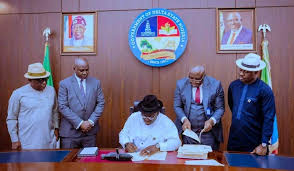
The 2026 Appropriation Bill, passed by the State House of Assembly, was, on Tuesday, December 15, presented to the Governor for assent. Speaking during the signing ceremony, Governor Oborevwori described the 2026 budget as “not just a budget of figures, but a budget of vision, action and expected deliverables for the next 12 months,” assuring that the state would hit the ground running in 2026 to accelerate development across key sectors.
According to him, the 2026 budget of N1,729,881,208,779 represents an increase of over 70 per cent compared to the 2025 budget. The Governor said the estimate, though ambitious, was achievable, with 70 per cent dedicated to capital expenditure and 30 per cent to recurrent spending, thus underscoring his administration’s commitment to infrastructure-led growth and sustainable development.
Briefing journalists in Asaba, the Commissioner for Economic Planning, Mr Sunny Ekedayen, said the 2026 budget, recently passed by the Delta State House of Assembly and assented to by Governor Sheriff Oborevwori, represents a major leap from the 2025 budget of N979 billion.
Ekedayen explained that the original estimate of N1.664 trillion sent to the House was subject to legislative review, which resulted in marginal adjustments that ultimately served the best interest of the state. He noted that the budget, now a legal and “live” document, would take effect from January 1, 2026.
“The most significant aspect of this budget is the strong tilt towards capital expenditure. For the first time, Delta State is prioritising capital projects to the tune of over N1.165 trillion, representing at least 70 per cent of the total budget,” he said.
He described the development as historic, noting that the capital component of the 2026 budget is even larger than the entire 2025 budget, a move he said would accelerate development across the state’s 25 local government areas.
The Commissioner, who was accompanied by the Commissioner for Works (Rural Roads) and Public Information, Mr Charles Aniagwu; the Executive Assistant to the Governor on Public Enlightenment, Projects and Policies, Mr. Olisa Ifeajika; and the Executive Assistant on Media, Mr Felix Ofou, said the administration was determined to “hit the ground running” from the first day of 2026.
According to him, ongoing projects would be completed without abandonment, while new ones would be carefully selected for maximum impact. He disclosed that contractors are usually mobilised up to 40 per cent to ensure timely delivery, especially given the state’s relatively short construction season.
Ekedayen said social protection would receive special attention in 2026, with about N20 billion earmarked for programmes designed to support artisans, small traders, vulnerable groups and small and medium-scale enterprises through cash and in-kind interventions. He added that a Social Protection Bill had been sent to institutionalise the programme and provide a clear framework for its implementation.
On infrastructure, he stressed that development would be evenly spread across the state’s multiple towns and cities, noting that Delta’s unique settlement pattern requires resources to be distributed across several urban and rural centres rather than concentrated in one location.
He also revealed that the state government had set aside N100 billion for targeted interventions in local governments to address special community needs, based on requests from grassroots stakeholders.
In the health sector, Ekedayen highlighted significant investments in tertiary healthcare facilities, including the procurement of high-end diagnostic equipment from Germany for three state-owned tertiary hospitals. He said plans were also underway to expand medical education and strengthen primary healthcare, alongside the recruitment of additional healthcare professionals and sustained support for the state’s health insurance scheme.
Education, he said, remains a priority, with continued investment in state-owned universities, polytechnics, colleges of education, nursing and health technology, as well as hundreds of primary and secondary schools across the state. He described Delta State as an emerging education hub, citing improvements in infrastructure and learning environments.
According to him, Agriculture is also expected to play a key role in the 2026 budget, with a three-pronged strategy involving direct government funding, private sector partnerships and large-scale agribusiness initiatives aimed at boosting food production, creating jobs and reducing post-harvest losses. He disclosed that the state is also favourably positioned to benefit from the second batch of the Federal Government’s Special Agro-Industrial Processing Zones initiative.
On revenue, Ekedayen said Delta State’s Internally Generated Revenue (IGR) had grown by over 140 per cent since 2023, rising from N83 billion to over N200 billion, with a target of at least N250 billion in the coming year. He attributed the growth to improved efficiency rather than increased tax burden on residents.
He further disclosed that the state is pursuing revenue diversification through innovative initiatives such as the blue carbon market, leveraging mangrove restoration and climate finance in partnership with international firms and the Federal Government.
Ekedayen described Governor Oborevwori as a practical and experienced leader focused on leaving a lasting legacy, assuring Deltans that every community would feel the impact of governance in the coming year. “From January 1, 2026, government machinery will be fully in motion. Development will deepen, projects will be reinforced, and every part of the state will witness tangible progress,” he said.

