


BY OGORAMAKA AMOS/CHIKA KWAMBA/PAUL EGEDE/JUDITH OBIANUA
The daytime busyness is replaced by a low, humming quietness, the kind that amplifies every footstep, every distant horn, and every flicker of light from half-asleep buildings. The sky hangs low, heavy with clouds that seem to mirror the mood of the night.
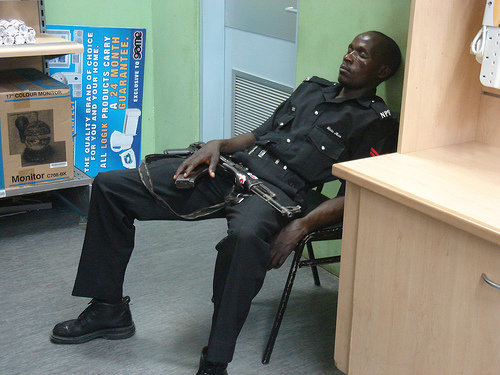
While most residents drift between dreams, others remain awake, working, watching, healing, protecting, and moving the city forward in quiet, uncelebrated ways. These are nightshift workers—the guards who hold vigil, the nurses who whisper reassurance to the sick, the journalists chasing midnight emergencies, the fuel attendants with tired eyes, the hotel staff navigating unpredictable guests.
Together, they form an invisible backbone that keeps the city running while the rest of us sleep. Their stories, rarely told, reveal the weight of responsibility carried in the dark hours, the fears they swallow, the exhaustion they battle, and the strange, extraordinary moments only the night can bring.
Chima Stanley is a security guard at a microfinance bank in Port Harcourt who spoke to our correspondent. According to him, “In this place we dey run shifts. No be only me, I dey resume from 6 pm, and then I close by 6 am. Once everybody don close for the day, the compound go just become quiet. People think say security men work for night dey easy. Na when everywhere quiet for night, na that time dangerous things dey start. ”
For four years, Chima said his day has not remained the same. “I dey stay alert. I dey walk round the buildings to ensure say everything is intact and pray the night is peaceful. He went further to say, “Sometimes the quietness dey deceive, and that’s why I walk around from time to time”
“I am a human being, of course, fear is real,” he admits. “You fear robbers even though they give me a cutlass, for instance, to defend myself, but you fear strange movements. You fear that something can happen, and you will be blamed for it. My eyes no dey rest for night. At times I dey tire, headache too disturb me.’’ The hours between 2 a.m. and 4 a.m., he says, feel like “fighting with myself because of sleep.” Yet, the pay doesn’t reflect the risks”.
Inside the University of Port Harcourt Teaching Hospital (UPTH), the night belongs to nurses like Blessing Amadi, who said, “I have grown intimately familiar with night duty. At night, the hospital feels like another world,” she said. “The corridors are silent. The wards feel heavier due to the tension of emergencies”
“I have attended to emergencies most people cannot imagine, accidents arriving in waves, patients gasping for breath, mothers in labour at odd hours. From 1 a.m. to 3 a.m., your body is begging for sleep. But patients don’t wait for you to rest because you are always called upon. You have to force yourself to stay awake because a mistake could kill someone.”
“Night shift has made me realise life is fragile. You see the boundary between life and death so closely. Yet, the salaries and allowances barely reflect the emotional and physical toll”.
For Dr Kelechi Nwachukwu, who works in a private clinic along Ada-George in Port Harcourt, “Night duty strips you of your ego. At night, you are dealing with emergencies back-to-back. You don’t have time to be tired.”
He recalls, “There are nights where I will be treating up to three accident victims, admitted patients and women in labour, sometimes simultaneously. The pressure is intense, aggravated by understaffing. Many nights, I’m the only doctor available. It’s dangerous. Your body is tired, but you push through.”
The financial compensation doesn’t match the risks, he said plainly. “Night allowances are small compared to the stress. But working night shifts builds resilience. It teaches you to stay calm in chaos. The biggest disadvantage is my social life. My family sees me less. And sometimes I’m awake when the world is asleep.”
Ebitari Sunday, a journalist working the night desk in a Radio station in Port Harcourt. In a chat with our correspondent, he said, “Night work in journalism is not glamorous. I have to edit my voice recording after coming back from beats, which sometimes creeps into the night”
Sunday said he covers police operations and crime scenes, adding that safety is his biggest concern. “I’ve been threatened. I’ve had my phone snatched on my way back from the office.”
Sarah Joseph, who works at a hotel at Rumuodomaya Port Harcourt, also spoke to our correspondent. According to her, ‘’I resume my work at 5 pm and I normally close by 12 am. You see things,” she said. “People who check in late at night, some guests who arrive drunk. I get exhausted. Sometimes guests call the reception desk at odd hours, placing food or drink orders. So, I am meant to be awake from 5 pm to 12 am when I finally get to rest”
In Agbor, Ika South Local Government Area of Delta State, Mr John Isichei, a security officer in James Hope College Agbor, told our correspondent he prefers engaging on night shift as it gives him the free time to engage in other activities, especially farming, to meet with family needs. He noted that he used to approach his colleagues on night duty once it was his turn to work from 6 am to 6 pm. ‘’This is how I can balance my farming and my job.
A Police officer (name withheld) serving in the Agbor Area Command shared his experience while on night duty. According to him, ‘’the remuneration is not worth the risk in night duty. We stay awake for the citizens to sleep, but a lot happens at night. We see things at night, the good, the bad and the ugly, but we are still here because we choose to serve our fatherland.
‘’We, the police officers, are not well appreciated, although there are some bad eggs in our midst. But the corruption in our country is in all sectors’’ he said, adding that he has served for over two decades and has faced so many attacks mainly during night duty’’ He said one of the advantages of night duty is being around to stay with his family and help the children but the disadvantage of night duty, he said, is the attack which comes from where less expected.
Meanwhile, a journalist, Mr Akinola Aladejowo, said that working at night has become one of the most intriguing parts of his professional journey. ‘’There is something deeply calming and inspiring about the late hours—an atmosphere that is almost impossible to replicate during the day. At night, there is no disturbance, no noise, and no unnecessary distractions. The mind becomes clearer, thoughts flow more smoothly, and the focus to work becomes naturally heightened.’’
He said beyond the serenity, another thing I find interesting about night work is the ease of movement. After finishing assignments or a late-night coverage, getting to my destination is usually effortless. With no traffic congestion and fewer vehicles on the road, the journey becomes faster, safer, and far more convenient. The coolness and quietness of the night also add a unique sense of peace that makes the work feel lighter.
‘’However, like every aspect of life, working at night comes with its advantages and disadvantages. While the serenity and ease of movement are major benefits, the risks involved cannot be ignored. One major disadvantage is that help may not always be readily available if an emergency arises. The streets are mostly empty, and the reduced human activity means that one must remain extremely vigilant.
As a journalist, the risk becomes even more pronounced. The profession itself carries hazards—ranging from hostile environments to unpredictable encounters. Working at night requires extra carefulness, a heightened sense of awareness, and sometimes even sacrificing comfort. On some occasions, I have had to sleep over rather than risk travelling at dangerous hours—an inconvenience made necessary by unexpected circumstances.
Still, the beauty of life is that everything comes with both positive and negative sides. To me, the advantages of night work—from the calm atmosphere to the distraction-free environment—remain valuable. But the risks serve as a reminder that journalism is not just a job; it is a calling that demands courage, caution, and unwavering commitment.
In Asaba, Mrs Anthonia Napoleon recounted her experience as a receptionist in a hospital, explaining that the disadvantages of working at night far outweighs its advantages, especially where there are lot of patients and those on night duty are few. ‘’we work throughout the night, she said, and there will be no space for you to sleep as all the beds are occupied by patients. You will not have time to rest, one might even have to sit down on the chair throughout or run from one office to the other. Sometimes, we even go towards. It is so tiring when working in a big hospital. Night shift is so tedious. After working the night shift sometimes, you wouldn’t be useful in the day because you would want to sleep before it’s time to go back to work.
Another disadvantage is when you are on night duty, and somebody passes out that night. It is very scary. I remember when I started work, whenever someone died at night, I would be so scared. I imagine that the person’s spirit is moving around the hospital promises until I become used to the system. I began to see it as a normal occurrence. I am no longer afraid.’’
Speaking with a police man who pleaded to remain anonymous, he noted that night work can be very stressful, especially when the power supply is off and everywhere is in a blackout. As he puts it, ‘’the mosquito bite, the smell from the jail… If the station is not properly secured, it might be invaded by bandits, especially at night. Working in an unconducive environment during the night shift is discouraging; the heat alone will almost kill you because there is no ventilation.’’
Another night worker, who simply identified himself as Mr Nweafor, a vigilante, said sometimes during the night, especially at midnight, it feels like someone is walking around. He said, ‘’We feel it but don’t see it. It can come in the form of wind, a very strong one.’’
He shared an encounter, ‘’At about 1 am, I walked down the street a little far from my colleagues, and suddenly I saw a dry palm fond coming towards me with speed. I observed it for some time, and when it was close to me, I began to run while it continued chasing me. I had to hide before it stopped running after him. According to him, scary things happen at night’’ he said.
In Edo State, a Benin-based medical practitioner, Shadrach Onakpoyan, opined, ”A typical night shift in my setting always feels different. Some night shifts are calm, whereas others make you regret coming to work. Imagine having a case of multiple road traffic accidents at 2:00 am. You know it’s going to be a “fun-filled” night till dawn.
‘’Even for the so-called calm shifts, you have inpatients who you need to make sure are doing okay by routinely checking on them. Then there is your own body telling you to sleep while also keeping you on the alert for emergencies. I mean “Who is fighting whom”.
‘’Everything sounds extraordinary. It’s like even the walls are awake at times. The hospital is like a living building, expecting an influx of patients even at odd hours. Your heart beats on a whole different frequency when you hear “emergency”, or someone starts bleeding, a syringe falls on the ground, a patient dies, even worse, ghosts, hmm, let’s not go there. I mean, the place is quiet and sometimes dark, especially when there’s no light. Trust “NEPA” to keep you entertained.
‘’Some of the challenges I’ve encountered: Firstly, there are fewer experts present. So you see, I’m a medical officer expected to keep these patients alive till the morning when more capable hands can be easily reached.
‘’Secondly, there is the issue of making critical decisions under fatigue. You are working against certain factors not entirely under your control. Sometimes there’s no light to attend to patients. Speed, precision and accuracy all come to play. In addition, emergencies are just different at night. Staff members are tense, the patient is scared, and the outcome is unpredictable. Omoh!
‘’Then there is the issue of exhaustion. You are expected to be awake, knowing that others are asleep. It’s like you’re working against the normal clock, so your body tends to give off a different vibe. Also, some night shifts can be so busy that you just become fatigued. This is the worst of them all.
‘’Are there advantages? Well, there’s the quiet environment, which helps you focus better. Also, there’s the sense of knowing you are in charge, and this helps you develop your skills. For the calm nights, there’s really nothing much to do, so rest brings a sense of relief, I would say. Is it worth it? The pay in this our setting is not commensurate with the service we render, but there’s this joy that comes with saving a life.’’
A nurse, Mrs Tessy Ehigiato, said, ‘’Nursing is more of a calling than a profession. The story is an endless one, but I will try my best to highlight it. The money is far less than the work done anywhere in the world. Going on night duty is demanding; you have to make preparations and be sure all that is required by your family is made available for the days you will be on night shift. You and your family may not see you for the number of days you are on night. You only talk on the phone, except if your spouse is in a private business.
‘Sometimes, the challenges are when there are emergencies and no gadgets to salvage the situations. Patients who would have survived will die, which is demoralising, especially when it’s children (it hurts the most). ‘’The fears are numerous, leaving your house for work is a risk itself. Getting to work, and you are your own security. My ward had no personal security. Once you are in a bay, you must not leave the babies unattended. To even drink water, you obtain permission from another nurse to stand in for you until you return. If any baby is missing, you can go in for it. If anyone stops breathing, you can go in for it.
‘’The extraordinary things are many. Sometimes you feed a patient with your money, buy infant formula for babies, even baby soap. Some strange feelings of spiritual forces, and then you start praying. A grandmother once visited a baby, and the baby died. Sometimes, a patient who was already improving can start deteriorating because of who visited.
‘’Exhaustion now and then. I am beginning to recover from the stress. I used to take Coke every day. One, two or sometimes three in a shift; if I am getting the third one for free.
‘’The disadvantages are numerous. Your children will be at the mercy of others while you are busy caring for people. My boy was malnourished at a time when he was malnourished because I was not there to monitor his feeding. You can experience robbery, though I have never experienced that.

