


BY RITA OYIBOKA/OGORAMAKA AMOS/JUDITH OBIANUA/ AMAYINDI YAKUBU
When the roots of a tree are watered, the branches flourish. Neglect those roots, however, and the entire structure slowly weakens. Societies operate in much the same way. Women, who nurture families, sustain communities, and contribute immensely to economies, form a critical foundation of human development. When their rights, opportunities, and voices are strengthened, societies thrive. When they are constrained by inequality, discrimination, or violence, the consequences ripple across generations.
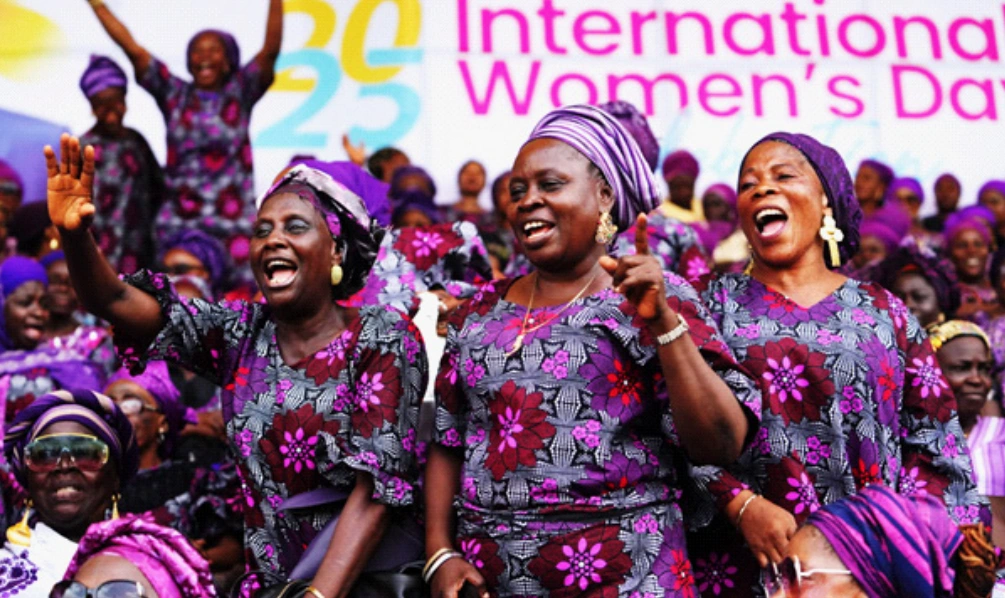
This central truth lies at the heart of International Women’s Day, which in 2026 is marked under the official theme “Rights. Justice. Action. For All Women and Girls,” complemented by the global campaign “Give To Gain.” The theme underscores an urgent reality: achieving gender equality requires more than policy declarations and symbolic celebrations. It demands structural change, enforceable rights, and concrete action that dismantles the barriers preventing women and girls from fully participating in society.
Observed annually on March 8, International Women’s Day serves as both a celebration of women’s achievements and a reminder of the persistent inequalities that remain. According to the United Nations, women globally possess only 64 per cent of the legal rights available to men. Even where laws exist on paper, weak enforcement and limited access to justice often prevent women from benefiting from them in practice. The 2026 theme, therefore, calls for stronger legal protections, decisive measures to end gender-based violence, equal pay for equal work, and greater representation of women in leadership and decision-making.
Moving beyond rhetoric
In an interview with The Pointer, the Delta State Commissioner of Women Affairs, Community and Social Development, Hon. Pat Ajudua, underscored the invaluable contributions women make across all spheres of life, political, economic, social, and cultural. Yet, she warned that discussions alone are no longer sufficient. She stressed that the time had come for decisive action.
According to her, gender equality cannot be achieved through speeches and policy statements alone. Instead, governments, institutions, and communities must take concrete steps that genuinely transform the lives of women and girls.
The Commissioner also commended the Delta State Government under the leadership of Rt Hon Sheriff Oborevwori, acknowledging what she described as the administration’s visionary approach to women’s empowerment. She equally praised the First Lady and founder of the You Matter Charity Foundation, Deaconess Tobore Oborevwori, for championing programmes aimed at strengthening opportunities for women across the state.
“These efforts,” she noted, “have not only opened doors of opportunity but have also created platforms for women to excel, lead, and inspire the next generation.”
Highlighting the ministry’s ongoing mandate, the Commissioner reiterated that the ministry remains committed to accelerating action towards a society where women and girls can thrive without fear of discrimination or violence.
She explained that the ministry is determined to eliminate structural barriers that limit women’s participation in development, even amid the persistent socio-economic challenges facing the country.
Addressing women directly, she urged them to recognise their power and pursue their aspirations with determination. “On this special day,” she said, “I urge every woman to recognise her worth, pursue her dreams relentlessly, and support one another in creating a future filled with opportunity and dignity.”
She also acknowledged the role of men as partners in the pursuit of gender equality. “To our men and partners in progress,” she added, “we value your dedication in championing the cause of equality. Together, we can build a Delta State where no woman is left behind, and where the contributions of every woman are recognised, celebrated, and fully realised.”
Cultural patterns and changing narratives
Despite increasing advocacy and policy reforms, gender inequality remains embedded in many social structures.
A certified educator, theologian, and advocate for United Nations Sustainable Development Goals 4 and 17, Dorcas Enitan Ajayi, believes Nigeria has made gradual progress but still has a long journey ahead.
According to her, traditional cultural patterns historically prioritised male children over females. “Nigerian culture generally doesn’t really give equal opportunities for girls and boys in education and career paths,” she explained. “Based on the tradition that the female children’s certificate ends in their husband’s house, and the male ones are the ones who will be the heir of the family.”
She noted, however, that the situation has slowly improved over time. “Things are actually taking shape, but not a perfect change; things have actually been improved over time,” she said. “We now have girls having access to education, even though it might not be of equal quality, for both genders, though.”
Ajayi observed that access to opportunities today is influenced not only by gender but also by merit and social connections. “People tend to have access based on merit, while some have access based on connection, maybe somebody knows somebody,” she explained.
While acknowledging that gender disparities still exist, she noted that opportunities sometimes vary depending on the sector. “Some sector provides better opportunities for females than males, while some prefer male than female,” she said.
She reflected a cautious optimism about Nigeria’s evolving social landscape. “I would rather say that the Nigerian society provides opportunities for both genders, depending on the sector, the gender I want to fit into.”
The fight for justice and a fair hearing
When asked about women’s legal rights and the broader struggle for gender justice, Ajayi clarified that her advocacy is not necessarily about competition between men and women. “What I’m fighting for, I as a person, I’m not actually fighting for equality per se,” she said. “What I am fighting for is that what belongs to me should not be denied.”
She emphasised that women deserve access to opportunities that rightfully belong to them, whether earned through merit or granted through social benefits.
Ajayi also spoke about her involvement with Voices Against Rape and Sexual Harassment, an organisation dedicated to supporting victims of abuse. “In this organisation, what is being done basically is to help women, women, ladies, girls, older and young, who face harassment, rape and maybe discrimination or sort of social vices like that,” she explained.
The organisation provides legal support, amplifies survivors’ voices, and assists victims in pursuing justice through the courts. Beyond advocacy, Ajayi believes awareness of legal rights is critical. “I’m aware of my legal rights as a woman or girl child,” she said, adding that she hopes to help more women understand their rights and learn how to defend them.
Justice, investigation, and accountability
Ajayi also emphasised the importance of fair legal processes. “Since we want justice for the female gender, I would want a situation whereby the legislature can pass a law that the judiciary system should uphold,” she said. Such laws, she explained, would ensure that women can voice their concerns without fear of discrimination or intimidation.
She stressed that both genders face harassment, but women often experience it more frequently in certain contexts. Ajayi believed grassroots-level reforms are necessary to encourage victims to speak out.
“If there is enough fair hearing, people will have the confidence to say their displeasure about harassment,” she explained. However, she cautioned that justice must also include a thorough investigation. “The fair hearing should be well investigated so that suspects would not be punished illegally,” she said.
According to her, emotional reactions can sometimes complicate cases, making it important for authorities to approach such matters carefully.
Education and early awareness
One of Ajayi’s strongest recommendations centres on education, particularly early awareness of harassment. She believes girls should be educated from childhood about the different forms of harassment that can take. “Parents should teach their female children different methods or different ways in which they can be harassed,” she said.
Harassment, she explained, is not limited to physical contact. “It’s not only when somebody is touching or when somebody is trying to… although those are the common ones. Other ones are not common, but they are actually harassment.”
She stressed that girls must learn to say no before situations escalate. “It should not get to the point that the person is forcefully lying on them before they now consider it as rape,” she said.
Drawing from personal experience, Ajayi explained that harassment often begins subtly. “From my experience, the harassment started in the form of words, whereby people around me did not really pay attention to it.”
What eventually empowered her to confront the situation, she explained, was access to information. “I got access to a piece of information that helped me to challenge the predator,” she said.
She believes that providing such information, particularly in grassroots communities, could significantly reduce cases of abuse.
Government’s evolving response
Government institutions have also expanded efforts to promote women’s rights. A senior officer with the Rivers State Ministry of Social Welfare and Rehabilitation, Mrs Blessing Nwankwo, said gender equality is increasingly integrated into development programmes. “Over the years, the government has recognised that women play a critical role in social and economic development,” she said.
Because of this recognition, she explained, several policies have been introduced to protect and empower women and girls. One key focus area has been combating gender-based violence.
“Rivers State has domesticated the Violence Against Persons (Prohibition) Act, which criminalises several forms of abuse, including domestic violence, harmful traditional practices, sexual exploitation, and emotional abuse.” The ministry collaborates with police authorities, health institutions, and non-governmental organisations to support victims.
“When victims report cases, they can access counselling, legal referrals, and sometimes temporary shelter depending on the severity of the situation,” she said.
Economic empowerment as protection
Beyond protection measures, the ministry also prioritises economic empowerment. “We run skill acquisition initiatives for women across various communities,” Nwankwo explained. These programmes provide training in areas such as tailoring, catering, soap making, hairdressing, agricultural production, and small-scale entrepreneurship.
Some initiatives specifically target widows, unemployed women, and single mothers. “When women have the means to earn income, they become less vulnerable to exploitation or abuse,” she said.
Economic independence, she added, enables women to make decisions about their lives with greater confidence.
Structural barriers remain
Despite these programmes, structural challenges persist. Policy analyst Samuel Briggs believes deeply rooted cultural expectations continue to limit women’s opportunities.
“In many communities, girls are raised with the expectation that their primary role will revolve around family responsibilities,” he said. While family life is important, such expectations sometimes discourage women from pursuing leadership positions or demanding careers.
Briggs also highlighted economic disparities. “Many women operate within the informal sector, selling goods in markets, running small shops, or engaging in small-scale farming,” he explained. Although these activities are vital to the economy, they often lack financial security and access to formal credit.
He added that women’s underrepresentation in politics further complicates the situation. “When women are absent from decision-making spaces, issues affecting them may not receive adequate attention.”
The role of civil society
Civil society organisations have played a major role in raising awareness about women’s rights.
Gender advocate Ifunanya Okeke noted that public attitudes toward domestic violence have changed significantly over the past five years. “In the past, many cases of domestic abuse were treated as private family matters that should not be discussed publicly,” she said.
Today, however, more people recognise gender-based violence as a serious human rights violation. Advocacy campaigns, including school workshops, community outreach programmes, and media engagement, have helped change perceptions. “Victims are now more willing to speak out,” she added.
However, she warned that support infrastructure remains insufficient. Shelters, counselling centres, and legal aid services are still limited in many communities.
Voices of young women
For many young women, progress has been noticeable but incomplete. Tonia Alabo, an engineering student, believes stereotypes still influence educational choices. “In many classrooms, there is still a perception that science and technical subjects are better suited for boys,” she said.
However, she acknowledged that more girls are entering fields such as engineering and technology. “Universities and professional organisations are also creating mentorship programmes that encourage female participation,” she explained.
Yet balancing career ambitions with societal expectations remains a challenge for many women.
Legal protections and the reality gap
From a legal perspective, Nigeria’s constitution provides several protections for women. Barr Ngozi Iheduru explained that the Constitution of the Federal Republic of Nigeria 1999 guarantees equality before the law. She cited Section 42, which prohibits discrimination based on sex, religion, ethnic group, or place of origin.
“This constitutional provision clearly establishes that women and men are equal before the law,” she said.
Section 17(2) further emphasises equality of rights and opportunities. However, she noted that enforcement challenges remain significant. “Many women do not pursue legal action because of financial constraints, social stigma, or lack of awareness,” she explained.
Bridging law and justice
Human rights lawyer Faith Opara emphasised that legal guarantees alone are insufficient. “The Nigerian Constitution provides equality before the law, but justice can only be achieved when legal processes are accessible, affordable, and efficient,” she said.
She referenced Section 34 of the Constitution, which guarantees the right to dignity and prohibits degrading treatment. Acts such as domestic violence and sexual assault violate this constitutional protection.
Opara believes cases involving gender-based violence should be fast-tracked in courts. “Lengthy court processes can discourage victims from pursuing justice,” she explained.
Persistent cultural bias
Other observers point to ongoing cultural bias. A public school teacher, Mrs Ijeoma Obiora, noted that gender discrimination can be seen even within educational institutions. “In schools, especially in mixed schools, the boy is made the senior prefect while the girl supports him,” she said.
She explained that leadership roles are often automatically assigned to male students. “I have not seen where the boy is an assistant even in the church,” she added.
According to her, cultural perceptions of men as natural leaders continue to influence decision-making.
The strategy of “Give to Gain”
Amid these challenges, global advocates emphasise strategic investment in women. UN Eminent Ambassador and Gender Priority Strategist Ogochuku Okekpolo highlighted the significance of the “Give to Gain” campaign.
“Across the world, especially in Africa, the needs of women are not uniform,” she explained. “Some require fundamental support, food security, clean water, safety, access to healthcare, and education. Others need opportunity, access to finance, enterprise platforms, leadership inclusion, and mentorship.”
Yet the principle remains consistent. “Every intentional investment in women produces exponential returns,” she said. When girls gain access to education, she noted, the benefits extend far beyond academic achievement. “They improve their health, increase their earning capacity, and strengthen the future of their children.”
Similarly, empowering women economically can transform communities. “A rural woman with clean water gains time for enterprise, family, and community leadership,” she explained. “A female entrepreneur with capital creates jobs and strengthens local economies.”
IWD: The unfinished journey
International Women’s Day 2026, therefore, arrives as both a celebration and a challenge. The celebration lies in the undeniable progress that has been made, greater awareness of women’s rights, expanding educational opportunities, stronger legal frameworks, and a growing network of advocates.
Yet the challenge remains equally clear.
From cultural expectations and economic inequality to gaps in legal enforcement and limited political representation, structural barriers still prevent millions of women from fully exercising their rights.
The message of this year’s theme is therefore unmistakable. Rights must be protected.
Justice must be accessible.
And action must follow words.
Only then can the roots of society be properly nourished, ensuring that women and girls everywhere can grow, lead, and flourish.

