


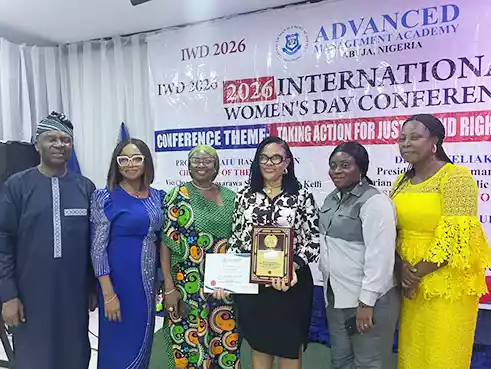
BY RITA OYIBOKA
“Justice delayed is justice denied”, a statement that goes beyond words to define the very measure of a society’s humanity. This urgent message set the tone at the 2026 International Women’s Day Conference in Abuja, hosted by the Advanced Management Academy (AMA), under the theme “Taking Action for Justice and Rights of Women and Girls.”
Far from a ceremonial gathering, the event became a powerful call to confront systemic barriers, demand accountability, and turn rhetoric into real change for women and girls across the nation.
Held at the Novare Central, Wuse Zone 5, the two-day gathering quickly revealed itself as more than another anniversary event: it was a focused convergence of leaders and stakeholders, academics, media professionals, security agencies, and policy voices, ready to confront systemic barriers and insist on measurable change.
Speaking during the occasion, the Chairman of the Advanced Management Academy, Dr Peter Oyeneye, set the agenda with a blunt assessment of the current realities. According to him, “there is a need to drive action towards anything that hampers the justice of women and girls.” He did not mince words. For him, the issue was not a lack of awareness but a deficit of deliberate action.
Dr Oyeneye stressed the importance of education as a foundational tool for justice, noting that “to show education, there is a need to educate boys about girls and girls about boys.” He drew a sharp distinction between passive existence and intentional progress, adding that “there’s a difference between growth and development. Something has to enter your demand for there to be development.” In his view, societal transformation requires more than rhetoric; it demands conscious investment in values, systems, and accountability.
He further emphasised that governance must play its role decisively. “Government should also ensure that the right thing takes place,” he said, before pivoting to the role of citizens in holding systems accountable. “We must speak up online when things go wrong. It is not just for the media house to post, but we as individuals have our role to play in making sure that things are done right.” In a digital age where silence can easily be mistaken for consent, his message was unmistakable: complicity thrives where voices are absent.
Equally, he warned against stereotyping, describing it as a subtle but powerful force that undermines justice. “We should also not stereotype, as that can also hamper right and justice of women,” he said, reinforcing the idea that bias, whether cultural or institutional, remains a major impediment to equality.
If Oyeneye laid the ideological foundation, Mrs Mercy Eluemunor provided a tactical roadmap. In her presentation on “Ten Action Steps to Challenge Injustice,” she stripped the conversation down to actionable realities. According to her, “there is a need to speak up and report abuse.” Silence, she argued, is not neutrality but complicity. “Silence enables injustice,” she warned, urging women to report cases to NGOs, community leaders, or trusted authorities.
She advocated for leveraging traditional and religious leaders for mediation, building support networks, and engaging law enforcement agencies. At the same time, she emphasised “self-protection without breaking the law,” acknowledging the complex environments many women navigate daily. Digital platforms, she added, should not just be spaces for expression but instruments for accountability and change.
On the academic front, the Acting Deputy Vice Chancellor of the Federal University of Technology, Ilaro, Dr Charlotte Iro-Idoro, focused on the structural barriers limiting women’s participation in science and technical fields. “There is a need to support women, encourage them into science courses,” she said, pointing to a historical imbalance that is only now beginning to shift.
She provided context, noting that technical education was once dominated by men due to low female participation in tertiary institutions. “The main objective… is to look at some of the factors that inhibit our young girls from pursuing science courses,” she explained. While acknowledging progress, “there is a lot of improvement”, she maintained that significant work remains.
Her message was both reflective and forward-looking. “We still have a challenge before us. They are giving us a task that we should go back to… let us help our young girls,” she said. She referenced initiatives such as mentorship talks themed “from classroom to boardroom,” accentuating the importance of continuity between education and leadership.
For Dr Lizzy Asomugha of the African University of Science and Technology, Abuja, empowerment is not granted; it is seized. “Women supporting women, for me, that is the greatest achievement,” she said, before dismantling outdated stereotypes. “The days are gone when you say women belong in the kitchen. No.”
She invoked examples of high-performing Nigerian women in leadership, arguing that competence, not gender, should define opportunity. “So don’t stand there and say, give us a right. Come and fight for it,” she said. Her critique extended to structural exclusion, particularly in decision-making spaces. “If they fix the meeting by 1 am… when you are there, you say no,” she noted, advocating for practical resistance to systemic bias.
Her call to civic participation was equally direct. “Do you have your PVC?… Not just cast your vote, but after casting your vote, sit down and make sure they count before you leave,” she urged, framing political engagement as a non-negotiable tool for change.
Adding a different dimension to the discourse, facilitator Mr Godwin Unguaga examined the influence of social media and digital culture among youths on identity and decision-making. “Social media is shaping our identity, shaping our future, shaping our choices,” he said, highlighting how daily consumption patterns influence aspirations and behaviour.
He warned against the dangers of uncritical engagement. “Misuse leads to distractions and distortion,” he said, describing how digital content can derail focus and distort priorities. Yet, he was equally emphatic about its potential. “There are more opportunities than risks,” he noted, outlining benefits such as learning, personal branding, entrepreneurship, and global networking.
“A smartphone in your hand can become a voice for change,” he said, challenging young people to move from passive consumption to active contribution. At the same time, he cautioned against addiction and time wastage, describing them as the hidden costs of digital immersion.
The conference also served as a platform for recognition, with a total of 23 awardees ranging from academics to media professionals, among others, honoured by the Academy. The General Manager of the Delta Printing and Publishing Corporation (DPPC), publishers of The Pointer Newspaper, Mrs Rosemary Nwaebuni, was honoured for excellence in journalism and leadership.
Responding on behalf of awardees, Nwaebuni reaffirmed her commitment to ethical journalism. “By God’s grace, we will continue to do what we do, and we will not retreat from that responsibility,” she said. Her words carried the weight of institutional memory and professional duty. “We will continue to remain a steadfast voice for the people and amplify the concerns of the ordinary citizen. We will continue to be a conscience of the society and ensure that truth is neither diluted nor suppressed.”
Providing insight into the Academy’s mission, Dr Oyeneye, in an interview with The Pointer, described the International Women’s Day programme as a long-standing initiative, noting that “this is the seventh anniversary of this programme.” The focus, he explained, has consistently been on identifying and celebrating women who have reached the pinnacle of their professions.
“If we look around the country for women who have reached the peak of their profession, any woman who is a deputy vice chancellor, or a chancellor, or maybe the registrar or chief executive of one company or the other, these are part of the criteria,” he said. Beyond titles, visibility and impact also matter. “When you go on social media, you see what they have done,” he added, highlighting the role of public recognition in amplifying excellence.
His advice to women was pragmatic and grounded in reality. “They should not be discouraged,” he said. “The award is about competition, so don’t give in. Just compete and win.” In his estimation, the path to recognition is not devoid of friction. “Everywhere we have people, there may be conflict, there may be misunderstanding, and there will be competition,” he added, framing challenges as inevitable rather than exceptional.
Yet, perhaps his most pointed message was directed at women who have already attained positions of influence. “There are a lot of women and young girls who are down there. It is their responsibility, it is their duty to pull them up,” he said. He outlined practical ways this could be achieved, “maybe by paying school fees, maybe by challenging men who want to prey on them”, while warning against indifference. “They should not fold their hands. They should not say, ‘What’s my business?’ It shouldn’t be that way.”
He issued a stark caution on institutional abuse, particularly within academic environments. “If a randy lecturer or an administrative staff member knows that you are observant and won’t keep quiet over oppressive behaviours, he will advise himself,” he said. Then came the line that lingered: “It is another person’s daughter who is being molested today. It may be yours tomorrow. Please, take action now.”
At the same time, he addressed the contentious issue of campus culture, urging balance and responsibility. “Women in tertiary institutions should also intervene wisely in addressing the issues of indecent dressing,” he said, adding that “school owners and administrators must also insist on decent dressing to safeguard our young men from indecent exposure.”
By the time the event drew to a close, one thing was evident: this was not a conversation that ended in a conference hall. It is a call to action, one that demands follow-through from government, institutions, and individuals alike because, in the final analysis, justice for women and girls is not a slogan. It is a test of societal integrity, and one that should neither be delayed nor denied.

