


BY RITA OYIBOKA/AMAYINDI YAKUBU
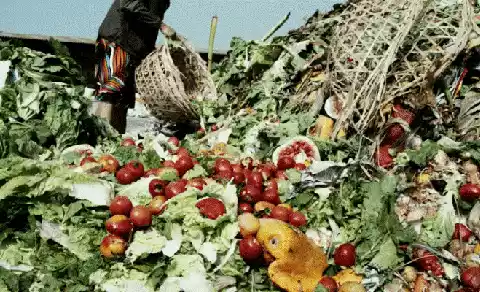
At dawn in Nigeria’s bustling markets, the promise of abundance arrives in baskets, ripe tomatoes, fresh peppers, leafy vegetables, and gleaming fish. By dusk, much of that promise is already slipping into decay. The same country battling food insecurity is quietly discarding millions of tonnes of food each year, a contradiction so stark it borders on policy failure.
Nigeria, with an estimated 38 million tonnes of food wasted annually, the highest in Africa, is not short on production. It is bleeding from systemic inefficiencies that turn harvest into loss, and opportunity into waste. This is even more tragic because a record near 35 million Nigerians are facing food insecurity,
This reality has triggered urgent calls for action from the European Union (EU), the Federal Government, and the United Nations Industrial Development Organisation (UNIDO), all pushing for a decisive shift toward sustainable consumption and production. Their warning is blunt: food waste is not just about what is thrown away; it is about the water, energy, labour, and capital lost alongside it, and the environmental damage that follows.
Deputy Ambassador of the EU Delegation to Nigeria and ECOWAS, Zissimos Vergos, did not mince words. Nigeria’s food waste crisis, he noted, is not just a national embarrassment but a global concern. With nearly one billion tonnes of food wasted globally in 2022, almost one-fifth of all food available to consumers, the scale of the problem is staggering. But Nigeria stands out, not for innovation, but for excess loss.
“This is not just a loss of food,” Vergos said. “It is a squandering of precious resources, a missed opportunity to combat hunger, and a direct threat to our planet’s health.”
The environmental implications are equally damning. Food loss and waste contribute up to 10 per cent of global greenhouse gas emissions, nearly five times that of the entire aviation sector, and account for as much as 40 per cent of global methane emissions.
Yet, within the crisis lies a paradoxical narrative of intent. According to Vergos, Nigeria is not entirely asleep at the wheel. The development of a circular economy roadmap, the establishment of an interministerial circular economy committee, and moves toward a National Plastic Waste Management Regulation signal structural ambition.
But ambition without execution is where Nigeria’s food system repeatedly collapses.
On the ground, far from policy rooms and diplomatic statements, the reality is far more brutal. In interviews with farmers, traders, and agribusiness experts, The Pointer got to know about what causes this food waste, the extent, consequences and how it can be tackled.
Farmers Produce, But the System Lets It Rot – Ikechukwu
Speaking, Lagos-based farmer and trader, Mr Chude Ikechukwu, offered a front-row account of the dysfunction. “The truth is that our preservation level is extremely low, and that is where the biggest problem lies. People talk about increasing food production, but what is the point if a large percentage of what we produce never even gets to the consumer in good condition?” he asked.
For Ikechukwu, food waste is not an abstract statistic; it is a daily spectacle. Markets like Ketu, Oyingbo, Owode in Offa, and Oro, he said, are ground zero for what he calls a “routine cycle of waste.”
“You will find heaps of tomatoes, peppers, and vegetables, already spoiling or completely wasted. Not because people don’t want to buy, but because the food has deteriorated before it even reaches the market stalls.”
The problem begins immediately after harvest. Without proper storage, farmers are forced into a race against time, selling quickly before their produce spoils. Then comes transportation, long hours on bad roads, under intense heat, without cooling systems. By the time goods arrive at markets, their value has already eroded.
The consequences are not just agricultural; they are economic and psychological.
“Imagine investing your time, money, and labour into farming, only to watch a large portion of your produce go to waste,” Ikechukwu said. “It discourages farmers.” His conclusion cuts through the noise: Nigeria does not have a production problem. It has a management problem.
We Waste What We Produce, Then Pay to Import It Back – Dako
Meanwhile, Aquaculture Business Specialist, Martha Queen Dako, expanded the lens beyond crops to include fisheries, where the stakes are equally high.
“Fish is highly perishable,” she explained. “Without proper preservation, losses can be massive.”
In many fish farming communities, post-harvest losses are a silent drain on productivity. Without cold storage or immediate market access, farmers are often forced to sell at distress prices to avoid total loss.
Dako identifies weak infrastructure and poor value chain integration as the core issues.
“In a functional system, excess produce should automatically flow into processing, smoking, freezing, and packaging. But that system is either weak or completely absent in many parts of Nigeria.”
The contradiction is glaring. Nigeria wastes raw materials while importing processed food products that it could easily produce locally.
“That is not just inefficient, it is economically unsound,” she said.
Her solution is straightforward but demands a mindset shift: agriculture must be treated as a full business ecosystem, not just production. Value addition, processing, packaging, and branding are the keys to extending shelf life and reducing waste.
“Government intervention must go beyond policy statements,” Dako insisted. “We need practical investments in cold chains, storage facilities, and agro-processing hubs.”
If done right, she argued, food waste could be converted into economic gain. If not, Nigeria will continue haemorrhaging resources at a scale it can no longer afford.
There are fewer than 1,000 Cold Trucks for 200m People – Soole
Perhaps the most incisive analysis comes from Olufemi Soole, a sustainable food system agricpreneur and master’s student in Agribusiness Innovation. His argument dismantled a common misconception.
“The food waste crisis in Nigeria is not a behavioural problem,” he said. “It’s an infrastructure deficit masquerading as one.”
Soole mapped the food value chain, from input supply to production, processing, storage, distribution, and final consumption, and identified post-harvest storage as the single biggest failure point. Estimates from industry sources suggest that between 30 and 40 million metric tonnes of food are lost due to post-harvest inefficiencies alone.
At the heart of this failure is the absence of a functional cold chain system.
“In Nigeria, we have fewer than 1,000 refrigerated trucks,” he noted, in a country of over 200 million people. The market potential is estimated at $160 billion, yet investment remains negligible.
Transportation is another choke point. Food produced in rural areas struggles to reach urban markets due to poor roads, limited rail infrastructure, and logistical inefficiencies. The result is a classic mismatch, surplus in production zones, scarcity in demand centres.
The human stories behind these failures are telling. Soole recounted the case of a strawberry producer in Jos who consistently runs at a loss because her produce cannot survive the journey to Lagos. Even air transport, when available, is unreliable and expensive.
Losses also occur at the farm level. Smallholder farmers often rely on open drying methods, exposing produce to contamination from insects, rodents, and environmental factors. The result is degraded quality and reduced market value.
Overlaying these structural issues is a deeper economic crisis. Food security is not just about availability; it is about access. With inflation eroding purchasing power, many Nigerians cannot afford the food that is available.
“Food is there,” Soole said. “But people cannot buy.”
For farmers, the situation is equally dire. Without storage or market power, they are forced to sell at distress prices. Buyers exploit this dynamic, waiting until evening when produce begins to spoil, then offering drastically reduced prices.
“You don’t have a choice,” Soole explained. “You either sell at a loss or lose everything.”
It is a system that punishes production and rewards opportunism.
Policy, in theory, should correct these imbalances. In practice, it often compounds them.
“In Nigeria, we create policies we don’t pursue,” Soole said, citing numerous agricultural and climate-smart initiatives that exist only on paper. Without infrastructure, funding, and enforcement mechanisms, these policies remain aspirational at best.
His recommendations are pragmatic and time-bound. Within five years, he argued, Nigeria could significantly reduce food waste through three non-negotiables: investment in cold chain infrastructure, modernisation of logistics systems, and deployment of technology.
“Technology is a core thing,” he said, pointing to the role of artificial intelligence in optimising storage and reducing post-harvest losses by up to 60 per cent.
Equally critical is policy execution, providing tax incentives for private investment in cold storage, offering grants to startups, and creating an enabling environment for scale.
But perhaps his most radical proposition is cultural.
“Every farmer should begin to see themselves as a CEO,” he said.
It is a call for a leadership mindset, one that moves farmers from subsistence to enterprise, from survival to strategy. Without that shift, he warns, the cycle of loss will persist.
The Way Forward
From an international viewpoint, Deputy Ambassador of the EU Delegation to Nigeria and ECOWAS, Zissimos Vergos, outlined three lessons that, if taken seriously, could redefine Nigeria’s food economy. First is the need for aggressive investment in rural infrastructure, roads, storage facilities, and cold chain systems, to fix what he described as the “last mile” problem.
Second is the integration of smallholder farmers into processing ecosystems, turning raw produce into value-added goods like tomato paste and cassava flour.
Third is cultural, embedding zero-waste principles into school curricula to shape a new generation that understands sustainability not as theory, but as practice.
The EU, he assured, is ready to support Nigeria through funding, technical cooperation, and “genuine solidarity.”
Nigeria’s Minister of Environment, Balarabe Lawal, echoed the urgency, framing food waste as a multidimensional crisis affecting the environment, economy, and society. Every wasted meal, he said, represents squandered resources, water, energy, labour, and capital, while millions of Nigerians continue to face food insecurity.
“Addressing food waste is central to sustainable development,” Lawal stated, pointing to ongoing projects targeting food waste elimination in major markets across the country. These initiatives, he explained, are designed to tackle post-harvest losses at their core.
On paper, the strategy aligns with global best practices. In reality, the results remain largely invisible.
Lawal emphasised that reducing food waste would lower pollution, conserve resources, and promote responsible consumption across households and institutions. It is a compelling argument. But in Nigeria, the gap between policy articulation and execution is where most good ideas go to die.
The Director of UNIDO’s Sub-Regional Office in Nigeria, Amb Philbert Johnson, took a broader view, situating food within the architecture of national stability.
“Food is far more than a commodity,” he said. “It is a foundation of wealth, a driver of health, and a pillar of security.”
When food systems work, they generate income, enhance resilience, and improve well-being. When they fail, the consequences ripple across economies and communities. In Nigeria, those ripples have become waves.
Johnson reaffirmed UNIDO’s commitment to supporting Nigeria in building resilient and inclusive agro-industrial systems. But even that commitment hinges on a critical variable Nigeria has historically struggled with: implementation discipline.
Nigeria’s food waste crisis is not a mystery. It is a management failure hiding in plain sight. The data is clear, the solutions are known, and the stakes are rising.
What remains uncertain is whether the country has the institutional will to move from rhetoric to results.
Until then, Nigeria will continue to perform the same tragic ritual, producing abundance, only to watch it rot.

