


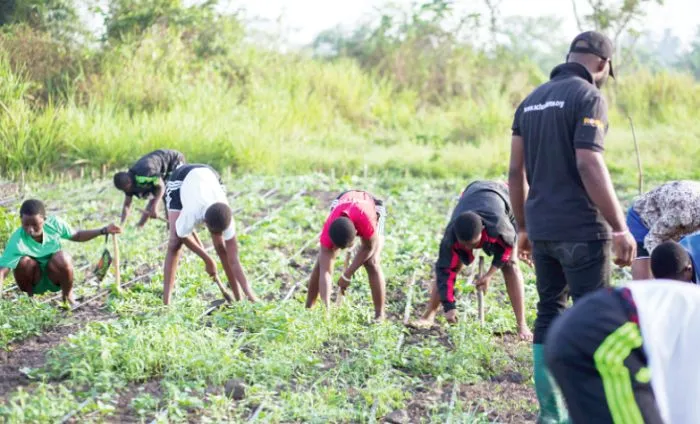
Encouraging, supporting and empowering Nigerian youths to engage in agriculture by governments at all levels is critical, not only to transforming the agricultural sector from its largely subsistence nature to a commercial, innovative and technology-driven industry but also ensuring sustainable food security.
Agriculture is described as the science, art and practice of cultivating the soil, growing crops and raising animals for food, fibre and other products used to sustain and enhance human life. Agriculture covers a wide range of activities, including planting, nurturing, harvesting, marketing of crops, breeding and management of livestock. There are different types of agriculture, including crop production (growing of plants for food, fuel, fibre and other uses), animal husbandry (breeding of livestock like cattle, sheep, pigs and poultry), horticulture (cultivation of garden crops), aquaculture (fish farming), and agroforestry (integration of trees and shrubs into agricultural landscapes).
Despite the centrality of agriculture to Nigeria’s economy, youth participation in this critical sector has remained low in comparison to the large youth population. It is rather surprising to note that despite the high rate of unemployment in the country and the potential of the agricultural sector to provide self-employment, many youths are not willing to engage in agriculture largely because they tend to perceive it as physically demanding, dirty, unappealing and low-paying. Studies have shown that only about 21.5 per cent of young Nigerians are engaged in the sector. Another survey highlighted that 79.5 per cent of Nigerian youths were not willing to participate in agriculture. Among the youths presently involved in agriculture, 70.97 per cent are in the fishery sub-sector, 58.06 per cent are in livestock, while 25.81 per cent are engaged in crop production.
Beyond these unappealing statistics, there are still a significant number of Nigerian youths who are enthusiastic about engaging in agriculture. This willingness is largely driven by high unemployment rates, the promise of income and the adoption of modern, tech-driven farming methods (agritech). This rising interest is mostly buoyed by the need for economic self-reliance, potential for perceived high returns on investment and different agriculture-related initiatives by the government and private bodies, offering support and training.
With a high unemployment rate, many Nigerian youths are beginning to view agriculture as a viable source of income and a way of becoming self-reliant. Reports indicate that 68.5 per cent of Nigerian youths, including graduates, are willing to participate in agriculture if provided with the necessary support like credit facilities, land, training and requisite technology. Nigerian youths are showing a strong interest in agriculture, especially in the face of a dearth of paid employment, and this enthusiasm is changing the face of farming across the country.
The introduction of smart farming initiatives, such as hydroponics (the technique of growing plants in sand, gravel or liquid, with added nutrients but without soil), which is making farming more attractive, efficient and less physically taxing, has also increased youth interest in agriculture.
Also, government programs like the Nigeria Youth Investment Fund (NYIF) and several initiatives by private organisations, which provide funding and training, have increased the interest of youths in agriculture-related businesses. Equally propelling youths’ interest in agriculture is the increased awareness of food insecurity in Nigeria. This development has prompted many young people to enter the agricultural sector, with a view to creating sustainable, local food systems. Above all, agriculture in Nigeria is being rebranded from a ‘’poor man’s job’’ to a huge business opportunity.
Undermining the increasing interest of youths in agriculture and agribusiness are several barriers, which include high capital requirements, difficulty in securing land, negative perceptions of farming as a dirty or non-lucrative business, inadequate training, poor infrastructure, limited technical skills and a social stigma that views farming as an occupation for the uneducated or elderly.
Agriculture is often perceived by many young Nigerians as a low-status, old-fashioned and physically demanding activity with minimal financial returns. Youths also face significant barriers in acquiring land, capital and credit facilities to start or expand agribusiness. Beyond these discouraging factors, Nigeria’s agricultural sector is largely plagued by low returns, high post-harvest losses and vulnerability to climate change, making it unattractive to other sectors.
The sector also lacks modernisation compared to other developing countries of the world. There is still a high reliance on manual, labour-intensive tools rather than modern, mechanised and technological solutions. This potentially discourages youths who are tech-savvy and want to venture into agriculture.
To be continued

