


BY RITA OYIBOKA
It was Pastor Emmanuel Adeboye, General Overseer of the Redeemed Christian Church of God, who once illustrated a powerful truth with a simple financial analogy: there is no counterfeit N2000 note because no original exists. Counterfeits, he explained, only appear where something valuable already commands trust.
In many ways, Nigeria’s civil society space mirrors that logic. Civil Society Organisations (CSOs) have long stood as watchdogs, advocates, service providers, and conscience-keepers of society. Yet, just as fake currency circulates alongside genuine notes, a few poorly governed organisations have weakened public confidence in a sector built largely on goodwill and voluntary service.
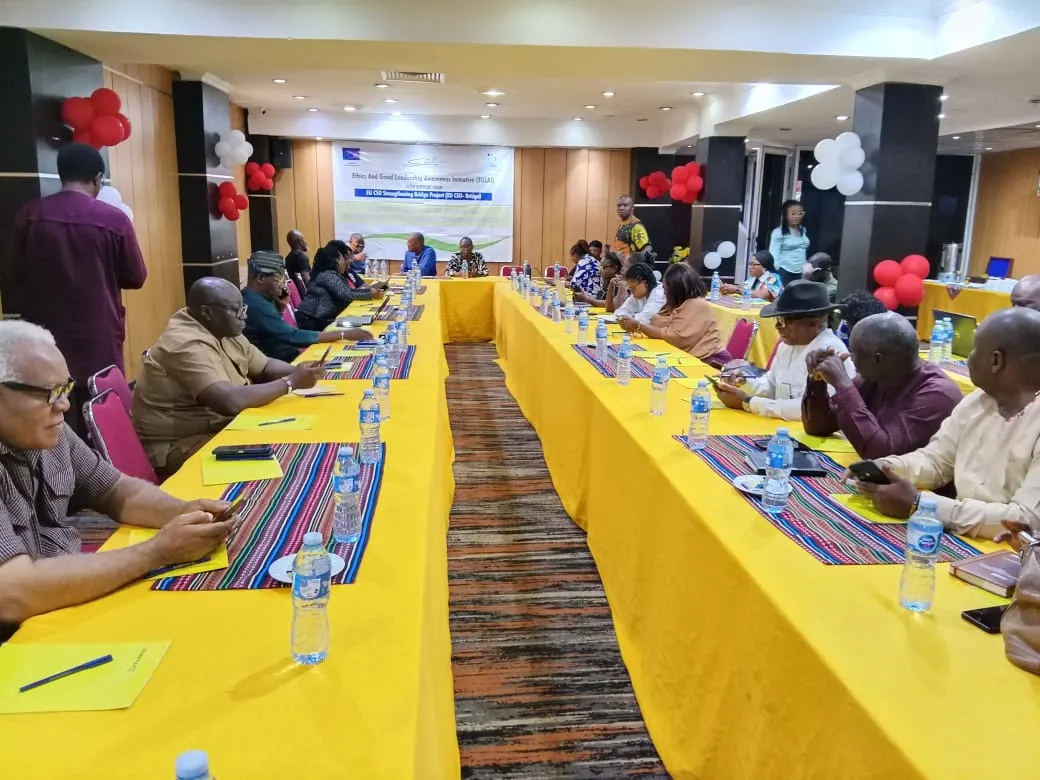
Recognising that credibility must be protected from within, civil society actors recently converged under the Ethics and Good Leadership Awareness Initiative (EGLAI) to take ownership of their standards, choosing self-regulation not as punishment but as preservation.
The gathering in Port Harcourt, Rivers State, was more than another workshop; it felt like a recalibration moment for Nigerian civil society. Supported by the European Union through the EU CSO Strengthening Bridge Project, the two-day capacity-building programme brought together CSO champions, subnational network leaders, journalists, Persons With Disabilities, and advocacy actors from across the South-South region.
At the centre of these conversations was EGLAI itself, a civil society initiative whose evolution dates back to engagements as far back as 2002 under the EU ART Project. According to the Team Lead of EGLAI in Nigeria, Mr Harry Udoh, the initiative was designed to reposition civil society through internal reforms rather than external enforcement.
He added that the initiative emerged from long-standing engagements dating back to 2002, when civil society organisations began confronting what he described as “regulatory overreach” that constrained civic operations. According to him, “there were all kinds of regulations that, rather than enhance the civic space, stifled it and constrained the operating environment for civil society organisations.”
Udoh noted that self-regulation became necessary as confidence in the sector declined among stakeholders and even within civil society itself. “Self-regulation is about putting in place principles, precepts, and mechanisms through which organisations discipline themselves and operate in ways that give comfort and confidence to regulators, partners, donors, rights holders, and the communities we serve,” he stated.
He further explained that the framework aims to sustain collaboration and establish legitimacy across the sector by ensuring shared operational standards. “Confidence in the sector was eroding; there was a growing trust deficit, and self-regulation is intended to restore and deepen that trust,” he added.
Tracing the programme’s progress nationwide, Udoh said the Port Harcourt training represented the fifth regional engagement under a structured rollout strategy. “We adopted a regional approach. We started in the South-East in Enugu, moved to Kano for the North-West, then Lagos for the South-West, and recently Yola for the North-East,” he said.
He explained that participants were expected to return to their states to cascade knowledge and scale adoption of the framework. “The grand finale of this phase will take place in Abuja on March 10 and 11, bringing together CSO champions, the Cooperative Federation of Nigeria, and media organisations,” he disclosed.
Udoh also highlighted regulatory challenges confronting organisations at subnational levels, describing the current system as fragmented and burdensome. “Organisations often have to register separately with multiple ministries depending on their sector of work, and these registrations appear largely revenue-driven rather than regulatory,” he said.
He added that six pilot states had been identified to harmonise registration processes, while eleven others had already expressed interest through peer learning initiatives. According to him, the long-term goal is to create a regulatory environment that enables civil society to operate effectively without unnecessary bureaucratic barriers.
Sessions emphasised that CSOs operate within statutory legal frameworks, yet legal compliance alone is no longer sufficient. Increasingly, legitimacy depends on voluntary adherence to higher standards of transparency, governance, and ethical conduct. Self-regulation, therefore, was presented not as an alternative to law but as an enhancement, a proactive demonstration that the sector can govern itself responsibly.
Participants were introduced to hybrid self-regulation modalities designed specifically for Nigerian nonprofits. These included working groups to coordinate compliance efforts, codes of conduct guiding ethical behaviour, information-sharing systems, and structured self-assessment tools allowing organisations to evaluate their own governance and performance. The hybrid model reflects a balance between autonomy and accountability, ensuring flexibility while maintaining measurable standards.
Facilitators stressed why self-regulation matters at this critical moment. Public trust, they argued, is the currency of civil society. Without credibility, advocacy loses moral authority, and service delivery loses legitimacy. By voluntarily committing to standards, organisations protect civic space, reduce justification for restrictive government policies, improve programme effectiveness, and strengthen donor confidence. Just as importantly, peer learning within the sector encourages continuous improvement rather than defensive compliance.
Delivering further insights during the training, Udoh stressed the broader democratic value of civil society organisations. “Civil Society Organisations play a critical role in democratic governance, service delivery, social accountability, and citizen engagement,” he said.
He warned, however, that civic space was facing increasing pressure due to overlapping regulations, weak institutional coordination, and political interference. “Subnational CSOs face unique compliance challenges arising from overlapping regulatory regimes and limited internal governance capacity,” he added, noting that self-regulation would help organisations strengthen internal systems while maintaining operational independence.
The training also unpacked Nigeria’s Minimum Standards of Operation for CSOs, which outline governance expectations and operational benchmarks. Organisations were encouraged to establish governance plans aligned with their mission and cultural values, clearly define leadership structures through accessible governing documents, and maintain voluntary principles at their core.
Volunteerism, participants learned, remains the lifeblood of civil society, extending from programme implementation to unpaid governing boards that serve out of commitment rather than financial reward.
Further sessions addressed programme effectiveness, urging organisations to ensure activities remain consistent with their stated missions while incorporating stakeholder feedback and periodic evaluations. Facilitators emphasised professionalism, transparency, and honest assessment of programme outcomes, costs, and community impact, practices seen as essential to restoring credibility.
Beyond lectures, the training thrived on participation. Breakout sessions allowed attendees to analyse real compliance challenges faced at subnational levels, particularly fragmented registration requirements that often compel organisations to register separately with multiple ministries depending on their thematic focus.
Udoh described many of these processes as revenue-driven rather than regulatory, noting plans to pilot harmonised registration systems in six states, with 11 others already expressing interest through peer learning initiatives.
In an interview, Coordinator of the Forum of Delta State NGOs, Deacon Okwezi Odugala, described self-regulation as a necessary evolution for the sector. “We believe in self-regulation, but that is not to say that we do not conform to the constitution of our country as law-abiding citizens,” he said. He emphasised that the openness of the civil society space requires stronger internal accountability measures.
“The sector is open, anybody can participate, but we must operate credibly, with accountability and transparency. What we are doing now is conducting an in-house self-audit and creating standards that can make the sector sustainable,” he explained.
Speaking on the expected impact of the training, Odugala said continuous learning and retraining were essential for strengthening institutional credibility. “The training is meant to equip us because we learn every day. Trainings like this have brought together state leaders of civil society organisations and selected actors, including the media,” he noted.
He added that participants would return to their communities to promote awareness and adoption of self-regulation. “When we return to our respective states, we will open this process to our members so that everyone can subscribe to self-regulation,” he said.
Odugala further stressed that civil society actors must lead by example if they intend to hold government and private institutions accountable. “If you want to act as a watchdog over government or the private sector, you must first ask yourself whether you are exemplary,” he stated.
He warned against poor accountability practices within the sector, adding, “Are you a civil society organisation that cannot account for funds given by donors? This is a sector meant for people who truly understand their responsibilities.” According to him, the initiative aims to establish and uphold best-practice standards capable of restoring credibility across the sector.
Participants echoed similar sentiments. Journalist Ifunanya Obeme described gaining clarity about the distinctions and overlaps between NGOs and broader civil society structures, as well as practical guidance on ethical participation and sustainable funding practices. The training, she noted, reshaped her understanding of how individuals and organisations can regulate themselves to maintain integrity and attract legitimate partnerships.
Executive Director of Wave of Growth Foundation, Ekenem Omosor, also praised the programme, highlighting lessons on compliance, operational safety, and governance systems. Despite the intensity of the sessions, participants frequently described the experience as energising, crediting the organisers and EU partners for creating a space where difficult conversations could occur without defensiveness.
Speakers repeatedly urged government authorities to avoid choking civil society through excessive regulations, arguing instead for an enabling environment that recognises CSOs as development partners. The consensus emerging from the training was clear: sustainable civic space depends on mutual trust, government trusting civil society to operate responsibly, and civil society demonstrating that trustworthiness through transparent self-governance.
Like Pastor Adeboye’s analogy of currency, the existence of counterfeits does not invalidate the original; it simply demands vigilance. The Port Harcourt gathering signalled a sector willing to inspect its own notes before presenting them to the public.
The way forward now is ensuring that through self-regulation, transparency, and collective responsibility, the genuine value of that currency continues to circulate freely, trusted by citizens, respected by partners, and supported rather than strangled by government regulation.

