


BY RITA OYIBOKA
The need to scale the adoption of self-regulation among Civil Society Organisations (CSOs) in Nigeria has been emphasised as a critical pathway toward strengthening accountability, restoring public trust, and safeguarding civic space.
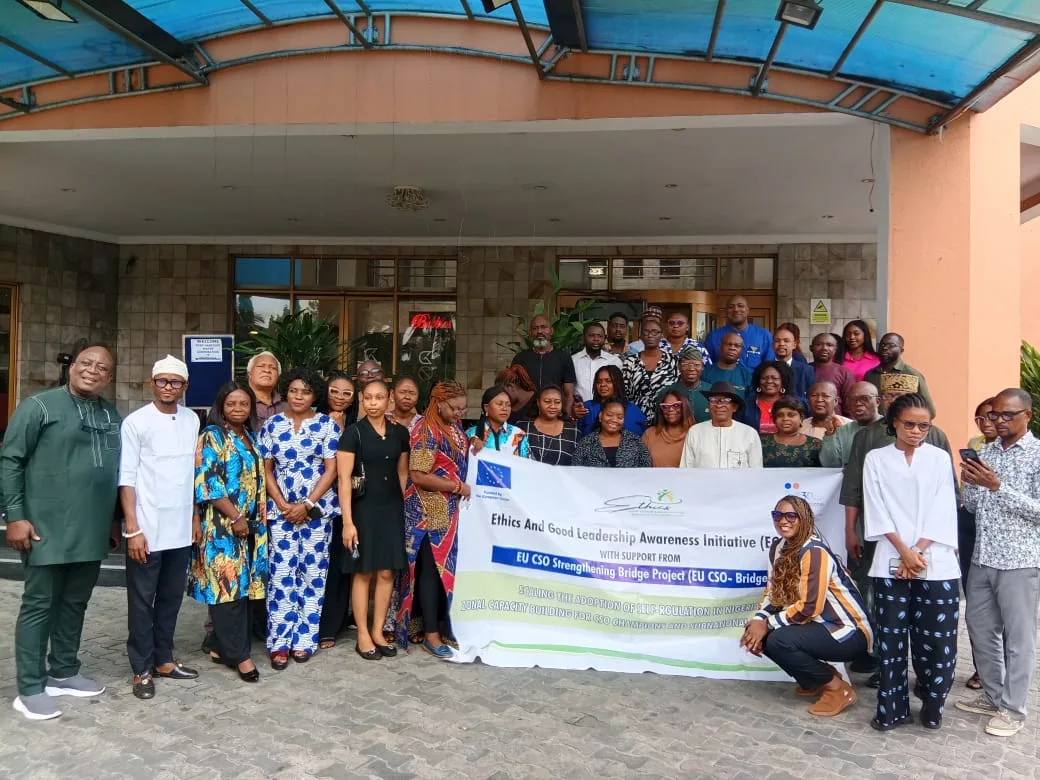
This formed the focus of a two-day capacity-building programme for CSO champions and subnational network leads organised by the Ethics and Good Leadership Awareness Initiative (EGLAI), with support from the European Union (EU) CSO Strengthening Bridge Project, held in Port Harcourt, Rivers State.
The training convened civil society actors, Persons With Disabilities (PWDs), journalists, and other stakeholders across the South-South region to deepen understanding of self-regulatory mechanisms within the sector.
Participants were equipped with tools aimed at improving transparency, compliance, and operational credibility among non-profit organisations.
Speaking at the programme, Team Lead of EGLAI in Nigeria, Mr Harry Udoh, explained that the initiative was designed to reposition civil society through internal reforms rather than external enforcement.
Udoh noted that self-regulation became necessary as confidence in the sector declined among stakeholders and even within civil society itself. “Self-regulation is about putting in place principles, precepts, and mechanisms through which organisations discipline themselves and operate in ways that give comfort and confidence to regulators, partners, donors, rights holders, and the communities we serve,” he said.
He further explained that the framework aims to sustain collaboration and establish legitimacy across the sector by ensuring shared operational standards. “Confidence in the sector was eroding; there was a growing trust deficit, and self-regulation is intended to restore and deepen that trust,” he added.
In an interview, Coordinator of the Forum of Delta State NGOs, Dcn Okwezi Odugala, described self-regulation as a necessary evolution for the sector. “We believe in self-regulation, but that is not to say that we do not conform to the constitution of our country as law-abiding citizens,” he said.
Odugala emphasised that the openness of the civil society space requires stronger internal accountability measures. “The sector is open, anybody can participate, but we must operate credibly, with accountability and transparency. What we are doing now is conducting an in-house self-audit and creating standards that can make the sector sustainable,” he explained.
Speaking on the expected impact of the training, Odugala said continuous learning and retraining were essential for strengthening institutional credibility. “The training is meant to equip us because we learn every day. Trainings like this have brought together state leaders of civil society organisations and selected actors, including the media,” he noted.
He added that participants would return to their communities to promote awareness and adoption of self-regulation. “When we return to our respective states, we will open this process to our members so that everyone can subscribe to self-regulation,” he said.
Odugala further stressed that civil society actors must lead by example if they intend to hold government and private institutions accountable.
The programme featured sessions on the evolution and mandate of EGLAI, understanding CSO operational realities in Nigeria, self-regulation modalities and mechanisms, reporting and accountability frameworks, civic space dynamics, and compliance challenges at the subnational level.
Participants were also trained on implementing self-assessment tools designed to strengthen organisational governance and transparency. Delivering further insights during the training, Udoh stressed the broader democratic value of civil society organisations. “Civil Society Organisations play a critical role in democratic governance, service delivery, social accountability, and citizen engagement,” he said.
He warned, however, that civic space was facing increasing pressure due to overlapping regulations, weak institutional coordination, and political interference. “Subnational CSOs face unique compliance challenges arising from overlapping regulatory regimes and limited internal governance capacity,” he added, noting that self-regulation would help organisations strengthen internal systems while maintaining operational independence.
Speakers urged government authorities to avoid choking civil society with excessive regulations, instead creating an enabling environment that allows organisations to thrive while maintaining accountability standards.
Participants who spoke after the training, including journalist Ifunanya Obeme and the Executive Director of Wave of Growth Foundation, Ekenem Omosor, noted that the programme had provided practical strategies for improving internal governance and strengthening collaboration within the sector. They expressed optimism that wider adoption of self-regulation would enhance public confidence in civil society organisations and reinforce their role as partners in Nigeria’s social and economic development.

