


BY OGORAMAKA AMOS/RITA OYIBOKA/JUDITH OBIANUA
Omor paced the length of the quiet hospital hallway, his footsteps echoing faintly against the sterile walls. At the far end stood a short, pleated Christmas tree, its artificial branches wrapped in flickering red and yellow lights that blinked with stubborn cheerfulness. He hissed under his breath. ‘’What business does a Christmas tree have here?’’ he wondered, watching a uniformed woman clutching a stack of files disappear around a bend.
Around him, other stranded relatives occupied the plastic chairs lining the corridor. Some were slouched, half-asleep, exhaustion weighing down their eyelids; others were lost in the glow of their phones, scrolling endlessly as though time itself could be outrun. No one spoke. The air hung heavy with waiting, as the fans squeaked sluggishly.
Outside the hospital, the city had erupted into merriment. Firecrackers cracked and boomed in the distance, tearing through the night like sudden gunfire. The usually subdued streets were alive—youngsters sped through the roads in saloon cars, music blasting, laughter spilling into the air, the madness of celebration swallowing all restraint. Christmas had arrived in full force.
But Omor stood apart from it all
His own plans for the day, so carefully imagined, had melted away like ice beneath a harsh Harmattan sun. He had envisioned a different Christmas: church in the morning, warm handshakes and familiar hymns; laughter with friends later in the day; the comforting indulgence of fried rice and chicken, or perhaps the luxury of uninterrupted sleep. Simple pleasures. Ordinary dreams.
Instead, he was here—marooned in a hospital on a day meant for joy, counting minutes rather than blessings. The festive season had gone on without him, indifferent to his disappointment. As he leaned against the wall, staring once more at the blinking tree, Omor realised that this Christmas did not belong to him. It belonged to the city outside, to the laughter and fireworks, to everyone else. All he could do now was wait—and hope that another festive season would find him elsewhere.
For many, Christmas is synonymous with joy, family reunions, laughter, carols, and plates filled with rice, chicken and laughter. Streets are usually alive with music, churches overflow with thanksgiving worshippers, and homes echo with warmth and celebration. But beneath the glittering lights and festive decorations, Christmas can also be a season of pain, waiting, anxiety and quiet endurance.
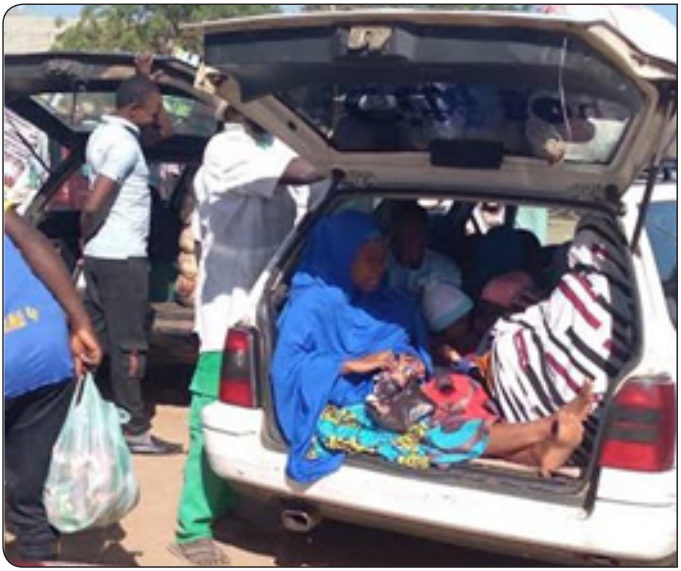
In Port Harcourt, the Rivers State capital, not everyone woke up to the warmth of celebration this Christmas. While some families gathered around dining tables, others found themselves stuck in gridlocked traffic, confined to hospital beds, stranded far from home, or battling personal losses and economic hardship.
Christmas in Traffic: “We Slept on the Road”
For 42-year-old Chinedu Okorie, a commercial bus driver plying the Port Harcourt–Enugu route, Christmas Day was spent inside a bus trapped in traffic. “I left Mile 3 by 7 a.m. on Christmas Eve, thinking I would reach Enugu before Nightfall so that I could get back on time to spend Christmas with my family,” he said. “But when we got to Owerri, everywhere was blocked with heavy-duty trucks, broken-down vehicles, and impatient drivers, everything combined.”
Passengers, including women and children, were stranded. “Some people were crying. One woman had a small baby. By midnight, some of us slept inside the bus. No Christmas rice, no family, just hunger and frustration. It didn’t feel like Christmas at all because I couldn’t be with my family. But I thank God we are alive. That alone is something to celebrate.”
At the University of Port Harcourt Teaching Hospital (UPTH), Christmas came quietly for Mrs Blessing Tamuno, a 35-year-old mother of three recovering from surgery. “I had plans to cook and welcome my extended family,” she said, “Instead, I am here, staring at the ceiling.”
Blessing was rushed to the hospital a few days before Christmas after severe abdominal pain. Surgery followed immediately. “When my children came to visit me on Christmas morning, they tried to smile, but I could see fear in their eyes,” she said, fighting back tears. “My youngest asked me, ‘Mummy, when are we going home for Christmas?’ That broke me.”
“I am alive. Some people did not even make it to see this Christmas. So I choose gratitude over sadness.”
A Nurse on Duty While the World Celebrates
For frontline health workers, Christmas is often just another workday. Nurse Ifunanya Eze, who works at a private hospital in GRA, Port Harcourt, spent her Christmas attending to emergency patients. “While people were sharing pictures of food and family online, I was checking blood pressure and inserting drips,” she said.
Though accustomed to festive duty, this year felt heavier. She added, Being away from my family was painful; this is the second time I haven’t been home for Christmas. The truth is, I really needed this Christmas holiday to rest and unwind. My parents kept calling, asking when I would come. But this is the sacrifice we make. I don’t have any other choice, when I saw my name on the roster that I am on duty on Christmas Day, it broke me badly. For us, it is about service.”
For Mrs Comfort Wokoma, Christmas used to be her husband’s favourite season. This year marked her first Christmas without him. “My husband died in June,” she said quietly in her home. “Since then, life has changed.”
“Instead of hosting guests and going on family outings, my home remained silent. I didn’t cook much. No strength. The memories were too loud, my kids have been dull, Christmas isn’t the same without my husband,” she said.
What made it more painful was watching neighbours celebrate. “You hear laughter from other houses, and you wonder how to survive your own pain.”
Still, she found comfort in faith. “I went to church and prayed. God is my only hope now.”
In an interview with an Agbor–based baker and event decorator in Ika South Local Government Area of Delta State, Ms Praise Emegha, this Christmas season has been one of frustration and emotional strain, as rising travel costs left her stranded far from her loved ones in Abuja, unable to enjoy the rest and reunion she had planned.
According to her, “I usually use Christmas to rest and recover from the stress of the entire year. My work is demanding, it’s back-to-back jobs, long hours, and physical stress. Christmas vacation is my gift to myself for the stress.”
She explained that travelling to Abuja to spend time with loved ones had become a personal tradition and a source of emotional balance after an exhausting year.
Emegha said, “Last year, I travelled for Christmas, and it really helped me. I rested, spent quality time with people I love, and came back mentally refreshed. That was the plan again this year. However, finance is low, expenses are high, and everything has increased. From food to transportation, nothing is the same again.”
She identified the sharp rise in flight ticket prices as the major barrier that stranded her in Asaba, cutting her off from Abuja, where her loved ones were waiting.
According to her, “Last year, a flight from Asaba International Airport to Nnamdi Azikiwe International Airport in Abuja was about ₦130,000. This year, the same flight is ₦270,000. That is too much. It’s more than double.
“For someone running a small business, that kind of increase is not realistic. In 2026, I have rent to pay, I need to restock many of my baking items, and handle other personal responsibilities. I can’t justify spending that much just to rest, and travelling by road in this period is a no-no for me.”
Instead of travelling to her preferred destination, Ms Emegha said she had to retreat to the village, a decision she described as a last resort.
According to a respondent simply identified as Omor, who spoke with our correspondent in Asaba, ‘’Christmas this year is something we should be grateful to God for; that we are alive to celebrate even with the difficult situation, because there is a high rate of death this year coupled with the economic situation in the country that is not stable.
‘’My mother is the reason we are in the hospital. She has been booked for surgery. As the doctors said, she might not survive; her chance of survival is 50-50. As you can see, we are celebrating Christmas here. The most important thing is that we are alive to witness this special day, the birth of our Lord Jesus. It does not matter where one celebrates Christmas, but knowing the reason for the celebration is what matters.
‘’The Bible tells us, in every situation we find ourselves, we should give glory to God. I am grateful to him and praying for a better and more prosperous new year. This experience is not a good one at all. Seeing your loved one lying on the bed just like that, not dead but unable to move, you have to clean her up, feed her, and give her drugs as if you are nursing a baby. It is not a thing of joy at all.
‘’Health is wealth, they say. If you are healthy today, appreciate God. I know how much we spend every day to keep her alive. This is the worst experience ever, but I am still grateful to God’’ Omor said.
Another respondent, Mr Amos Akalue, lamented the traffic gridlock before Christmas Day. As he puts it, ‘’before Christmas, the traffic used to be so hectic, cars were stuck at a spot even on the flyover by the Koka Junction. But the Federal Road Safety Corps came and controlled the traffic, and cars began to move slowly. We are no longer stuck in a spot. If not for the intervention of Road Safety, who deployed their men to control the traffic, it would have been so bad this period.
‘’The road is busy because people are travelling back home for the festive season. Those of us living across the expressway barely drive out in our cars whenever we are going out due to the traffic jam. We would rather park the car at home and use public transport; that was how bad the situation was back then, but now I can drive out at ease, and the road is clear. At first, I was thinking of how this year’s Christmas was going to be, with the traffic, but to God be the glory, the celebration was peaceful and quiet. I am looking forward to the New Year’’ he said.
And so, Christmas came and went—quietly for some, loudly for others. Yet its passing did not signal the end of celebrating Christ’s birth, nor did it diminish the essence of the season. Christmas is not a single date circled on the calendar; it is a recurring prompt, returning year after year as it has done for ages past and will continue to do for as long as life tarries.
For those who missed this edition, not out of conviction, nor from any deliberate religious stance, but simply because circumstance intervened, there will be other opportunities. Time, in its mercy, offers repeats. There will be other Decembers, other carols, other tables set with food and laughter. Celebration, after all, is not lost forever; it is only deferred.
And perhaps, when it comes again, it will be embraced with deeper gratitude and greater restraint. For the essence of Christmas is not in fireworks or fleeting merriment, but in reflection, compassion, and hope. In celebrating rationally, we rediscover meaning beyond excess—finding joy not in how loudly we celebrate, but in why we do.
Thus, Christmas does not abandon those it seemed to pass by. It waits patiently, returning in its appointed season, offering yet another chance to rejoice, to remember, and to give thanks.
Omor watched as the nurses wheeled the woman into one of the wards, a baby’s cry rising sharply and drowning out the soft Christmas tunes drifting from the tree. This time, Omor sighed. ‘’Perhaps a Christmas tree has its place everywhere, he thought.

