


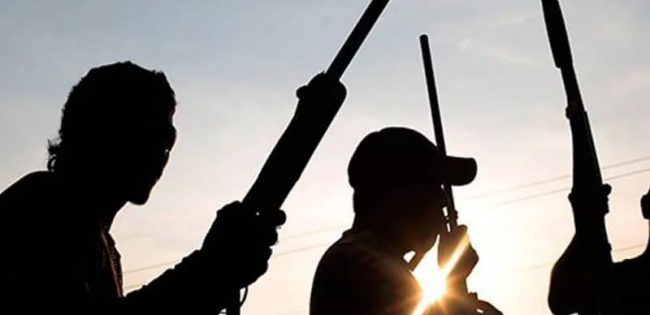
NIGERIA is inching toward a full-blown national security breakdown, and the evidence is no longer scattered; it is overwhelming. The November 18 attack on Christ Apostolic Church (CAC) in Eruku, Kwara State, is evidence that no part of the country is insulated from violent extremism. Recall that gunmen stormed the evening service of the Church, opening fire on worshippers and abducting 38 congregants, including the pastor.
This incident did not happen in a vacuum. Kwara, and other cities, once considered relatively stable, have been grappling with surging violence. Although all abducted worshippers were released by November 25, the protests that followed were telling. People are frustrated. People are afraid. And, more importantly, people no longer trust the system meant to protect them. Earlier attacks in August and October in Kwara left at least five residents dead and displaced thousands.
If the Church attack highlighted civilian vulnerability, the killing of Brigadier General Musa Uba revealed something even more alarming: the Nigerian military itself is under siege. Between November 16 and 18, the senior commander was ambushed, captured, and executed by Islamic State West Africa Province (ISWAP).
His death, confirmed by President Bola Tinubu, marks only the second time since 2021 that such a high-ranking officer has been killed by terrorists.
And the bleeding did not stop there. Days later, a senior officer was killed in Katsina on November 21, followed by the murder of five more in Bauchi on November 23. These repeated ambushes reveal structural weaknesses: compromised intelligence, inadequate reconnaissance, and suspicions of internal sabotage.
While the military battles insurgents, bandits continue targeting the nation’s most vulnerable: schoolgirls. Between November 16 and 18, 24–25 girls were abducted from the Government Girls Comprehensive Secondary School in Kebbi State. More than 300 pupils were also abducted from a Catholic school in central Niger State. Thankfully, some escaped. Yet their ordeal mirrors an ugly pattern.
Since the Chibok girls’ kidnappings in 2014, over 1,799 students have been abducted in major attacks. Boarding schools, especially girls’ schools, remain soft targets despite years of warnings, government promises, and recurring tragedies.
Victims of school abductions often suffer lifelong emotional scars. Many experience sexual violence, forced marriages, and pregnancies. These are not just crimes; they are violations of national conscience.
In recent times, there have been pockets of kidnapping for ransom, especially in the Kogi State axis. The bandits have intensified their onslaught as victims affected directly or indirectly, continue to lick their wounds.
Nigeria cannot continue on this trajectory. Our internal security architecture is overstretched, outdated, and misaligned with modern threats. There is no shame in seeking external assistance, whether in intelligence-sharing, drone technology, or operational support. National pride cannot trump national survival, and it is even more weakening that Military insiders themselves have hinted at the possibility of informants leaking troop movements to terrorist networks. If true, this is not just a security failure; it is institutional rot.
What is needed now is a decisive pivot. First, all boarding schools, especially girls’ schools, require permanent, armed security detachments. Not ad-hoc patrols. Not emergency deployments. Dedicated units supported by surveillance technology and rapid-response capability.
Second, the military must initiate a full-spectrum counterintelligence audit. Insider sabotage is a force multiplier for terrorists. Any officer or civilian collaborator found complicit must face swift, public prosecution.
Finally, the presidency must lead from the front. President Bola Tinubu’s recent declaration of a national security emergency and his directive to recruit 20,000 new police officers is a long-overdue operational reset. But it must not end as another headline-generating initiative with poor execution. The recruits must be properly trained, adequately equipped, and deployed strategically, not absorbed into bureaucratic inertia or politicised duties. Scaling the police force without reforming command efficiency, intelligence capability, and accountability frameworks will simply expand an under-performing system.
Nigeria’s citizens are facing systematic, sustained assaults from non-state actors. They are not asking for miracles; they are demanding the basic right to live, learn, worship, and travel without fear. It’s time for the government to prove that national security is more than a talking point. It must become the national priority.

