


One thing that has always unsettled me in modern-day churches is those large cameras that sweep across the congregation and project people’s faces onto giant screens. I have often wondered what my own face would look like if it ever appeared there. Watching others on those screens has always been a curious experience.
Some people smile shyly when they realise they are on camera, some quickly look away, while others suddenly become very serious, almost as if they are aware they are now part of a public moment.
Eventually, one Sunday, my face did appear. What was on it was pure shock, simple, unfiltered shock. I did not even recognise my own expression. Before I could fully process that the startled face staring back from the screen was mine, the camera had already moved on. The moment was brief, but it left me thinking about something deeper: how much the presence of a camera changes behaviour.
Many people have quietly voiced discomfort about cameras in churches. Worship, which is supposed to be intimate and personal, suddenly feels like a stage performance. People become conscious of their posture, their facial expressions, even how passionately they worship. Some temper down their emotions; others seem to amplify them. The camera, whether intentionally or not, introduces an audience.
That uneasy thought brings us to a more recent situation that has sparked conversation across the internet: the viral deliverance video involving Nollywood actress turned evangelist Tonto Dikeh.
Over the past few months, Tonto Dikeh has publicly embraced a dramatic spiritual shift. Once known for her bold “King Tonto” persona and headline-making controversies, especially “40 seconds man”, she recently announced that she would no longer use that nickname. Instead, she asked to be addressed as “Evangelist Tonto Dikeh”, “Woman of God”, or simply “Auntie Tonto”.
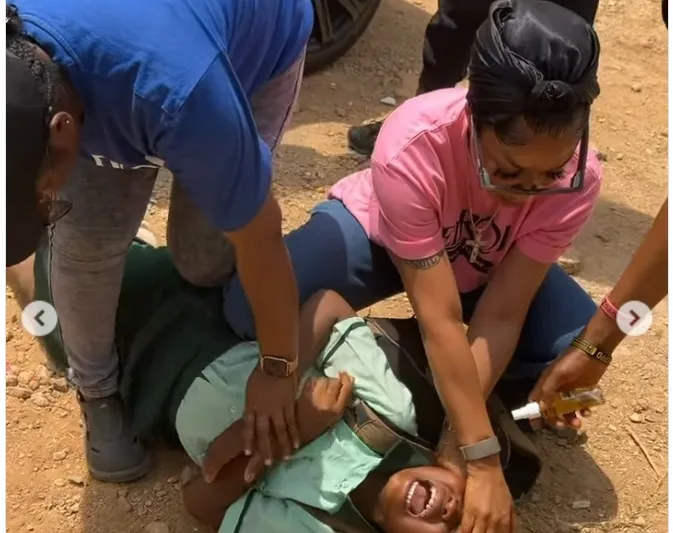
Her social media pages have since been filled with videos of prayers, church volunteering, and spiritual reflections. But on March 6, 2026, something new happened, something that instantly caught the attention of the internet. During an evangelism outreach at a public secondary school in Abuja, she and her team conducted what she described as a deliverance session for a female student whom she believed was under a “spirit of death”.
The moment was intense. Tonto laid hands on the girl, prayed in tongues, and commanded the spirit to leave. The student, pinned down by several hands, appeared shaken and visibly reacting during the prayer. The entire event was filmed and later posted online by Tonto herself, who described it as the beginning of God’s work in her ministry and promised to continue following up with the girl spiritually.
Within hours, the video spread across social media like wildfire.
The reactions were sharply divided. Some Christians applauded her openly. For them, it was a powerful testimony, proof that God can transform anyone and use them for His work. To these supporters, the same woman who once lived loudly in the world is now living just as loudly for Christ.
But others were far less convinced.
Critics questioned the ethics of filming such a moment, especially because a minor was involved. Actress Doris Ogala reportedly called for an investigation and raised concerns about whether the girl’s parents had given consent for the video to be shared publicly. Meanwhile, social media commentator VeryDarkMan strongly condemned the act, accusing Tonto of staging “fake miracles” and warning her not to involve vulnerable children.
Beyond the specific arguments for or against Tonto, the incident has opened a broader conversation about faith, performance, and the power of the camera.
One only needs to look at certain patterns in modern Pentecostal spaces. Pastors wave their hands, and entire rows of congregants fall backwards. Dramatic testimonies emerge, stories of marine spirits, generational curses, mysterious enemies. Sometimes the accounts are shocking, sometimes they are strange, and occasionally they are unintentionally funny.
Why do these things happen so often in front of cameras?
One reason is simple: visibility. In the digital age, churches no longer compete only within neighbourhoods; they compete online. Viral moments attract attention. Attention brings followers. Followers bring influence, and influence can eventually bring resources.
Once cameras and money enter any environment, whether politics, entertainment, or religion, the ecosystem changes.
That does not automatically mean everything becomes fake. But it does mean the incentives shift. Dramatic moments travel faster online than quiet ones. A spectacular deliverance clip will always generate more engagement than a silent prayer in the corner.
And so, sometimes consciously, sometimes unconsciously, religious experiences begin to move in the direction of what is most watchable.
This is where the discomfort many people feel begins to make sense. Worship was traditionally understood as something deeply personal, something between the believer and God. Yet in the age of livestreams, LED screens, and viral clips, even the most intimate spiritual moments can suddenly become public content.
It raises uncomfortable questions. Why does Tonto Dikeh so often pray in front of a camera? Did Jesus not warn that acts of giving, fasting, and worship should be done quietly, away from the applause of men, lest the reward come from people rather than from God?
But the conversation is not so straightforward. If the internet is flooded daily with vice, vanity, and excess, should faith completely retreat from that same space?
This tension becomes even clearer when one looks at the phenomenal rise of Jerry Eze and his now-famous prayer platform, New Season Prophetic Prayers and Declarations. What began as a daily online prayer meeting has grown into one of the most-watched religious broadcasts in Africa. Millions tune in each morning, testifying to healings, breakthroughs, and renewed faith. At the same time, the platform has elevated its founder into one of Nigeria’s most influential and financially successful digital ministers.
For supporters, this is evangelism evolving with the times. Just as missionaries once used radio and television to spread the gospel, livestreams now serve as the modern pulpit. Which raises a fascinating thought experiment: if Jesus were physically present in the 21st century, would he livestream his sermons? Would the Sermon on the Mount appear on YouTube or TikTok? Or would he still retreat to quiet hillsides, speaking to crowds without cameras, unconcerned about algorithms, followers, or trending hashtags?
No one (at least not me) can answer that question with certainty, and none of these questions has easy answers.
Faith itself has always been expressive. In African Pentecostal culture, especially, loud prayers, dramatic declarations, and emotional worship are not unusual. They have existed long before social media arrived. But the presence of cameras has undeniably added another layer to the experience.
A worshipper might now wonder: How do I look on screen? A preacher might wonder: Will this moment go viral? And viewers online might wonder: Is this genuine, or is it theatre?
The truth probably sits somewhere in between. I guess at the end of the day, we all have to ask ourselves, when the camera comes on, who is our audience, God or the world?

