


BY RITA OYIBOKA
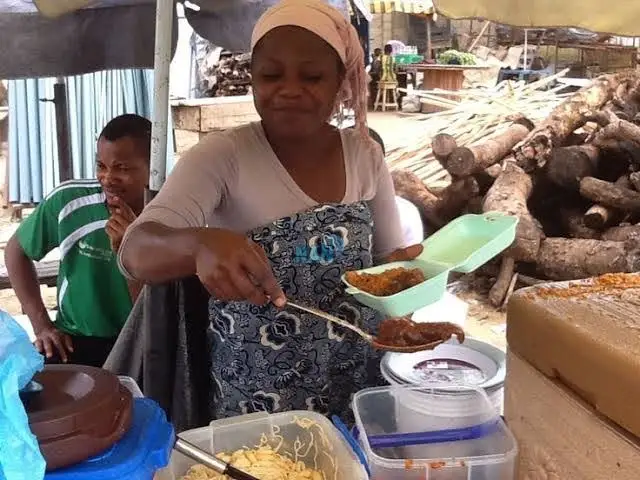
“One kpomo. Two shaki.” “Give me swallow. Two fufu and one meat.” “Put Rice. Plantain dey?” This is the daily life of Mrs Juliana Ezenkwu, who runs a small food business (popularly known as buka in local palance) in Okpanam Town, Oshimili North Local Government Area, Delta State.
According to her, the food business has both thrived and suffered due to the increasing cost of cooking. However, before talking about the food business and its patrons, especially in Asaba. We must explore why people buy food.
As early as 8 am, anyone using the road must encounter people having breakfast on the streets. Whether it be the patrons of the akara seller standing beside the flaming hot oil while squeezing soft bread as they wait and sometimes struggle for steaming bean cakes, or the labourers (daily workers) with their shovels resting calmly beside their legs while they load up on fufu and maybe rice, depending on the person. This food will get them set for the day, just like a commercial bus stops by a fueling station before embarking on a journey.
But the morning bustle is only the surface of a much deeper social reality. Nigeria has gradually become a country where eating outside one’s home is not a luxury; it is a survival strategy and economic necessity. Whether you are buying buka food or puff puff and soft drinks, the average Nigerian household is no longer structured around the traditional model where one major shopping trip and twice-daily home-cooked meals were a staple of life. The new system is fragmented, improvised, and largely dependent on street food economies.
And if you think it is just those who are in a hurry to get to work or don’t have time to cook in the mornings who buy food, you would be wrong. The food retail culture has evolved beyond convenience; it is now embedded in the everyday routine of Nigerians across age brackets and income levels. From students living in lodges to young professionals, artisans, security workers, and even elderly people who can no longer toil in the kitchen, the roadside buka has become a quiet cornerstone of urban feeding.
According to a food seller for five years, Mrs Ezenkwu, who has sold both in the south east, in Asaba, before moving to Okpanam, she has regular customers, mostly single men who buy food day and night. As her shop has exactly four chairs and tables for customers, most of her patrons do take out, but she confirms that she daily caters to breakfast and dinner, about 40 per cent of her customers, of whom 60 per cent are male.
In her words, “Women usually cook their food because they are often more intentional about what they eat. Also, many would prefer to eat in a fancy restaurant rather than a buka. Many of my customers here are men, and what attracts them is that the food is good but also affordable. One plate of rice with meat is N1300, while two swallow and one meat is N1200 with a sachet of water. If you want a bigger meat, it is N500.
“I open my shop by 9 am, but I close by 10-11 pm because I get more sales in the evening. The reason is that many people can manage hunger in the morning. They can buy snacks, drink water, and you know, when you are around people, you might not feel so hungry. Moreover, some people do not get hungry until about 12 pm, and by then, many people who sell food have finished selling morning food. However, at night when they are passing to go home, they must buy food because they cannot bear hunger to sleep,” she said.
Her testimony mirrors a broader consumer pattern across Asaba and other fast-urbanising towns: evening sales outperform morning rushes. The “night economy” for food sellers is now where the real turnover comes from. This trend is driven by two forces: long working hours and the high physical and emotional fatigue that people now deal with daily. By the time the average worker closes, fights traffic, endures the heat, and drags themselves home, the kitchen becomes the last place anyone wants to be.
When asked why people buy food rather than cook, she said, “Many people do not have time to cook. Some have to go to work as early as 7 am, so there is no time. Other people consider how expensive foodstuffs are, especially in the market; the cost of making a good pot of soup is nothing less than N4000. Others do not want to go through that stress, especially the men who cannot cook. Many people, especially the single men who buy from me, calculate that instead of cooking soup that will last three days, they can spend that money here, minus the stress. Others just like the convenience eat and go and hustle.”
Her explanation paints a picture of the collapse of the traditional home-cooking economy. The reality is that inflation has altered food habits. A decade ago, a pot of soup was economical; now it is a major financial undertaking. Vegetables, gas, protein, seasoning, transportation, everything stacks up into a bill that makes buying cooked food seem almost like a strategic financial choice rather than a lazy one.
Speaking on the successes and challenges of the business, she said, “In a day I can make about N100, 000-N150, 000, but not all of it is my profit and considering the price of food stuff these days, you can start making a loss if you are not careful. I recently had to remove pounded yams from my menu because yams are so expensive, and the portion had to be so small, and customers were complaining. Those are some of the issues we face.
“Also, getting someone who will help you cook is a battle. My mother and run this business because I took over from her, but she is getting old and cannot continue with the early morning cooking. I have to find girls who will join me to cook and serve, which means paying them and providing accommodation. I have been searching, but I have not found many of them prefer to work in restaurants where they can get big tips instead of a roadside buka.”
Her operational struggles reveal an ecosystem under pressure. Beyond food inflation, buka owners face labour shortages, rising cost of energy, unpredictable weather (especially for those cooking with firewood), and customer expectations that rarely match the operating cost. Nigeria’s food economy has become a delicate balancing act where sellers must stretch resources without compromising taste, a compromise customers will never tolerate.
Another respondent, a food seller at Midwifery Market who simply identified herself as Madam Grace, runs a larger operation that serves traders, civil servants, and transport workers. She did not mince words about the volatility of running a food business today.
In her words, “When I started this business nine years ago, a 12.5kg gas cylinder refill was less than N5, 000. Today, that same gas is pushing between N15, 000 and N16, 000, depending on the area. That single input has changed the whole pricing structure of cooking. Everything revolves around energy. If gas jumps, food jumps. If kerosene jumps, food jumps. Firewood is now as expensive as luxury. So when customers complain that a plate of rice in a takeaway is N2, 500, I just look at them. If they see what we spend, they will know we are even helping the public. I have not even talked about the main issue, the cost of foodstuff.”
Her point is straightforward: the food economy is energy-dependent. Without stable and affordable cooking gas, every other cost becomes a chain reaction. It also explains why some buka owners now strategically reduce menu options or alter serving portions to remain afloat.
She added that the evening rush is dominated by “the office people”, young professionals closing late from hospitals, private schools, banks, and ministries.
According to her, the average civil servant buys food at least four times a week, whether they admit it or not.
“People are working, but their salaries do not match the cost of living. Many of them tell me that cooking a single pot of soup now costs N6, 000 to N8, 000, depending on the protein. That same soup will finish in two or three days. Meanwhile, with N1, 800 to N2, 500, they can pick up a plate here and move on. Convenience is the new currency. People are buying time, not just food.”
Her comment captures a quiet truth: Nigeria’s middle class is slipping downward, and the roadside food economy has become a safety net preventing many from sliding into hunger. Eating out is no longer a treat; it is a controlled response to economic pressure.
On her daily figures, she said she turns in between N180, 000 and N250,000 on a good market day, but her profit margin is “thin like paper.” “People see sales and think you are making money. They don’t see gas, pepper at N500 per small cup, tomatoes at N2, 000 per paint, and staff salaries. They don’t see how volatile the market is. One week you are okay, the next week you are fighting for life.”
Mrs Veronica Ude, who runs a small but busy food spot near the Summit Junction axis of Asaba, added her perspective on why business is thriving despite the economic strain.
“I sell mainly to commercial drivers, POS attendants, and shop girls,” she explained. “For drivers, cooking is a luxury. They leave home by 5 a.m. and return around 10 p.m. For POS attendants and shop girls, many live in single room with no kitchen. Buying food is their default lifestyle.”
She stressed that the food business is now a high-risk, high-turnover venture. “A bag of rice is above N70,000. Before, if I cooked two dericas of rice, it fed 15 people. Now, people eat more because stress is high. Everything affects consumption. Still, you must keep the price fair, or customers disappear.”
At Nnebisi Road, the owner of Rosie Restaurant (who pleaded anonymity) runs a popular buka that caters mostly to construction workers, motorcycle riders, and security personnel. Her business model is simple: high volume, low margin, consistent turnover.
But the rising cost of operations is altering the balance. “Cooking is now a heavy-duty project,” she said.
“My gas bill used to be N3,000 daily. Today it is N12,000 to N15,000, depending on how many pots I run. Protein prices keep climbing. Even the so-called cheap meats, shaki, kpomo, and liver, are no longer cheap. I pay staff, I buy water, and I buy firewood to support the gas. And people still want to buy N500 food.”
This is the contradiction at the heart of the food business: customers want affordability, sellers face escalating production costs. Something has to give, and usually it is the seller’s profit or the customer’s portion size.
She stressed that the evening economy is the strongest. “Around 8 pm to 10:30 pm, the queue is a management issue. People are tired, hungry, and not ready to enter the kitchen. Once they see hot rice, they just align.”
These long queues are evidence that the buka culture is not just economic, it is behavioural. Nigerians bond over hot food, over shared tables, over the collective exhaustion of the day. The buka often doubles as a therapy room where strangers sigh, gist, laugh, and eat their stress away.
Mr Chinedu Okolie, a 32-year-old bachelor who works in a private logistics firm, admitted that food sellers have practically become part of his monthly expenditure plan. His reason is simple: food bridges the gap between restocking cycles.
In his words, “I buy food mostly when I am in between restocking my groceries. Sometimes I push market runs to once or twice a month because the prices are unpredictable. Instead of going to the market every week and spending N25,000, I just buy food outside. Economically, it is not perfect, but it is time-efficient. I work long hours; I get home by 8 pm most days. Cooking at that point is unrealistic.”
He represents a growing demographic: young Nigerians making pragmatic choices because consistency in the market has disappeared. Food buying is not lazy; it is an adaptive strategy.
For him, the value proposition is not just affordability, but efficiency. “If you look at transportation to the market, the stress of selecting good foodstuff, the cost of gas, and the time it takes to cook, buying a N1,300 plate of rice is a strategic decision. People think I’m being lazy. No. I’m just managing my time and resources.”
Another regular buyer, Miss Oghenevwoke Efe, a young banker living in Asaba, said she buys food for a different reason altogether; it is simply cheaper than satisfying cravings at home.
“When cravings hit, you can spend N10,000 cooking something that should cost N2,500. Tomatoes, onions, peppers, vegetables, everything has become premium. If I want fried yams and sauce at 9 pm, buying from a roadside seller for N800 is smarter than boiling yams, frying eggs, using gas, washing plates, and stressing myself after work. I am not running a restaurant; I am just trying to eat.”
For her, food sellers have become “emotional shock absorbers” for young Nigerians navigating a tough economy. “Food is comfort. After a long day, I just want something warm, cheap, and straightforward. It’s that simple.”
Her statement ties the entire ecosystem together: buka food is no longer just about hunger; it is about convenience, affordability, emotional relief, and survival.
As Nigeria grapples with inflation, rising food costs, and shrinking household budgets, the humble buka has become both a lifeline and a mirror of society’s shifting realities. What began as a modest street-side enterprise has grown into an essential institution, sustaining workers, students, and families who navigate the daily grind with little patience for the traditional kitchen.
For food sellers like Mrs Ezenkwu, Madam Grace, and others, the buka is not just a business; it is a high-stakes balancing act between affordability, quality, and survival. For their customers, it is a strategic choice, a source of comfort, and a pragmatic response to economic pressure and maybe a bit of laziness.

