


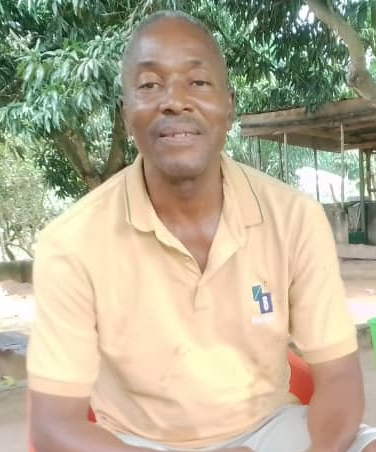
Our personality this week is a humble farmer in his 60s whose piggery and fish farm is located in the quiet agrarian Illah Community of Delta State. He is Mr Gabriel Nduka Ofuokwu. Beyond being a farmer, Mr Ofuokwu is the Managing Director and Chief Executive Officer (CEO) of Gabycord Cleaning Services in Yola, Adamawa State. He holds a Diploma in Business Administration from Modibo Adamawa University and a BSc degree in Business Administration from the Federal University of Technology, Yola.
“With Corporate Cleaning, I began to have contracts from federal ministries and other bodies from where I made some money, and in the North, my company, Gabycord Nig. Ltd became one of the best in Corporate Cleaning and Waste Management”, he says.
Interestingly, he has been in the Corporate Cleaning and Waste Management business for years, but with age, a time came when he thought of doing something besides it; something that could bring him close to nature. Five years ago, he got through with the thought, and relocated to his home town, Illah, to take to farming, and live a quiet lifestyle.
Hear him: “In Illah, we are blessed with fertile land. My ancestors are a blessing to me. I was given a land in a swampy area. Because I strongly believe in turning waste into wealth, and think positively in any situation I find myself in, I did not waste time to make the best of the land environment.
“Not too long after, I discovered that the running water across the land, probably from a stream, could be used for fishing. So I decided to invest in fish breeding. Together with a partner, who was already into fishery, I began to own my own earthen ponds. I think at the beginning, there were four ponds, where I had fingerlings. That was a testing period for me”.
“However, some three to four years ago, the fish farm was booming, thus becoming the talk of the town and beyond because, over time, the number of earthen ponds we had multiplied, and we started constructing concrete ponds. We had a good number of them. It was a good business, and very profitable too. Apart from making money, it was a thing of joy to watch the fish grow from fingerlings to maturity. It was a combination of nature and business. The number of pounds was increased from four to 21 or 22 with different sizes, with a capacity of 12,000 fish in all, but later increased to 50,000”.
Unfortunately for Mr Ofuokwu, a time came when “Nigeria happened to him”. The cost of buying feeds to feed the fish skyrocketed, and the situation was like him having to spend a greater chunk of his profit on feeds. So he had to slow down. “The cost of feeding the fish was my greatest challenge”, he lamented.
However, being a man who strongly believes in seeing opportunities in any and every situation, he turned the challenges he had in fishery into something more profitable by switching to piggery.
By dint of hard work and the grace of God, today, Mr Nduka Ofuokwu owns one of the largest and flourishing piggeries in Delta State, with a special breed of pigs that has low fat, thus making them good and healthy for consumption.
And how did Mr Ofuokwu achieve this tall feat? Hear him: “I converted most of the concrete ponds for fish into rearing pigs; redesigned them, with a roof and adequate partitions, and today, my story has changed for good. The pigs are breeding well in a clean and well-ventilated environment.
“I started the Piggery with one Bower (male pig) and five sows (female pigs) in 2021, and today we stock not less than 450 pigs of different sizes and stages”.
However, he had a challenge managing the Piggery at a time. Again, it was the high cost of feeding the pigs. What did he do, and how did he go around it? He had to embark on mass sales of the pigs. “I did so at a time because of the rising cost of feeding the pigs and insufficient space for them, as a result of the high prolific nature of pigs.
“As a pig farmer, you must have a breeding programme; otherwise, you may be faced with the challenge of mass production that would require larger capital investment. So you’ve got to regulate their breeding, to keep the number of pigs you have under affordable control/management”, he said.
But to the glory of God, he says, “That challenge is over now, because we have improved on our facilities at the piggery to be able to accommodate the number of pigs we have at the moment. We are actually managing our breeding to ensure that we do not have a spill over”.
Asked how he has been able to keep up with feeding the pigs, even with the high cost, Mr Ofuokwu has this to say, “We do our own feed formulation to keep us in business. We source the ingredients and do the mixing. They include wheatophals, soybeans, groundnut cake, palm Carmel cake, fish meal and the necessary medications.
On what it feels like being a farmer, he says: “I’ve been in the piggery business for six years now. We also breed some fish. It is a fulfilment of purpose; a realisation of self. I love nature, and so, I love seeing my fish and pigs grow, even though they are lower creatures. Beyond that, piggery is a lucrative business. With good management, you can have a breakthrough.”

