


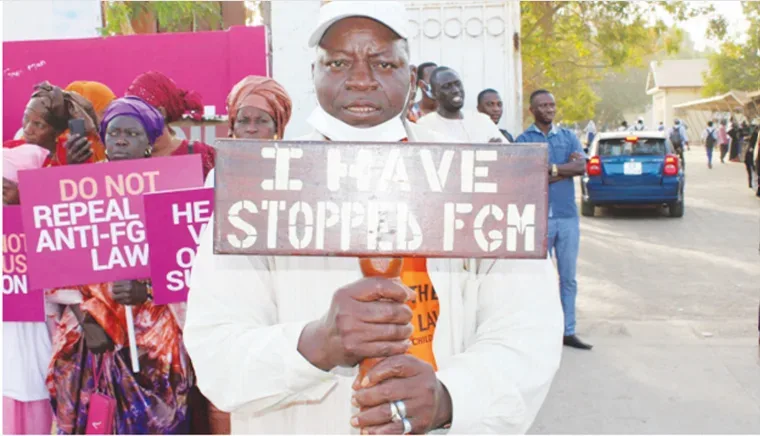
BY AMAYINDI YAKUBU/JUDITH OBIANUA
Amina was seven the morning the women came. She remembers the smell first, smoke from firewood curling into the pale sky, mixed with the sharp scent of antiseptic that did not belong in a village courtyard. The sun had barely risen, yet her mother had already bathed her and wrapped her in her best wrapper, the one reserved for weddings and naming ceremonies. No one explained why.
They told her she was becoming clean. She did not understand what that meant, only that her mother’s hands trembled as she braided her hair, and her aunt avoided her eyes. The women sang softly as they led her into the room, songs passed down through generations, melodies meant to drown out fear. Amina tried to sing along, but her voice caught in her throat.
Then came the pain. It arrived suddenly, violently, without warning. A white-hot shock that tore through her petite body and stole the air from her lungs. She screamed once before a hand covered her mouth. The ceiling blurred as tears streamed down her face. She remembers the dust on the floor, the buzz of flies, the way the room spun as her body shook uncontrollably.
Years later, she would still wake at night, heart racing, body aching with a pain she could not name. She would struggle to sit in class, to walk long distances, to understand why something done “out of love” left her broken in ways no one wanted to acknowledge. When complications followed bleeding, infections, questions about marriage and childbirth, the answers were always the same: endure, this is our culture, this is how it has always been.
By the time Amina became a woman, Female Genital Mutilation (FGM) was no longer just a memory; it was a lifelong sentence etched into her body and psyche—a scar carried quietly in a society that preferred tradition to truth. Amina’s story is fictional. But her pain is not.
FGM in Nigeria: A Crime Sustained by Silence
Across Nigeria, thousands of girls live versions of this reality, some surviving, some suffering in silence, some never making it past the day the women come. Despite laws, advocacy, and decades of global commitment, FGM remains deeply entrenched, sustained by silence, social pressure, and uneven investment in prevention and enforcement.
Every year on February 6, the world marks the International Day of Zero Tolerance for Female Genital Mutilation, a moment not just of remembrance, but of reckoning. This year’s theme, “Towards 2030: No End to FGM Without Sustained Commitment and Investment,” is both a warning and a call to action.
The Pointer Newspaper engaged FGM advocates and stakeholders whose work sits at the frontlines of Nigeria’s response to FGM. Their insights reveal not only the progress made but also the uncomfortable truths that remain.
Pouring Hot Water on Child’s Genitals Still FGM – Advocate
A TV presenter with Hude Network Abuja and an Adolescents’ Sexual reproductive health rights and justice advocate, Hannah Omokafe Dennis speaking about concrete actions beyond public condemnations that are federal and state government are taking to eliminate FGM, and how consistent the commitment said, “I think I’m going to appreciate the various states in Nigeria who have moved beyond just structural implementations to thorough consistency actually. But again, it’s still a challenge in the sense that, while the VAPP Act originally applied only to the federal capital territory, the majority of Nigerian statistics are domesticated, yet the legal basis for prosecution is still not as deep as it’s supposed to be. Several states, particularly those in the southwest, southeast, that is, maybe Osun, Ekiti, and Ebonyi, have established gender-based violence task forces, and these units include trained police officers and even legal aid providers specifically tasked with responding to reports of medicalised FGM, which is a growing trend where healthcare professionals perform the procedure.”
Citing an example of female genital mutilation, Hannah said, “I once saw a particular post on Facebook where somebody had tagged me to it, and he said that there was a particular healthcare worker who would always take her female children to her fellow health worker and pour hot water on the children’s private parts. That is a very terrible thing that needs close attention.”
Speaking on the nationalisation of the VAPP Act Hannah said that, “The national policy and plan of action it was done in 2021 and still existed on to 2025 and they integrated the FGM prevention into its maternal and child health guidelines so this is to be able to ensure that the commencement is not just a women’s affair but it has now become a public health priority so if that woman who I mentioned earlier who usually takes her child to her fellow public healthcare worker to pour hot water on her daughter’s private part the law can be used against her and of course take her to court because that is a violation of human rights it’s harm on a child’s body but again despite the progress there is a commitment gap that still exists amongst the state amongst persons amongst the stakeholders like healthcare workers like parents themselves like traditional and cultural leaders religious leaders and the rest.”
Revealing the state of VAPP Act implementation in the northern part of Nigeria, Hannah says, “For example, in some northern states, the implementation of the VAPP Act is slower due to complex cultural interpretations. For instance, some people believe that a woman cannot get married if she has not been genitally mutilated, or she cannot give birth properly or any of those kinds of things. These are some of the problems and the complex cultural interpretations that people would give to girls who their parents or their guardians would allow them to go through this particular inhuman process and this has led to a fragmented legal landscape where the perpetrator actually can face a four-year prison sentence in one state but then another state, where the cultural complexity has accommodated the practice.”
Hannah, commenting on how much sustained public funding Nigeria is investing annually in FGM prevention, community education, survival supports, law enforcement, and health services, and measurable outcomes, said, “The financial landscape for female genital mutilation elimination in Nigeria is shifting over the years from a reliance on just international donors to a model that involves domestic resource mobilisations.
There’s also an establishment of one-stop centres, which you can find across 15 states in Nigeria, where they provide medical, legal and psychosocial care for people who have had to go through FGM or people who are running away from going through FGM, because some people might have grown up. However, still, you see that some of their guardians or some of their parents might want to send them back to the village for the FGM process. These parents are scared of the consequences of not practising FGM on their wards because of their cultural mindset.”
Given that FGM is deeply rooted in social norms, Hanah explains how traditional leaders, religious institutions, health workers, and community-based groups are to be held accountable for abandoning and preventing the practice.
She continued, “Now, health workers who are definitely much involved in trying to stop female genital mutilation, especially in Nigeria, the Medical and Dental Council of Nigeria, and the Northern and Midwifery Council have issued strict directives that health workers who are caught performing FGM risk the permanent revocation of their professional licenses in addition to criminal persecution under the VAPP Act. I dare to say that is an awesome thing, because imagine if you’re being caught as a health worker, you definitely know that FGM does not have any health benefits, so why on earth would you still want to be part of the people who perpetrate this evil act on young girls and on babies?
“Female genital mutilation is a form of gender-based violence. You can report to NGOs, like the one I get to work for, called Education as a Vaccine (EVA). They have a free toll line, and you can always call them when somebody is about to go through that, so just in case you’re not bold enough to stop them, or you do not have the capacity to stop them. You can check them out on Instagram or across social media pages, or just type their toll lines to see it and call them to send someone, or the police, or other stakeholders who can definitely help. FGM is a very terrible thing and should definitely be eradicated from our society totally.”
Nigeria Can End FGM — If the Law Actually Works – Akor
Speaking, the head of corporate communications at the Diplomacy and Corporate Communication Conference, and Founder of the Ideal Woman from Port-Harcourt, Tabitha Akor, expressed her dissatisfaction over the continual practice of FGM in the nation.
“It is deeply troubling that nearly a decade after the Violence Against Persons (Prohibition) Act was signed into law, FGM is still being practised in some parts of Nigeria. This reality is not just disappointing; it is unacceptable.”
Akor counselling on how the government can move into action beyond policy formulation said, “While the passage of the law was a significant step, legislation alone is not enough. Concrete and sustained action is required to ensure that the law is fully implemented and enforced. This begins with widespread awareness campaigns, led by the federal and state governments, to educate communities about the dangers of FGM and the legal consequences attached to it. There must also be deliberate efforts to ensure that every state, local government, and community adheres to and strengthens the provisions of the VAPP Act.”
She advocated protecting and supporting those survivors, noting that, “They should have access to proper medical examination, psychosocial care, and safe channels for reporting. Their cases should be carefully documented, and their stories, where consent is given, should inform public advocacy and policy action.”
Tabitha further called for justice for victims of FGM and prosecution for those encouraging the practice. “Equally critical is accountability. Individuals who perpetrate or enable FGM must be investigated and prosecuted, and these actions should be made public. Transparency in enforcement not only builds trust but also serves as a strong deterrent to others.”
FGM Has No Medical Benefit — Only Consequences- Nurse
Speaking with a nurse in Federal Medical Center Asaba, Mrs Eunice Kelvin, affirmed that FGM is a harmful practice with no health benefits, especially when it is not properly done. “Those who are still doing it are ignorant of the harmful effects. In some communities, it is often seen as a social norm or tradition and a cultural identity that a person has grown into womanhood. While some communities link FGM to cultural or ethnic identity, believing that it enables the girl child have control over sexuality.
“But research had it that FGM is harmful to the female child, which is one of the reasons it been eradicated; it is no longer done in hospitals. It has severe health consequences, which include infections and infertility, and can lead to death if care is not taken, as it violates human rights. After all, the persons involved have to give their approval before such action can be carried out on them.
“The benefit of eradicating FGM is that it makes childbirth easy because the uterus will enlarge and the baby will come out so easily, unlike when it is mutilated, and we have to give a cut before the woman can deliver her baby,” she said
“We Did It Then, Nothing Happened” — The Beliefs That Refuse to Die
According to Mrs Esther Onyekpe, a grandmother, female genital mutilation was widely practised during her childbearing years and was not considered harmful at the time. She said her two daughters were circumcised and later gave birth to children of their own, arguing that she sees no reason the practice should be discontinued.
“My two daughters were mutilated, and they also gave birth to their own children. I see no reason it has to be stopped. When it is done seven days after birth, it does not harm the child. The only one I think is harmful is the old practice where a girl is mutilated at about 15 years, which was seen as purification. That can cause severe bleeding, and the person involved may die in the process. But that of a baby causes no damage. It is done to control the sexual urge of the girl child. We were told that if it is not removed, as the child grows, it makes her run after men. That is the reason for the act,” she said.
The Final Question
Nigeria has made notable progress. Laws exist. Awareness has grown. Advocacy organisations continue to push back against a practice that violates the rights, health, and dignity of women and girls. Yet, as stories like Amina’s remind us, progress on paper does not always translate to protection on the ground.
As Nigeria stands at a crossroads between commitment and complacency, the stories, data, and perspectives that follow seek to answer one pressing question: Can Nigeria end Female Genital Mutilation by 2030, or will girls like Amina continue to pay the price of our collective hesitation?

