Category: COLUMNS

Featured posts

  • A Red Letter To The Minister Of Health

    A Red Letter To The Minister Of Health

    This is a call to the Minister of Health to protect the health of our nation. Before now, Wisdom Class Movement has taken a bold step to declare a state of emergency on drug abuse and another bold step to begin a war against drug abuse in Delta State. We also declared our total commitment and support to the federal government against drug abuse.

    We commend the courage of the honourable minister for his red letter to all, and this is our response to also call him to accountability and transparency, especially in the area of drug abuse in Nigeria.

    The burden of drug abuse is becoming a major public health concern in Nigeria. The recent World Drug Report 2019 of the United Nations Office on Drugs and Crime (UNODC) estimated that 271 million (5.5 per cent) of the global population (aged between 15 and 64 years) had used drugs in the previous year.

    Also, it has been projected that 35 million individuals will be experiencing drug use disorders. Further, the Global Burden of Disease Study 2017 estimated that, in 2017, there were 585,000 deaths due to drug use globally. In Nigeria, the burden of drug abuse is on the rise and becoming a public health concern.

    Nigeria, which is the most populous country in Africa, has developed a reputation as a centre for drug trafficking and usage, mostly among the youth population. According to the 2018 UNODC report “Drug use in Nigeria”, the first large-scale, nationwide drug use survey in Nigeria, one in seven persons (aged 15–64 years) had used a drug in the past year. Also, one in five individuals who have used a drug in the past year is suffering from drug-related disorders. Drug abuse has been a cause of many criminal offences such as theft, burglary, sex work, and shoplifting.

    The prevalence of drug abuse is skyrocketing because no serious intervention to rehabilitate addicts is in place. Other interventional strategies are not fully implemented. There’s no restriction on access to drugs. Open drug markets and access to drugs without a prescription are still fully operational in Nigeria.

    This red letter is a call to action to the honourable minister to: Immediately set up rehabilitation centers across the six geopolitical zones providing easy and accessible services; Initiate a bill to enact enabling laws for the success of the rehabilitation centers and rehabilitation centres, provide policies that would address the wider availability of drugs in society, Implement effective addiction counselling and prevention programmes, Create job opportunities for youth to become self-reliant; Commence compulsory drug testing for all youths and all students before admission in all schools. Commence full implementation of all enacted laws and policies; Ensure strict restriction of access to illicit and nonprescription drugs; Full implementation of the ban on open drug market, and increase allocation of funds to drug-abuse intervention.

    Enforcement activities should be strengthened as drug abuse cannot be treated with kid gloves.  Therefore, stringent measures and sustainable interventions are urgently needed to curb the increasing burden of drug abuse in Nigeria.

    Let this red letter reach the Honourable Minister of Health and let it remind us that the health of this nation is in the hands of everyone, especially the hands of the Honourable Minister of Health. Together we plan, together we spend, and together we protect lives.

  • Nigeria’s Security Burden And The Weight On Musa’s Shoulders

    When President Bola Tinubu appointed General Christopher Musa (Rtd) as Nigeria’s new Minister of Defence, the announcement landed in the middle of a nation already weighed down by fear. It was not just another cabinet appointment; it felt like a quiet admission that the country’s security crisis had entered a dangerous and defining phase. At a time when mass abductions, attacks on highways, and raids on farming communities compete daily for headlines, Nigerians are less concerned about titles and more desperate for results. The burden on the new defence minister is therefore not ceremonial. For many citizens, this appointment represents a final gamble on experience in the face of relentless violence.

    Musa arrives at the defence ministry with the credibility of a soldier who once stood at the very top of Nigeria’s military hierarchy. As former Chief of Defence Staff, he understands the machinery of war, the limits of intelligence, and the cost of hesitation. But this new role demands more than battlefield command. It calls for political wisdom, strategic patience, and the ability to navigate the spider’s web of military operations, inter-agency rivalry, public expectations, and executive pressure from Aso Rock. What lies before him is not just a campaign against armed groups, but the task of restoring public faith in a state that many now feel can no longer guarantee their safety.

    Insecurity in Nigeria is no longer confined to one region or explained by one cause. It has mutated and spread, cutting across ethnic lines, economic classes, and geographical boundaries. Banditry, kidnapping, terrorism, and communal violence overlap in ways that defy simple solutions. Rural communities are emptied overnight, highways become hunting grounds, and schools meant to nurture the future turn into danger zones. Each attack deepens public despair and weakens confidence in government promises. It is against this grim backdrop that Musa’s leadership will be tested most harshly.

    The declaration of a national security emergency earlier signalled the gravity of the moment. Yet Nigerians have heard similar warnings in the past without seeing the decisive reforms such alerts imply. Defence budgets have expanded over the years, but so too has the sophistication of criminal networks. Citizens have watched brave soldiers fight and fall, often with questions raised about equipment, welfare, and logistical support. Under Musa, the challenge is no longer just to prosecute war, but to fix the broken systems that undermine it. Without addressing these structural weaknesses, every tactical victory risks becoming temporary.

    Unlike his previous role in uniform, General Musa now stands in the full glare of public accountability. Every military operation will be interpreted politically. Every casualty will provoke questions in the minds of Nigerians, and failure will be magnified.

    The Defence Ministry, under his watch, must therefore operate with a new level of transparency and coordination. Civil-military relations, respect for human rights, and trust between communities and security forces will shape success as much as firepower. A frightened population will not readily share intelligence with an institution it does not trust, no matter how strong that institution appears on paper.

    What makes this moment even more delicate is the public demand for instant turnaround. Nigerians want to wake up to safer roads and quieter villages. Yet the roots of today’s insecurity run deep, nourished by years of impoverishment, religious tension, unemployment, weak law enforcement, porous borders, and the slow erosion of local governance.

    Beyond troop movement and military deployment lies the deeper work of rebuilding national security. Intelligence gathering must move from reactive to proactive. Information sharing among agencies must cease to be a bureaucratic obstacle. The welfare of officers and soldiers must shift from campaign rhetoric to lived reality. Security cannot be sustained on the fatigue of underpaid, overstretched personnel alone.

    In a country where hope is often fragile, the return of a seasoned soldier to the centre of national security policy has stirred cautious optimism. Communities ravaged by attacks are not asking for miracles. They are asking for consistency, honesty, and a government that understands that security is not a privilege but a right.

    General Christopher Musa now stands at the intersection of public expectation and harsh reality. His legacy will not be measured by press briefings or condemnation of killings, but by the ordinary Nigerian who dares to travel again without fear, the farmer who returns to abandoned fields, and the child who goes back to school without trembling at the distant sound of gunshots. History will be kind only if peace becomes visible in the daily lives of the people during General Musa’s leadership.

    Nigeria has entrusted a seasoned General with the safety of a wounded nation. Whether this chapter marks a turning point or another pause in a long struggle will depend not on intentions but on the courage to reform, the discipline to execute, and the humility to place national survival above all other interests.

  • Bonano’s Confusion About Wives Of Today

    Bonano’s Confusion About Wives Of Today

    Matrimonial security and respect are something that few married men of today have, and what many would like to have. For the latter, it often seems elusive and hard to come by these days; more so with the upcoming young couples, or should I say, the new ‘generation couples’, and that is if one has even challenged their matrimonial disregard and disrespect or insecurity. For these people, it may appear to be how life is, and this means that it is often accepted.

    If a man is matrimonially disregarded or disrespected, it is going to affect many areas of his life. There is, of course, the inner stress that will be created, and this will then lead to outer stress. So, the inner instability that one feels always has the potential to increase through the combination of the two sides, staying away from home or becoming a brutal husband that is orchestrated by an unruly, disloyal and disrespectful wife.

    There are moments in a man’s life when he will feel insecure, depressed and challenged. This could be after the loss of a loved one, during a time of illness or a relationship that has come to an end. These could be described as part of the human experience, but these are very different to the feeling of being emotionally brutalised by one’s wife regularly.

    That our forefathers lived a life full of age is a truism; they enjoyed the complete respect, care, attention and good domestic ministration of their wives. But the same cannot be said or guaranteed of the married men of today, because most wives now can best be described as ‘weapons of men’s destruction’. Little wonder we, in most cases, die before our time, all thanks to a nagging, confrontational and disrespectful wife!

    Yes, agreed, it is also possible for one to have certain habits or tendencies that cover up their inadequacies, and this can be done so automatically that it is out of one’s conscious awareness and soon passes without the slightest recollection. While this may be true for some women and at certain times for others, there will be times when this approach is unsuccessful. And this can lead to a myriad of internal experiences being triggered.

    Most women, and possibly some men and some esteem readers, may find it hard to conceive what Bonano is trying to structure here and why he is on the threshold of today’s wives. The reason is not a mile away, but the alarming rate of broken and disharmonious homes with this generation has orchestrated this approach. A comparative analysis between wives of today and those of yesterday will give a pointer to the fact that Bonano holds no grudges against the wives of today, but he is pained by the uncultured turn of events by these women! Now, let us evaluate the attitude of yesterday and today’s wives.

    Yesterday’s Wives: Welcome my husband, hope the office was not stressful, your favourite food is ready, let me lead you to the bathroom first, then you take your dinner. You look so tired, I am sure you’ll be okay after taking your dinner. Welcome, welcome, my one and only.

    Today’s Wives: “Look at the time you are returning from work, how am I sure it’s even your workplace you are coming from? Please don’t put unnecessary pressure on me, you can go to the fridge, pick up the stew, microwave it and boil the remaining rice, I am your wife and not your cook”.

    Yesterday’s Wives: Darling, stop thinking about our lack of money. It’s going to be temporary. God will see us through, and we are going to come out of it stronger. After all, we can still feed ourselves and the children. We need to give the Almighty that glory. I am with you through thick and thin, my husband, the owner of my dowry.”

    Today’s Wives: Look, I am sick and tired of living in this abject poverty with you. Why did you bring me to your house when you know that you are not ready for marriage? Every day is one complaint or another. Are you the ‘Complainant General of Nigeria? We don’t have cars, our house is ‘face me I slap you’, when your mates are in GRAs. Look, if you don’t find solutions to your problems, you will come back and not find me in this, your rotten house.

    Yesterday’s Wives: My husband, take heart and don’t worry. I shall go with you to Ozoro. You being transferred from the glitterati of Asaba to Ozoro might be a blessing in disguise. We shall take advantage of the educational institutions to advance our education. Some disappointments could be a blessing.

    Today’s Wives: I can’t follow you to Ozoro o. God forbid a bad thing. From Asaba to Ozoro? I can’t cope with such a demotion. To start living in a village? You had better look for another wife. I can’t live in a town without Silver Birds, Crunchies, Fortune Supermarket or Shoprite”!

    Continue next week

  • X-Raying Delta’s 2026 Budget Proposal Of N1.664 Trillion

    X-Raying Delta’s 2026 Budget Proposal Of N1.664 Trillion

    Budget in governance structure or institutional management, no doubt, plays a crucial role in the operational activities of any government or organisation. It is, indeed, a roadmap outlining projected income and expenditure of any government, organisation/association or an individual within a given financial year.

    Globally, governments prepare annual budgets to plan and allocate resources effectively; achieve development goals and priorities; manage finances transparently and accountably; attract investments and stimulate economic growth; and deliver public services and infrastructure to citizens.

    Only recently, Delta State Governor, Rt. Hon. Sheriff Oborevwori presented a budget proposal of N1.664 trillion for the state’s 2026 fiscal year to the State House of Assembly for consideration and approval. Giving a breakdown of the budget christened ‘Budget of Accelerating the MORE Agenda,’ Governor Oborevwori said N499 Billion, representing 30 per cent of the total budget, was for recurrent expenditure, adding that N1.165 Trillion, representing 70 per cent of the total budget, was for capital expenditure.

    He disclosed that the 2026 budget size indicates an increase of N685 billion or 70 per cent over the 2025 Appropriation, pointing out that the budget as proposed, would be mainly funded from Statutory Allocation, Internally Generated Revenue, Mineral Derivation, Value Added Tax, Other Capital Receipts and Savings and Oil Revenue Recoveries.

    The Governor pointed out that N720 billion, or 43.28 per cent of total projected revenue, was expected from statutory allocation, which, he said, was boosted by post-subsidy FAAC inflows and improved oil production stability in the Niger Delta, adding that Internally Generated Revenue was projected at N250 billion, representing an 86.5 per cent increase over 2025.

    While saying that the projected increase in the state’s IGR was driven by ongoing reforms to plug leakages and widen the tax net, he pointed out that VAT receipts were expected to rise sharply to N120 billion, buoyed by improved federal administration of the tax.

    “Capital receipts, however, have been deliberately cut down to N25 billion, a 73 per cent reduction as the government pushes toward a zero-borrowing fiscal strategy. Savings and oil revenue recoveries are projected to contribute N489 billion. This is a testament to prudent and disciplined financial management,” the Governor added.

    According to him, the proposed recurrent expenditure estimates for 2026 of N499 billion are made up of personnel costs of N185 billion, representing 37 per cent of the proposed recurrent budget, stressing that N204 billion, representing approximately 41 per cent, was earmarked for overheads. He pointed out that the balance 22 per cent or N110 Billion was accounted for by social contributions, benefits, and grants, emphasising that the personnel cost of N185 Billion anticipates the annual increments and allowances, while the overhead cost mirrors the inflationary trend in the country.

    Giving insights into the proposed capital expenditure estimate of N1.165 Trillion, Governor Oborevwori noted that the proposal was N535 billion, or 85 per cent higher than the 2025 capital budget of N630 billion, saying “this is largely accounted for by the larger budget size of N1.664 trillion, as against the 979.2 billion of 2025.”

    Highlighting the priority sectors of the budget, the Governor said N450 billion was budgeted for road infrastructure, N105.086 billion for education, N50.067 billion for health, N20 billion for the Delta State Capital Territory Development Agency and N20 billion for Warri, Uvwie and Environs Development Agency.

    According to him, N16 billion was budgeted for Power and Energy, N10 billion for Agriculture, and N20 billion for Social Protection, adding that the sum of N100 billion was budgeted for local government intervention in the 25 local government areas in the state (N4 billion per local government).

    Reviewing the performance of the 2025 Budget themed “Budget of Fiscal Consolidation,” where ₦979,228,818,719 was approved for funding both capital and recurrent expenditures, the Governor said the performance of the budget was encouraging.

    “From January to October 2025, the actual revenue receipts from the Federation Account Allocation Committee and Internally Generated Revenue stood at N738.640 billion, representing 90.5 per cent of the proportionate budget of N816,024,015,599.

    “The recurrent expenditure for the period under review was N340,554,006,448, as against a proportionate amount of N290,639,798,863.50, representing 117 per cent performance. The sum of N509, 780, 336,370 was expended during the period under review, as against a proportionate amount N525, 384, 216, 736, representing 97 per cent performance.

    “It is pertinent to appreciate this stellar performance. It is also gladdening to note that the bold and reformist policies of the Federal Government have started to yield the desired result and the country is beginning to turn the corner,” the Governor added.

    While highlighting the importance of peace and security in promoting sustainable development, he said his administration had worked closely with security agencies to tackle crime, including kidnapping and cultism, with a view to ensuring sustainable peace and security in communities across the state.

    “We will continue to strengthen the security architecture in the state to better protect our citizens from all threats. This administration has invested heavily in security infrastructure upgrades and will continue to do so for enhanced peace and security.

    “We are looking at deploying cutting-edge technology, including drones, sophisticated intelligence gathering capabilities and surveillance equipment. All these are in addition to the prompt payment of personnel emoluments and allowances, as well as the provision of covert logistics,” he added.

    With the budget envelope of N1.165 trillion for capital expenditure, which is N535 billion or 85 per cent higher than the 2025 capital budget of N630 billion, it is crystal clear that the Oborevwori administration is irrevocably committed to expanding the frontiers of sustainable socio-economic growth and development of the state.

  • Food Security: The Ughelli North Example

    Food Security: The Ughelli North Example

    BY CHIBUZOR ISICHEI

    Essentially, there are two primary types of farming: subsistence and Mechanised farming. Subsistence farming, simply defined and as the name implies, is practised in rural areas, while mechanised farming is the opposite and is practised on a large scale, mainly by big-time farmers, especially those with government support and the necessary resources.

    People are venturing into farming due to various reasons, including growing demand, economic opportunities, food security, youth empowerment, innovation, diversification, technology and more. In Nigeria, some of the most profitable farming ventures include crop farming, livestock farming, fish farming and agro-processing.

    Overall, farming offers numerous benefits for food security and income generation, personal satisfaction, job creation, improved livelihood, and stimulates economic growth.

    On the above premise, Ughelli North Local Government, in conjunction with the Department of Agriculture and Food Security under the Supervisory Councillor for Agriculture, Hon Efemena, recently organised a one-day training programme for farmers in the local government Area for Cucumber cultivation, cassava production, maize farming, yam cultivation, fish farming and poultry farming.

    According to the reports, the event took place at the local government secretariat and was designed to empower farmers with essential farming skills, innovative ideas and contemporary methods. Also, the aim is to upgrade their productivity and assist them in becoming mechanised farmers.

    From all perspectives, the move is progressive and worthy of emulation, especially now that the local governments have a lot on their hands to do.

    In his remarks, the Chairman of the Local Government Area, Barr Jaro Egbo, addressed the importance of training due to the declining state of farming and the upsurge in prices of foodstuffs in the market.

    He noted that the programme was organised to revitalise the farming culture in Ughelli North Local Government Area, noting that every space in the area has fertile lands for agricultural activities.

    The local government chairman revealed that Ughelli North has plans to fully engage in Palm tree farming and cassava production in the coming year.

    This initiative, he said, is aimed at meeting the market food demand and generating revenue for the council.

    The Ughelli North Local Government Chairman urged the participants to take the training seriously in order to apply the knowledge acquired in their training in their farming practices, which will enhance their productivity and increase their standard of living.

    Speaking on the issue, one Engr Anthony Nnamdi, a businessman in Asaba, described the event as the best thing that has happened to the people in the local government area. He said that by going into farming, local governments in Nigeria can reduce poverty, improve food security and foster economic development.

    He said that with events like this, local governments in Nigeria can consider going into farming or supporting agricultural initiatives as a way to improve food security, create jobs and support local farmers.

    He named some potential models to include partnership with farmers, training, capacity and market development, among others.

    He also stressed that training local government staff in farming is essential for several reasons, including improved service delivery, enhanced productivity, better decision making, increased agricultural output, job creation and effectiveness of agricultural programmes.

    Another person, who spoke on the matter, Mr James Edet, an agriculturist, said some of the benefits of farming include access to fresh produce, improved health, community building, sustainable livelihood and more.

    He said that it is necessary for each local government in Nigeria to go into farming for compelling reasons such as job creation, food security, improved livelihood and general economic growth.

    He urged the people of Ughelli North and other local government areas in the State to take any training on farm produce seriously as it would help them in their future endeavours, nothing that there is a declining state of farming and an upsurge in prices of food items in the market, saying that this makes it necessary to review the whole thing in line with new trends.

    He pointed out that most of the farming systems people are using today are old and outdated and need to be reviewed, adding that it was only programmes such as the one the people of Ughelli North Local Government would change the system for good, just as he lauded the local government chairman for the programme.

    He also called on other local government chairmen to emulate Ughelli North.

  • Nightshift: The Good, Bad And Scary

    Nightshift: The Good, Bad And Scary

    BY OGORAMAKA AMOS/CHIKA KWAMBA/PAUL EGEDE/JUDITH OBIANUA

    The daytime busyness is replaced by a low, humming quietness, the kind that amplifies every footstep, every distant horn, and every flicker of light from half-asleep buildings. The sky hangs low, heavy with clouds that seem to mirror the mood of the night.

    While most residents drift between dreams, others remain awake, working, watching, healing, protecting, and moving the city forward in quiet, uncelebrated ways. These are nightshift workers—the guards who hold vigil, the nurses who whisper reassurance to the sick, the journalists chasing midnight emergencies, the fuel attendants with tired eyes, the hotel staff navigating unpredictable guests.

    Together, they form an invisible backbone that keeps the city running while the rest of us sleep. Their stories, rarely told, reveal the weight of responsibility carried in the dark hours, the fears they swallow, the exhaustion they battle, and the strange, extraordinary moments only the night can bring.

    Chima Stanley is a security guard at a microfinance bank in Port Harcourt who spoke to our correspondent. According to him, “In this place we dey run shifts. No be only me, I dey resume from 6 pm, and then I close by 6 am. Once everybody don close for the day, the compound go just become quiet. People think say security men work for night dey easy. Na when everywhere quiet for night, na that time dangerous things dey start. ”

    For four years, Chima said his day has not remained the same. “I dey stay alert. I dey walk round the buildings to ensure say everything is intact and pray the night is peaceful. He went further to say, “Sometimes the quietness dey deceive, and that’s why I walk around from time to time”

    “I am a human being, of course, fear is real,” he admits. “You fear robbers even though they give me a cutlass, for instance, to defend myself, but you fear strange movements. You fear that something can happen, and you will be blamed for it. My eyes no dey rest for night. At times I dey tire, headache too disturb me.’’ The hours between 2 a.m. and 4 a.m., he says, feel like “fighting with myself because of sleep.” Yet, the pay doesn’t reflect the risks”.

    Inside the University of Port Harcourt Teaching Hospital (UPTH), the night belongs to nurses like Blessing Amadi, who said, “I have grown intimately familiar with night duty. At night, the hospital feels like another world,” she said. “The corridors are silent. The wards feel heavier due to the tension of emergencies”

    “I have attended to emergencies most people cannot imagine, accidents arriving in waves, patients gasping for breath, mothers in labour at odd hours. From 1 a.m. to 3 a.m., your body is begging for sleep. But patients don’t wait for you to rest because you are always called upon. You have to force yourself to stay awake because a mistake could kill someone.”

    “Night shift has made me realise life is fragile. You see the boundary between life and death so closely. Yet, the salaries and allowances barely reflect the emotional and physical toll”.

    For Dr Kelechi Nwachukwu, who works in a private clinic along Ada-George in Port Harcourt, “Night duty strips you of your ego. At night, you are dealing with emergencies back-to-back. You don’t have time to be tired.”

    He recalls, “There are nights where I will be treating up to three accident victims, admitted patients and women in labour, sometimes simultaneously. The pressure is intense, aggravated by understaffing. Many nights, I’m the only doctor available. It’s dangerous. Your body is tired, but you push through.”

    The financial compensation doesn’t match the risks, he said plainly. “Night allowances are small compared to the stress. But working night shifts builds resilience. It teaches you to stay calm in chaos. The biggest disadvantage is my social life. My family sees me less. And sometimes I’m awake when the world is asleep.”

    Ebitari Sunday, a journalist working the night desk in a Radio station in Port Harcourt. In a chat with our correspondent, he said, “Night work in journalism is not glamorous. I have to edit my voice recording after coming back from beats, which sometimes creeps into the night”

    Sunday said he covers police operations and crime scenes, adding that safety is his biggest concern. “I’ve been threatened. I’ve had my phone snatched on my way back from the office.”

    Sarah Joseph, who works at a hotel at Rumuodomaya Port Harcourt, also spoke to our correspondent. According to her, ‘’I resume my work at 5 pm and I normally close by 12 am. You see things,” she said. “People who check in late at night, some guests who arrive drunk. I get exhausted. Sometimes guests call the reception desk at odd hours, placing food or drink orders. So, I am meant to be awake from 5 pm to 12 am when I finally get to rest”

    In Agbor, Ika South Local Government Area of Delta State, Mr John Isichei, a security officer in James Hope College Agbor, told our correspondent he prefers engaging on night shift as it gives him the free time to engage in other activities, especially farming, to meet with family needs. He noted that he used to approach his colleagues on night duty once it was his turn to work from 6 am to 6 pm. ‘’This is how I can balance my farming and my job.

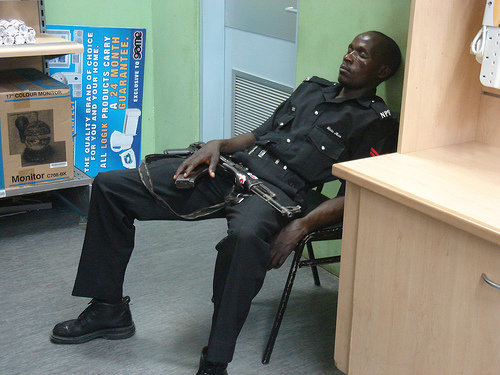
    A Police officer (name withheld) serving in the Agbor Area Command shared his experience while on night duty. According to him, ‘’the remuneration is not worth the risk in night duty. We stay awake for the citizens to sleep, but a lot happens at night. We see things at night, the good, the bad and the ugly, but we are still here because we choose to serve our fatherland.

    ‘’We, the police officers, are not well appreciated, although there are some bad eggs in our midst. But the corruption in our country is in all sectors’’ he said, adding that he has served for over two decades and has faced so many attacks mainly during night duty’’ He said one of the advantages of night duty is being around to stay with his family and help the children but the disadvantage of night duty, he said, is the attack which comes from where less expected.

    Meanwhile, a journalist, Mr Akinola Aladejowo, said that working at night has become one of the most intriguing parts of his professional journey. ‘’There is something deeply calming and inspiring about the late hours—an atmosphere that is almost impossible to replicate during the day. At night, there is no disturbance, no noise, and no unnecessary distractions. The mind becomes clearer, thoughts flow more smoothly, and the focus to work becomes naturally heightened.’’

    He said beyond the serenity, another thing I find interesting about night work is the ease of movement. After finishing assignments or a late-night coverage, getting to my destination is usually effortless. With no traffic congestion and fewer vehicles on the road, the journey becomes faster, safer, and far more convenient. The coolness and quietness of the night also add a unique sense of peace that makes the work feel lighter.

    ‘’However, like every aspect of life, working at night comes with its advantages and disadvantages. While the serenity and ease of movement are major benefits, the risks involved cannot be ignored. One major disadvantage is that help may not always be readily available if an emergency arises. The streets are mostly empty, and the reduced human activity means that one must remain extremely vigilant.

    As a journalist, the risk becomes even more pronounced. The profession itself carries hazards—ranging from hostile environments to unpredictable encounters. Working at night requires extra carefulness, a heightened sense of awareness, and sometimes even sacrificing comfort. On some occasions, I have had to sleep over rather than risk travelling at dangerous hours—an inconvenience made necessary by unexpected circumstances.

    Still, the beauty of life is that everything comes with both positive and negative sides. To me, the advantages of night work—from the calm atmosphere to the distraction-free environment—remain valuable. But the risks serve as a reminder that journalism is not just a job; it is a calling that demands courage, caution, and unwavering commitment.

    In Asaba, Mrs Anthonia Napoleon recounted her experience as a receptionist in a hospital, explaining that the disadvantages of working at night far outweighs its advantages, especially where there are lot of patients and those on night duty are few. ‘’we work throughout the night, she said, and there will be no space for you to sleep as all the beds are occupied by patients. You will not have time to rest, one might even have to sit down on the chair throughout or run from one office to the other. Sometimes, we even go towards. It is so tiring when working in a big hospital. Night shift is so tedious. After working the night shift sometimes, you wouldn’t be useful in the day because you would want to sleep before it’s time to go back to work.

    Another disadvantage is when you are on night duty, and somebody passes out that night. It is very scary. I remember when I started work, whenever someone died at night, I would be so scared. I imagine that the person’s spirit is moving around the hospital promises until I become used to the system. I began to see it as a normal occurrence. I am no longer afraid.’’

    Speaking with a police man who pleaded to remain anonymous, he noted that night work can be very stressful, especially when the power supply is off and everywhere is in a blackout. As he puts it, ‘’the mosquito bite, the smell from the jail… If the station is not properly secured, it might be invaded by bandits, especially at night. Working in an unconducive environment during the night shift is discouraging; the heat alone will almost kill you because there is no ventilation.’’

    Another night worker, who simply identified himself as Mr Nweafor, a vigilante, said sometimes during the night, especially at midnight, it feels like someone is walking around. He said, ‘’We feel it but don’t see it. It can come in the form of wind, a very strong one.’’

    He shared an encounter, ‘’At about 1 am, I walked down the street a little far from my colleagues, and suddenly I saw a dry palm fond coming towards me with speed. I observed it for some time, and when it was close to me, I began to run while it continued chasing me. I had to hide before it stopped running after him. According to him, scary things happen at night’’ he said.

    In Edo State, a Benin-based medical practitioner, Shadrach Onakpoyan, opined, ”A typical night shift in my setting always feels different. Some night shifts are calm, whereas others make you regret coming to work. Imagine having a case of multiple road traffic accidents at 2:00 am. You know it’s going to be a “fun-filled” night till dawn.

    ‘’Even for the so-called calm shifts, you have inpatients who you need to make sure are doing okay by routinely checking on them. Then there is your own body telling you to sleep while also keeping you on the alert for emergencies. I mean “Who is fighting whom”.

    ‘’Everything sounds extraordinary. It’s like even the walls are awake at times. The hospital is like a living building, expecting an influx of patients even at odd hours. Your heart beats on a whole different frequency when you hear “emergency”, or someone starts bleeding, a syringe falls on the ground, a patient dies, even worse, ghosts, hmm, let’s not go there. I mean, the place is quiet and sometimes dark, especially when there’s no light. Trust “NEPA” to keep you entertained.

    ‘’Some of the challenges I’ve encountered: Firstly, there are fewer experts present. So you see, I’m a medical officer expected to keep these patients alive till the morning when more capable hands can be easily reached.

    ‘’Secondly, there is the issue of making critical decisions under fatigue. You are working against certain factors not entirely under your control. Sometimes there’s no light to attend to patients. Speed, precision and accuracy all come to play. In addition, emergencies are just different at night. Staff members are tense, the patient is scared, and the outcome is unpredictable. Omoh!

    ‘’Then there is the issue of exhaustion. You are expected to be awake, knowing that others are asleep. It’s like you’re working against the normal clock, so your body tends to give off a different vibe. Also, some night shifts can be so busy that you just become fatigued. This is the worst of them all.

    ‘’Are there advantages? Well, there’s the quiet environment, which helps you focus better. Also, there’s the sense of knowing you are in charge, and this helps you develop your skills. For the calm nights, there’s really nothing much to do, so rest brings a sense of relief, I would say. Is it worth it? The pay in this our setting is not commensurate with the service we render, but there’s this joy that comes with saving a life.’’

    A nurse, Mrs Tessy Ehigiato, said, ‘’Nursing is more of a calling than a profession. The story is an endless one, but I will try my best to highlight it. The money is far less than the work done anywhere in the world. Going on night duty is demanding; you have to make preparations and be sure all that is required by your family is made available for the days you will be on night shift. You and your family may not see you for the number of days you are on night. You only talk on the phone, except if your spouse is in a private business.

    ‘Sometimes, the challenges are when there are emergencies and no gadgets to salvage the situations. Patients who would have survived will die, which is demoralising, especially when it’s children (it hurts the most). ‘’The fears are numerous, leaving your house for work is a risk itself. Getting to work, and you are your own security. My ward had no personal security. Once you are in a bay, you must not leave the babies unattended. To even drink water, you obtain permission from another nurse to stand in for you until you return. If any baby is missing, you can go in for it. If anyone stops breathing, you can go in for it.

    ‘’The extraordinary things are many. Sometimes you feed a patient with your money, buy infant formula for babies, even baby soap. Some strange feelings of spiritual forces, and then you start praying. A grandmother once visited a baby, and the baby died. Sometimes, a patient who was already improving can start deteriorating because of who visited.

    ‘’Exhaustion now and then. I am beginning to recover from the stress. I used to take Coke every day. One, two or sometimes three in a shift; if I am getting the third one for free.

    ‘’The disadvantages are numerous. Your children will be at the mercy of others while you are busy caring for people. My boy was malnourished at a time when he was malnourished because I was not there to monitor his feeding. You can experience robbery, though I have never experienced that.


  • The Resignation Of  Troost-Ekong

    The Resignation Of Troost-Ekong

    Nigeria is a funny country and things will continue to happen in a funny way. I doubt if anything in the nearest future will change it. Reason is because those at the helm of affairs are not ready to quit and are not ready to change.

    The truth is that it is a country where when you see wrong, you keep your mouth closed. It is a country where you cannot ask for your right and when you do so, you are tagged an enemy.

    Few days ago, like a bolt form the blue, the Super Eagles Captain with 2 weeks to the commencement of the African Cup of Nations not only resigned as Captain of the team, but quit international football.

    He, however, gave reasons why he decided to call it quit which sounds funny to many Nigerians who saw it coming. Ekong would not be the first to resign this way as many who believes in their integrity have done so in the past.

    Nigerians are all aware of what happened when the Super Eagles went for the play off in Morrocco where they lost to D.R.Congo in a penalty shootout with Calvin Bassey and Seyi Ajayi the worst culprit.

    Since then, a source close to the Nigerian Football Federation revealed that there has been a silence war going on between Ekong and those responsible for the management of the national team.

    The source said the NFF shifted the whole blame on the captain for allowing such an embarrassment at that critical time. Ekong was also accused of not having authority over his players and with the AFCON around the corner, the Akwa Ibom-born footballer who has put in over 10 years for the national team felt he might not be able to stand the heat.

    The source said we all know that he grew up in a foreign land where they call a spade a spade and may not be interested in the politics of Nigerian football.

    The source disclosed that the big wigs in Abuja may want to frustrate him and make things difficult for him and instead of waiting for that humiliation; the best thing is to call it quit.

    Already, he has been reduced to a non-playing captain and this has been affecting him for months with the last straw being the shifting of the load on why Nigeria failed to make it to the World Cup on his head.

    With the turn of events, the source said the last of such things have not been heard as many players are scared of playing for the country and his refusal to join the train to Morocco for the Nation’s cup may not augur well for the country.

    And that reminds of the maiden edition of “Big Sports Dialogue”in November,  the Chairman of the organising committee of the event, Osaze Ebueku explained that the time for stake holders to speak the truth to the power that be and unlearn what we have learnt.

    Ekong seems to be the first victim of that message having spoken the truth and got consumed in the power play. No warriors will abandon his territory with 2 weeks to the battle like what Ekong has done.

    The convener of the Big Sports Dialogue, Aaron Akeredola, also revealed that the time has come to confront the problem bedevilling the National team and sports honestly, spark new ideas and chart a lasting roadmap that will rebuild the team into a credible and globally competitive one.

    The former President of the Nigeria Football Federation (NFF), Amaju Pinnick, has recently made several statements regarding the state of Nigerian football. His key message emphasizes the need for a “total reorientation” and unity among stakeholders, while also blaming personal rivalries and a new World Cup qualification format for recent failures.

    Amaju also called for Reorientation insisting that true progress is impossible without a collective change in mind set among Nigerians and football stakeholders, arguing that “deep-rooted bitterness, personal rivalries, and political vendettas” have consistently undermined the sport.

    He accused certain individuals of praying for the Super Eagles’ failure during qualification campaigns to sabotage the current NFF administration led by Ibrahim Gusau.

    Pinnick attributed Nigeria’s failure to qualify for the 2026 World Cup partly to the revised qualification format, arguing that the team would have advanced under the previous 2018 structure. He maintains that in 2022, “Nigeria neither lost nor won” the decisive fixtures but was affected by the format. In essence, his recent statements focus on a moral and administrative reset for Nigerian football.

    The bottom line of my take is that if Nigerian football must return to the glory time, those managing football must be ready to listen to the yearnings of the stake holders. They must be ready to listen to the truth by the few and not praise singers. They must be ready to abide by the message from Pinnick Amaju for a total re-orientation and unity among stakeholders.

    The issue of corruption must be tackled with the National Sports Commission spearheading the crusade to put a stop once and for all especially now that the African Cup of Nations is staring us in the face.

    Thus, we have become a laughing stock before the international community with the issue of unpaid allowances and bonuses to our national teams.

    Not quite long, the former Super Falcons coach, Randy Waldrum, has publicly raised allegations of corruption against the Nigeria Football Federation (NFF), accusing the federation of mismanaging funds intended for the women’s national team.

    According to Waldrum, significant sums allocated by FIFA for team preparations were either misappropriated or poorly managed, leaving the Super Falcons with insufficient support for training camps, travel arrangements, and player welfare. He claimed that the lack of transparency had negatively affected the team’s performance and morale.

    The allegations have reignited debates about governance in Nigerian football, particularly around the administration of the women’s national team, which has long been Africa’s most successful women’s squad. Under Waldrum’s leadership, the Super Falcons achieved remarkable results, but he insists that inadequate support from the NFF made his work increasingly challenging.

    Waldrum also alleged that the NFF had employed “ghost staff” and mismanaged logistics, contributing to delays in allowances and poor coordination during international competitions. He emphasized that these issues undermine the credibility of Nigerian football on the global stage.

    Finally, some people have said if we fail to kill corruption, corruption will sports and that is the truth, nothing but the truth.

  • Kudos To Delta/Zenith Bank Principals’ Cup

    Kudos To Delta/Zenith Bank Principals’ Cup

    The 2025 Delta state Zenith Bank Principal Cup edition came to a close with a thrilling final at the Stephen Keshi Stadium in Asaba with Urhobo College, Effurun, emerging the overall winner, defeating Ogbe-Ijoh Grammar School, with a score of 2-1.

    While this year’s tournament has come and gone the humongous goodwill and camaraderie the sports fiesta represents or brought to Deltans, a culturally diverse state, cannot be quantified.

    It’s heartwarming that many Deltans now see the competition as superlative and a reflection of the rich sporting talent in the State. According to them, the competition is reflective of the avalanche of youthful energies, potentials and talents in Delta which, if well harnessed, will be a catalyst for the promotion of unity, discipline, and healthy competition among schools.

    A broad spectrum of Deltans are of the view that the tournament underscores the rich sporting talents in the State and confers importance on nurturing them.

    Participants and guests at the event praised the Executive Governor of Delta State, His Excellency, Governor Sheriff Oborevwori, and Zenith Bank Nigeria PLC., for sustaining the tempo of the competition as it sends positive message about the values of teamwork, discipline, and sportsmanship, which are critical for the holistic development of our young people and the growth of the State. This is the whole essence of continuity, an area that the present administration has done creditably well.

    As the annual competition continues to flourish, analysts and policymakers are of the opinion that Mr. Chiedu Ebie, Chairman, Governing Board of the Niger Delta Development Commission (NDDC), should be applauded as well for reviving the Competition during his time as Delta state Commissioner for Basic and Secondary Education from 2015 to 2019.

    Commenting on the tournament during a chat with newsmen in Asaba, the Delta state capital, shortly after the wrap up of this year’s edition, Dr. Godwin Edozie, a former Senior Special Assistant (SSA) to the Governor of Delta State described Mr. Ebie, as the “architect of the revamped Delta State Principal Cup, and annual football tournament for all Secondary schools in the state”. He noted that each time Delta State Principal Cup competition is mentioned, Ebie’s name naturally resonates.

    According to him, Mr. Ebie represents so many invaluable virtues which have been instrumental in the various achievements and firsts he recorded in the course of occupying public offices. Dr Edozie recalled that as a former Delta State Commissioner for Basic and Secondary Education between 2015 and 2019, Ebie revived the previously abandoned Delta State Principals’ Cup Competition and in order to sustain it, he creatively brought in Zenith Bank Nigeria Plc, a reputable banking organisation in the country to be the sponsor of the competition.

    “Ebie as Commissioner revived the hitherto abandoned Principal Cup in the state, a football tournament for all Secondary schools in the state. To make the tournament sustainable, Ebie creatively and proactively brought in the well-respected Zenith Bank as both partner and sponsor. Today, the football tournament has become a veritable platform for harnessing talent in the state”.

    Continuing, Edozie listed other achievements of Ebie as Commissioner, to include: Introduction of the Headmasters Cup Competition for primary schools; Teachers Award, Award of Academic Excellence in collaboration with Eroton Exploration and Production Company Ltd.; and created a sustainable benchmark for the appointment and recall of Chief Inspectors of Education which is still upheld till today. He further stressed that “Delta State was always in the news for good reason during Ebie’s tenure as Honourable Commissioner”. These milestone achievements were bolstered by the political will provided by the former Governor, His Excellency Senator Ifeanyi Okowa.

    Statistics indicate that the role of sports in the lives of young people cannot be overstated as it plays a crucial part in the physical, mental, and emotional development of the youth, providing them with opportunities to learn important life skills such as teamwork, leadership, discipline, and resilience. In addition, engaging in sports offers young individuals a constructive outlet for their energy and drive, steering them away from negative influences and behaviors.

    “Sports promote a healthy lifestyle, helping young people build and maintain physical fitness while also fostering a sense of camaraderie and belonging. This essay aims to explore and emphasize the importance of sports for the youth, shedding light on the myriad benefits that sports participation brings to their overall well-being and development. Through a comprehensive analysis and discussion, we will delve into the various ways in which sports can positively impact the lives of young people, and why investing in sports programs for the youth is essential for their growth and success’’, Dr. Edozie stressed.

    Physical Health and fitness experts counsel that regular participation in sports and physical activity offers a multitude of physical health benefits for the youth. One of the primary advantages, according to them, is the improvement of cardiovascular health and encourages the heart to work more efficiently, leading to a stronger heart muscle, lower resting heart rate, and improved overall circulation thus not only reducing the risk of developing cardiovascular diseases such as heart attacks and strokes later in life but also enhances the immediate physical performance of the young athletes.

    Experts also say Sports contribute to the development of enhanced motor skills as the repetitive movements and coordination required in various sports activities help in the development of fine and gross motor skills.

    “This not only results in better physical agility and coordination but also promotes the overall physical development of the youth. Additionally, the development of motor skills through sports has a positive impact on the cognitive and emotional development of the young athletes, contributing to their overall well-being. In summary, engaging in sports and physical activity during childhood and adolescence brings about significant physical health benefits for the youth, including improved cardiovascular health and enhanced motor skills. These benefits not only have immediate positive effects but also contribute to the long-term overall well-being of the young athletes.

    “Engaging in sports activities has been shown to have a positive impact on the mental health of youth. Firstly, participating in sports can provide stress relief. Physical activity has been proven to release endorphins, which are known as the body’s natural feel-good chemicals. This release of endorphins can help to reduce feelings of stress and anxiety, promoting a more positive mental state. Additionally, the sense of camaraderie and support that often comes with being part of a sports team can provide a valuable social support system, further contributing to stress relief. Furthermore, engaging in sports can also lead to improved self-esteem in youth. As they develop and improve their physical skills, young athletes can gain a sense of accomplishment and a positive self-image. Success in sports can also foster a sense of pride and confidence, which can carry over into other aspects of their lives.

    “Additionally, being part of a team can provide a sense of belonging and acceptance, which can be particularly beneficial for adolescents who may be struggling with self-esteem issues. In conclusion, the mental health benefits of sports for youth are significant. Not only can sports provide stress relief through the release of endorphins and the support of a team, but they can also contribute to improved self-esteem through a sense of accomplishment and belonging. As such, promoting youth involvement in sports can be an important aspect of supporting their overall mental well-being.

    Sports plays a significant role in promoting stress relief among the youth. Physical activity stimulates the production of endorphins, which are known as the “feel-good” hormones. These hormones help to alleviate feelings of stress and anxiety, promoting a sense of well-being.

    “Sporting activities provide a healthy outlet for managing stress, as it allows individuals to channel their energy and focus onto the game or physical activity, helping to distract them from their worries and concerns. In addition, the social aspect of being part of a sports team or community can also contribute to stress relief, as it offers a support system and a sense of belonging, providing individuals with an opportunity to connect with others and share common goals. Ultimately, the stress-relieving benefits of sports for the youth are invaluable in promoting mental well-being and overall health”, says Mike Oshobi, a physical fitness expert.

  • Oborevwori’s Impactful  Appearance At Hallowed Chamber

    Oborevwori’s Impactful Appearance At Hallowed Chamber

    “Leader of the House, please, move a motion to suspend Order Nine Rule ……of this Honorable House to enable this House admit strangers into the hallowed chamber”

    Those were the words of the speaker, Delta State House of Assembly, Rt. Hon. Emomotimi Guwor on Wednesday, November 26, 2025

    To the leader of the House, Hon. Emeka Nwaobi, the other 27 members of the State House of Assembly and, indeed regulars at the chamber, the instruction is clear and understood. It was an indication that there were indeed strangers who must be recognised and, lawfully admitted into the hallowed chamber.

    Expectedly, as the door was quietly opened by the Sergeant-at-Arms (the legislative officer appointed by the legislature to maintain peace and order as well as the custodian of the Mace), a handful of them (strangers) comprising the Deputy Governor of the State, Sir Monday Onyeme, Secretary to the State Government (SSG), Dr. Kingsley Emu, members of the State executive council, top government functionaries as well as former members of the state legislature now codenamed non-sitting members walked in peacefully.

    Besides, there was yet another ‘Stranger’ who needed additional instruction before he was admitted into the hallowed chamber.

    And, Alas, the instruction came;

    “ Leader, please go to the reception and accompany His Excellency, the Governor, Rt. Hon. Sheriff Oborevwori into the chamber”.

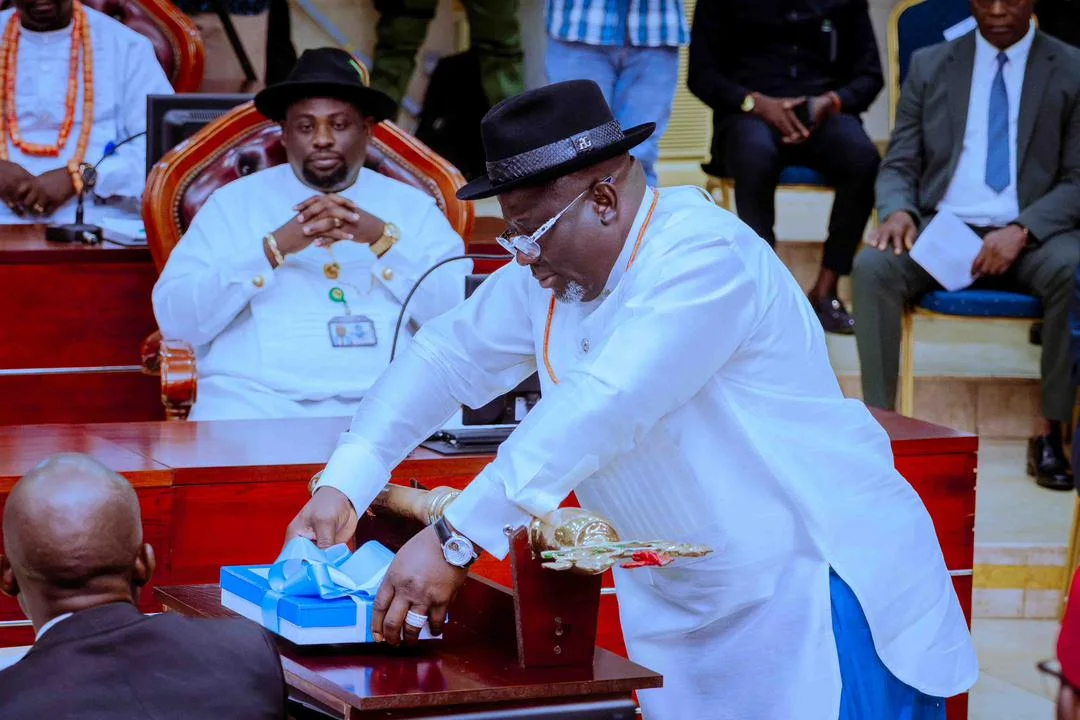
    Decked in his traditional Urhobo attire; Wrapper, shirt and cap, the Governor who was wearing a beautiful smile as he walked beside the majority leader, ordinarily, was never a stranger to the complex. Haven sojourned the State Assembly for over a decade and holding sway as Speaker of the State Assembly with yet-to-be beaten record as the longest Speaker of the State legislature, even the gavel, mace, walls, chairs would, at the slightest glance, recognize him.

    But for the caveat that, at the hallowed chamber, “No clapping, no cheering, no singing, no dancing, no eating, no movement”, even the Mace, the gavel, the chairs and, indeed the human elements at the full-capacity hall would have stood in an unending ovation for this “Stranger”.

    Walking through the pathway to his seat; his beautiful seat, beautifully adorned with red-coloured velvet, the Governor, already armed with the rules of the House, halted midway to observe the needful; to bow before the mace- the symbol of legislative authority. That was not his first time in the recent years he was bowing before the Mace since he became Governor of the State and, of course, not his first time appearing before the State Assembly; the Eight Assembly after assuming the headship of the State. He has been there a couple of time for same purpose. It was an annual Executive/legislative ritual.

    His re-appearance at the hallowed chamber where, like others, he was received as “Stranger” is well understood. He had come to present to the State legislature the 2026 proposed budget of the State.

    And that was it.

    The Governor, Rt. Hon. Sheriff Oborevwori at the meeting proposed a budget estimate of N1.664 Trillion for the 2026 fiscal year.

    Christened “Budget of Accelerating The MORE Agenda” a breakdown of the budget envelope shows that N499 Billion, representing 30 per cent of the total budget was for recurrent expenditure, while N1.165 Trilllion, representing 70 per cent of total budget was for capital expenditure.

    The Governor, while giving further breakdown of the proposed Budget,  disclosed that the 2026 budget size indicates an increase of N685 Billion or 70 per cent over the 2025 Appropriation, pointing out that the budget as proposed, would be mainly funded from Statutory Allocation, Internally Generated Revenue, Mineral Derivation, Value Added Tax, Other Capital Receipts and Savings and Oil Revenue Recoveries.

    The Governor disclosed that N720 billion, or 43.28 per cent of total projected revenue was expected from statutory allocation which, he said, was boosted by post-subsidy FAAC inflows and improved oil production stability in the Niger Delta, adding that Internally Generated Revenue was projected at N250 billion, representing an 86.5 per cent increase over 2025.

    While saying that the projected increase in the state’s IGR was driven by ongoing reforms to plug leakages and widen the tax net, he pointed out that VAT receipts were expected to rise sharply to N120 billion, buoyed by improved federal administration of the tax.

    “Capital receipts, however, have been deliberately cut down to N25 billion, a 73 per cent reduction as the government pushes toward a zero-borrowing fiscal strategy.

    “Savings and oil revenue recoveries are projected to contribute N489 billion. This is a testament to prudent and disciplined financial management,” the Governor added.

    According to him, the proposed recurrent expenditure estimates for 2026 of N499 Billion is made up of personnel costs of N185 Billion, representing 37 per cent of the proposed recurrent budget, stressing that N204 Billion, representing approximately 41 per cent was earmarked for overheads.

    He pointed out that the balance 22 per cent or N110 Billion, was accounted for by social contributions, benefits, and grants, emphasising that the personnel cost of N185 Billion anticipates the annual increments and allowances, while the overhead cost mirrors the inflationary trend in the country.

    Giving insights into the proposed capital expenditure estimate of N1.165 Trillion, Governor Oborevwori noted that the proposal was N535 Billion, or 85 per cent higher than the 2025 capital budget of N630 Billion.

    “This is largely accounted for by the larger budget size of one trillion, six hundred and sixty-four billion naira (N1.664Trillion), as against the nine hundred and seventy-nine billion, two hundred million naira (979.2Billion) of 2025,” the Governor said.

    Highlighting  the priority sectors of the budget, the Governor said N450 billion was budgeted for road infrastructure, N105.086 billion for education, N50.067 billion for health, N20 billion for Delta State Capital Territory Development Agency and N20 billion for Warri, Uvwie and Environs Development Agency.

    According to him, N16 billion was budgeted for Power and Energy, N10 billion for Agriculture, N20 billion for Social Protection, adding that the sum of N100 billion was budgeted for local government intervention in the 25 local government areas in the state (N4 billion per local government).

    Reviewing the performance of the 2025 Budget themed “Budget of Fiscal Consolidation,” where ₦979,228,818,719 was approved for funding both capital and recurrent expenditures, the Governor said the performance of the budget was encouraging.

    “From January to October 2025, the actual revenue receipts from the Federation Account Allocation Committee and Internally Generated Revenue stood at Seven Hundred and Thirty-Eight billion, Six Hundred and Forty million naira only (N738.640 billion), representing 90.5 per cent of the proportionate budget of eight hundred and sixteen billion, twenty-four million, fifteen thousand, five hundred and ninety-nine naira only (N816,024,015,599).

    “The recurrent expenditure for the period under review was three hundred and forty billion, five hundred and fifty-four million, six thousand, four hundred and forty-eight naira only (N340,554,006,448), as against a proportionate amount of two hundred and ninety billion, six hundred and thirty-nine million, seven hundred and ninety-eight thousand, eight hundred and sixty-three-naira, fifty kobo only (N290,639,798,863.50), representing 117 per cent performance.

    “The sum of five hundred and nine billion, seven hundred and eighty million, three hundred and thirty-six thousand, three hundred and seventy naira only (N509, 780, 336,370) was expended during the period under review, as against a proportionate amount of five hundred and twenty-five billion, three hundred and eighty-four million, two hundred and sixteen thousand, seven hundred and thirty-six naira only (N525, 384, 216, 736), representing 97 per cent performance.

    “It is pertinent to appreciate this stellar performance. It is also gladdening to note that the bold and reformist policies of the Federal Government have started to yield the desired result and the country is beginning to turn the corner,” the Governor added.

    While highlighting the importance of peace and security in promoting sustainable development, he said his administration had worked closely with security agencies to tackle crime, including kidnapping and cultism with a view to ensuring sustainable peace and security in communities across the state.

    “We will continue to strengthen the security architecture in the state to better protect our citizens from all threats. This administration has invested heavily in security infrastructure upgrade and will continue to do so for enhanced peace and security.

    “We are looking at deploying cutting edge technology including drones and sophisticated intelligence gathering capabilities and surveillance equipment. All these are in addition to the prompt payment of personnel emoluments and allowances, as well as the provision of covert logistics.

    “Mr Speaker, as I conclude this Budget Address, let me say that we are proud of the progress that we have made so far. However, there is still a lot more to do and the journey to a more prosperous, secure and stronger Delta will take the concerted efforts of all arms of government.

    “I want to place it on record, Mr. Speaker, that this honourable House has proved to be a worthy partner in the implementation of our policies and programmes. I commend you all for the sacrifices and contributions you have made and continue to make, for the smooth and effective running of this administration.

    “In that same spirit of partnership, I invite the House to kindly and speedily consider and approve this appropriation request, so that collectively we can work towards building the Delta State of our dreams where no one is left behind,” the Governor said.

    Earlier in his welcome address, the Speaker, Rt. Hon. Emomotimi Guwor who lauded the Oborevwori’s administration for the steady strides it had recorded under the Renewed Hope for MORE Agenda, said sustained investments in critical infrastructure, impactful social interventions, prudent fiscal management of resources, and strategic initiatives aimed at promoting peace, security, and economic stability across the State have been witnessed over the past year.

    “Your Excellency, it is indisputable that your leadership has ensured the continuation of key legacy projects, expansion of road networks, ongoing construction of five strategic flyovers, improvement of healthcare facilities, empowerment programmes for youth and women, and the strengthening of the educational system.

    “These interventions have not only elevated the quality of life for our people but have also reaffirmed the State’s position as a sub-national model of development,” the Speaker said while thanking the Governor for the approval and payment of the Consolidated Legislative Salary Structure (CONLESS) to staff of the House and Assembly Service Commission.

    He noted that the projections in the Fiscal Strategy Paper (FSP) for 2026, 2027 and 2028 approved by the House reflected national, regional, and global economic dynamics, even as he assured the Governor that the 2026 Appropriation Bill presented to the House would be considered with a view to passing the Bill.

    Motion to receive the 2026 Appropriation Bill presented by the Governor was moved by the Leader of the House, Hon. (Engr.) Emeka Nwaobi who represents the people of Aniocha North State Constituency.

    The motion was seconded by the member representing Ika North East, Hon. Marilyn Okowa-Daramola as it was unanimously adopted by the House following a voice vote called by the Speaker, Rt Hon Emomotimi Guwor.

  • Cases Of Financial ‘Unaccountability’

    Cases Of Financial ‘Unaccountability’

    The recent court case instituted by the Socio-Economic Rights and Accountability Project (SERAP) against the leadership of the National Assembly, NASS has once again exposed the new negative narrative in Nigeria’s governance – Financial unaccountability. The human rights group wants the Senate President, Mr Godswill Akpabio and Speaker of House of Representatives, Mr Tajudeen Abbas to account for the missing N18.6 billion meant for the construction of the National Assembly Service Commission (NASC) Office Complex.

    SERAP’s lawsuit followed the grave allegations documented in the latest 2022 annual report published by the Auditor-General of the Federation on 9 September 2025. Not too long ago, the same Auditor-general for the federation’s office discovered financial impropriety amounting to N210 trillion discovered in the accounting books of NNPC Limited. The case is yet to be resolved by the company despite several emissaries from the National Assembly, demanding its explanations concerning the missing fund.

    According to statistics, annual Nigeria fraud count increased from 44,947 in 2019 to about 95,620 in 2023, representing about 112%. And the financial figure lost also rose from about N2.9billion in 2019 to about N17.67 billion in 2023, representing close to 496%.

    With the recent discoveries in NNPCL and the National Assembly, Nigeria, no doubts faces the risky embarrassment offoreign intervention on its corruption index, just like America is already intervening in her security maladministration.

    The reasons for this financial cankerworm are not far-fetched. Many Nigerians in positions of authority are very greedy. They often get themselves into amassing the kinds of wealth they do not need in the first place. It sounds funny that a former Accountant-general of the federation allegedly embezzled a whopping sum of N109 billion while in office despite all the official paraphernalia that go with his office..

    Many of the citizens are fast embracing the wrong value system wherein peoples’ wealth are never questioned. Rather, a good number of fraudsters are often given recognition by way of chieftaincy titles, political appointments or award of contracts.The implication of this recognition pattern is that the next generation of Nigerians will tend towards emulating this life style of amassing unexplained wealth.

    Nigeria’s growing population, especially the youth is generally swayed into the get-rich-quick syndrome.  This has pushed many of them into vocations such as yahoo-yahoo, human kidnapping for ransom, armed robbery, stealing and political thugry.

    Lack of proper relevant trainings also account for the spate of poor account record keeping in government offices. Today’s accounting system is complex. They cannot therefore be handled by lowly skilled personnel. A lot of those responsible for driving the financial policies of government are not conversant with automated systems of financial record keeping. Even a few of them that are proficient in this direction are poorly paid. And it is rare for a worker overseeing huge sums of money to be hungry without being tempted to pilfer what he or she has in custody.

    Government seldom goes for the relevant and appropriate accounting software that are fraud proof with built-in financial regulations. Software without relevant build-in security checks is prone to resulting into the perpetration of frauds.

    Curbing this negative trend of financial impropriety requires that those given to functioning on behalf of government in financial management must be exposed to regular trainings that can continually expose them to latest trends in accounting practices. Apart from good salaries for them, they must also work in conducive environments.

    It is abnormal for any accounting system to go beyond one year before it is audited.  The Auditor-general for the federation must ensure that governments finances are checked annually in order to eliminate the encumbrances associated with poor accounting procedures. Like is normally done with private sector, public accounting methods must begin to embrace bi-yearly auditing and investigations.

    Everyone found to have been involved in public funds misappropriation must be brought to book. Their experiences will deter others from getting involved in the corruption acts. Like SERAP, any person or group of persons that observe infractions in government finances should endeavor to, not only speak up, but also take lawful actions in the interest of Nigerians.

×