


BY RITA OYIBOKA/AMAYINDI YAKUBU
The sky over the parade ground is pale, almost hesitant, as if it, too, understands the weight of the morning. Rows of uniforms stand in disciplined silence. Boots are polished. Brass buttons catch the light. Then, in a moment that always cuts through protocol and rank, the cages are opened. Two hands reach out and grab the white pigeons before releasing them into the sky.
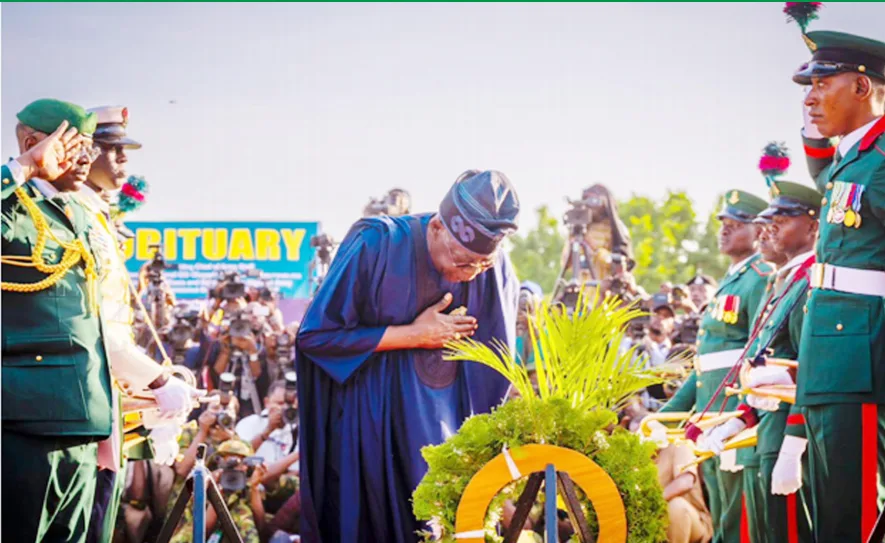
They surge upward, rise in a soft storm of wings, startled at first, then certain, climbing above the heads of generals, governors, widows, schoolchildren, and old soldiers whose backs now bend under the years. The birds circle once, twice, before setting their course into the open sky. Below them, a wreath has been lowered gently onto the coffin of the Unknown Soldier. The green and white ribbon flutters. A bugle sounds the Last Post. A minute of silence follows, not empty silence, but the kind that carries names, faces, and unfinished lives.
It was the Armed Forces Remembrance Day. Or, as it was rebranded in 2026, Armed Forces Celebration and Remembrance Day, a deliberate repositioning meant to do two things at once: honour the dead and acknowledge the living.
As the pigeons disappear into the distance, imagination takes over. One bird, separated from the rest, seems to drift lower, its white body stark against the blue. In the mind’s eye, it is no longer above a ceremonial ground but above a battlefield. Below it, a soldier struggles forward, boots heavy with dust, shoulders tight under the weight of gear and fear. His face is not heroic in the cinematic sense; it is human, strained, determined, tired. The pigeon passes over him, wingbeats soft against the roar of distant conflict, an impossible contrast of peace floating above duty.
Then the scene shifts again. The same white bird, now over a small, quiet compound. A widow sits on a low stool. Children cluster close, their eyes too old for their faces. The pigeon circles once, as if searching, then flies on. Below, the family of a fallen soldier remains, living evidence that every gun salute echoes far beyond the parade ground.
This is the real theatre of Armed Forces Celebration and Remembrance Day.
A Day Rebranded, History Retained
Observed every January 15, Nigeria’s Armed Forces Remembrance Day has long been a fixed point in the national calendar. Its roots stretch back to the Nigerian Civil War and extend through decades of peacekeeping missions, internal security operations, and counterinsurgency campaigns. It is the country’s formal pause button, the day Nigeria is supposed to stop moving, look backwards, and account for the cost of staying whole.
In 2026, the Federal Government rebranded the event as Armed Forces Celebration and Remembrance Day, signalling a shift in emphasis. The new framing sought to spotlight not only sacrifice but service: heroism, professionalism, and humanity. The messaging was clear. This was not just about graves. It was about governance, morale, and national cohesion.
Activities began on January 9 with special Juma’at prayers at the National Mosque in Abuja and across military formations nationwide. Churches followed with interdenominational services. By January 15, the machine of remembrance was in full operation: wreath-laying ceremonies, parades, and symbolic rituals in Abuja and in state capitals across the federation.
The national centrepiece unfolded at the National Arcade in Abuja. Vice President Kashim Shettima, representing President Bola Tinubu, led the wreath-laying. A 21-gun salute rolled across the grounds. The Last Post sounded. Silence fell. Then came the parade: Nigerian Army, Navy, Air Force, and Legionnaires moving as one, a choreographed statement of institutional continuity.
Across Nigeria, governors mirrored the ritual. The choreography was national, the emotions local.
Yet beneath the formality lay a harder truth: this day has never been only about honour. It has always been about accountability.
Tribute as Policy Signal
President Bola Tinubu’s message was unambiguous in tone and ambition. In a signed statement, he declared: “On this Armed Forces Remembrance and Celebration Day, Nigeria pauses to honour its heroes. We remember the brave men and women of the Nigerian Armed Forces who sacrificed everything for our country. Their names might not always be remembered, but their courage sustains our freedom and peace.”
He reaffirmed his administration’s commitment to the welfare and dignity of the Armed Forces, stressing that national security architecture cannot be separated from the well-being of those who operate it. The peace enjoyed in many areas, he noted, rests on the vigilance of the military.
Former Vice President Atiku Abubakar aligned his voice with the national mood, saying, “I and my family are united with Nigerians in solemn remembrance and deep gratitude to the brave men and women of the Armed Forces who have defended the nation.”
He paid tribute to those who made the supreme sacrifice and saluted serving personnel for their courage and commitment to Nigeria’s safety and unity. His attendance at prayers in Abuja ahead of the day reinforced the symbolism: remembrance as civic duty.
Vice President Kashim Shettima used the platform of special prayers to reaffirm the Federal Government’s resolve to empower the military to subdue national crises. Senate President Godswill Akpabio emphasised legislative–executive collaboration to restore peace and security. Governors, too, brought state-level colour to the narrative.
Lagos State Governor Babajide Sanwo-Olu stressed that fallen heroes must be remembered in tangible ways. Ondo State Governor Lucky Aiyedatiwa hailed the military’s sacrifices. Rivers State Governor Siminalayi Fubara went further, ordering immediate employment for the children of fallen heroes. Abia State Governor Alex Otti thanked security agencies for maintaining relative peace.
Chief of Army Staff, Lt. Gen. Waidi Shaibu, delivered a message celebrating the Nigerian Army’s contributions and calling for sustained public support. PDP National Chairman Kabiru Tanimu Turaki demanded improved welfare and stronger funding to neutralise insecurity. Public commentator Reno Omokri amplified the softer side of remembrance, wearing the emblem and urging discounts and concessions for military personnel.
On social media, remembrance went digital. Handles associated with national leaders pushed tributes. Hashtags like #ArmedForcesRemembranceDay and #OurSoldiersOurPride trended. Videos of parades circulated. Influencers weighed in. Engagements ran into the thousands. Nigeria’s memory machine, modernised.
The Appeal Fund: When Honour Meets Accounting
At the core of the 2026 observance was the Armed Forces Remembrance Day Emblem Appeal Fund, the financial engine designed to convert gratitude into material support.
President Tinubu personally donated N200 million at the launch inside the Presidential Villa, urging institutions and individuals to give generously. The National Assembly and the FCT Minister jointly pledged N120 million for the welfare of retirees and widows.
Lagos State escalated the benchmark, announcing N100 million, four two-bedroom apartments, two vehicles, and food items to support Legion operations and members. Rivers State followed with N100 million, described by its governor as extraordinary support. Ondo State introduced N50 million in interest-free loans for 120 widows and dependants, increasing individual benefits from N200,000 to between N450,000 and N500,000.
Akwa Ibom referenced a prior N250 million commitment, urging sustained generosity. Osun State launched its emblem drive. Niger and Sokoto focused on prayers and symbolic launches.
The emblem itself, small, red, and worn on the chest, became a roaming badge of moral participation. In corporate terms, it functioned as both brand and receipt: proof that one had bought into remembrance.
But even as figures were announced and pledges applauded, a parallel narrative disrupted the optics.
A viral video showed retired officers struggling for food at an Abuja event. The clip cut through official messaging like a hostile audit report. Public reactions were swift: calls for better pensions, improved healthcare, salary reviews, and year-round, not seasonal, welfare.
The day, in short, exposed Nigeria’s dual reality: ceremonial unity on the surface, structural tension underneath.
Oborevwori, Service Commanders Honour Nigeria’s Fallen Heroes
Activities marking the 2026 Armed Forces Remembrance Day celebration came to a climax in Delta State with a solemn assembly that culminated with the laying of wreaths at the ceremonial tomb of the unknown soldier at the Cenotaph in Asaba.
Upon his arrival at the ceremony, Governor Oborevwori, who was the Special Guest of Honour, was received with a traditional military salute before he proceeded to inspect a guard of honour mounted by officers and men of the Nigerian Armed Forces and the Nigerian Legion, which showcased a stirring display of discipline, honour, and national unity.
A minute of silence was observed in honour of the fallen heroes, followed by interfaith prayers offered by Christian and Muslim clerics for the repose of the souls of the departed heroes, their families, the welfare of veterans, and divine guidance for the nation’s leadership.
After the interfaith prayers by the clerics, Governor Oborevwori led Service Commanders of the Armed Forces in the state, the Commissioner of Police, representatives of traditional rulers, legionnaires, and top government functionaries in the solemn laying of wreaths at the ceremonial tomb of the unknown soldier.
Highlights of the ceremony were the firing of volleys and the release of white pigeons by the Governor, symbolising peace, hope, and renewal, while reaffirming Delta State’s commitment to the noble ideals for which the nation’s heroes fought and fell.
In an interview with The Pointer, the member representing Aniocha and Oshimili Federal Constituency, Hon. Ndudi Godwin Elumelu, used the platform to push for institutional reform. While canvassing support for fallen heroes, he affirmed plainly: “So, I subscribe to the National Assembly, first of all, putting in legislation that will create an incentive for the fallen heroes and make sure that the families of those people are well taken care of.”
His position reframed remembrance as a legislative deliverable, not just an annual emotion.
The Commander of the Nigerian Army’s 63 Brigade in Asaba, Brigadier-General M.A. Shonibare, who also leads Sector 1 of Operation Delta Safe, contextualised the day from within the system.
“Today is a special day for us, the armed forces, and Nigeria at large,” he said. “It is a day to mark and praise our fallen heroes and celebrate them for what they have done, even though they are gone beyond, and also to remind us that those who are still alive about the sacrifices of those before us have paid. And to also encourage us and ginger us to do more, all in the interest of peace and security of our dear country and the world at large.”
He explained that January 15 remains fixed in military culture, a date that will continue to be observed. At the end of the event, he noted, the bell is blown to activate the new year, a symbolic reset that encourages troops and boosts morale to conduct operations in the interest of the nation.
On morale, Shonibare was blunt. He compared the ceremony to a condolence visit after a burial. “If you conduct a burial and people visit you to come and condole with you, you’ll be encouraged that you are alive. So, it’s the same thing. What we’ve done is we’ve done the Remembrance Day. The troops on the parade and all troops across the nation will see that the fallen heroes are always recognised and remembered. So, of course, this boosts morale. It’s an administrative upliftment.”
On welfare, he acknowledged movement but framed it as an ongoing process. Incentives, he said, are dynamic. The Federal Government keeps updating. The House, the Senate, and the services continue to review conditions for both veterans and serving personnel.
Then the conversation shifted, from command language to lived experience.
Widows, Privileges, and the Politics of Survival
Among the attendees in Asaba was Mrs Sarah Nwabueze, whose husband is counted among the fallen. Her story disrupted the standard narrative.
She openly credited her relative privilege. Her late husband, she s
aid, was a coursemate of General Lucky Irabor, the former Chief of Defence Staff. He pays her children’s school fees. He assists with bills. When she asks for N500,000, he gives her a million. When she asks for N200,000, he gives her N500,000.
“I just count myself lucky,” she said.
Then she pivoted.
“But that will not stop me from championing the cause of other women. They need help, assistance, and should not be shortchanged.”
Her intervention exposed an uncomfortable truth: welfare in Nigeria’s post-service military ecosystem often runs on connections, not systems. Her gratitude did not erase her critique. It sharpened it.
Another widow was even more direct. She appealed to the government to give widows something to do, work, structure, and means of livelihood. “We mothers, we need something to be doing,” she said. “Please, the Government should help us find something for us to be doing… they should not leave us alone just like that.”
These were not rhetorical statements. They were operational demands.
Veterans Speak
In a separate interview with The Pointer, Isa Mohammed Idris, a retired Warrant Officer of the Nigerian Armed Forces, framed the 2026 observance as recognition not only of the fallen but of active personnel.
Nigeria, he said, has made visible progress in security over the years, even as new leadership emerges within the defence structure. A new Defence Chief is now in place. Challenges remain, but the situation, in his assessment, is better than before. What matters most, he stressed, is consistency and proactivity from the government.
On welfare, Idris acknowledged improvement. The government, he said, is trying. “At least now, when we go to the market with what we take home, we can still afford basic things. That is progress.” But he insisted that more must be done to stabilise veterans and make post-service life less fragile.
He also redirected attention to serving personnel. These officers, he said, are their (veterans) younger brothers. “Support given to them today is an investment in tomorrow’s security. Their working conditions and support systems must continue to improve because their work is indispensable,” he said.
Addressing the fear many Nigerians associate with military service, especially in a country scarred by loss, Idris urged the public not to lose faith in the institution. He described the Armed Forces as a place of discipline, opportunity, and national service, an institution capable of shaping lives far beyond the battlefield. With proper support, he said, it will continue to attract young people willing to serve with pride and confidence.
Armed Forces Remembrance Day: Beyond The Parade Ground
The good is visible: national coordination, high-level participation, structured ceremonies, financial commitments, and a deliberate attempt to modernise remembrance into celebration. The rebranding itself reflects a forward-facing mindset, one that acknowledges sacrifice but refuses to freeze the Armed Forces in perpetual mourning.
The bad is persistent: veterans struggling, widows uncertain, welfare systems inconsistent, and reliance on ad-hoc generosity rather than institutional guarantees. The ugly is structural: when access determines survival, when legislation lags behind rhetoric, and when remembrance becomes seasonal instead of operational.
Armed Forces Remembrance Day 2026 showed a Nigeria trying to professionalise gratitude. The optics were solid. The statements were aligned. The funds were notable. But strategy is not sentiment. It is follow-through.
As the last pigeon disappeared into the sky, the ceremony ended. The bands packed up. Officials moved on. But the soldier on the front line kept moving. The widow went home. The children returned to their absence. The veterans folded their programmes and calculated their next month.
This is the real business of remembrance.
Not what is said on January 15, but what is sustained on January 16.

