


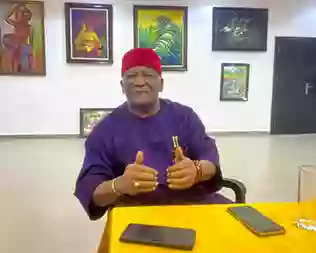
THIS week, we present to you the man, popularly known as “Desert Warrior”, Dr Newton Jibunoh, from Akwukwu-Igbo in Delta State. He gained international recognition for crossing the Sahara Desert solo, three times. In this interaction with him; he spoke extensively about all you need to know about the Mandele Garden, located within the Asaba International Airport, and many such projects in Lagos and other parts of Nigeria, his vision beyond the project in Asaba, the prospects, his view on the proposed creation of Anioma State, and many more. Excerpts.
Shall we meet you, sir?
I am Newton Jibunoh. I am the founder of this place – Nelson Mandela Gardens. This is amongst many similar things that I have done all over the country.It was some 15–17 years ago that a park was dedicated to me as an honour by Babatunde Fashola when he was Governor of Lagos State, and he then invited our then Governor here from Delta State to the event.
The then Governor of Delta State made a speech, in which he said that he had been following what I had done in Abuja and what I was doing in Lagos, but that I had yet to do anything in my home state, Delta. Not long after that, I got an endorsement to build a monument to celebrate the life and times of Nelson Mandela. So I took it straight to the Governor, and I said, “Your Excellency, remember your speech?” He said yes. I said, “I have something that I would like to bring to my home state.”He was very delighted when he saw the endorsement, and that was how the land was provided.
This was in 2012. If you go around, you will see what we have been able to achieve between 2012 and now. Then you can make your own judgment as to whether I have been able to please His Excellency for the speech he made, or whether I have fallen
Do you have a vision beyond what you have on ground now?
Oh yes, the plan is much more than this. Apart from the offices, the animal kingdom, the Olympic-sized swimming pool, the Tennis Court, the children’s playground.
“I say “Children’s playground” because when I met Nelson Mandela himself to show him the plan, he said that whatever we do, we should take children into consideration, because (when he was imprisoned) he did not see children for 27 years.
That was why we started with the Children’s playground. We have the animal kingdom. We are going to bring in more friendly animals. We have about twelve different animals now in the park, but we plan to bring in more that are friendly so that we do not constitute a problem for the Airport, and we do not constitute a problem for the families that will be coming here, especially children. So, we are going to do a lot more than this. What you see here is work in progress.
Shall we take a look at the edifice, the newest initiative at the Nelson Mandela Gardens – the Newton Jibunor International Convention Centre?
Well, we started, as I said, with the Children’s playground, then followed with offices, then a gym and the swimming pool, and later blocks for accommodation for people who come here and want to stay. We left out this one. Mind you, the Newton Jibunor International Convention Centre was not my idea. It was something coined by the architects, the Engineers, and the consultants that we have. They came to me, well, they did not even come to me; I saw it in the drawings they prepared. So I asked, “Why did you do this?” They said that I am ageing, I am 88 now, and that everything I have done in Lagos, in Abuja, and now in Asaba, carries the names of other things, and that they had decided that this one, after me, should be my legacy. When they said it, I could not resist it.
Why “International”?
Because we have hosted the World Health Organisation, we have hosted the World Bank, and we have hosted the United Nations here. Each time they visited, they stayed here and used some of our facilities. In fact, the United Nations had a retreat here around the swimming pool. Every one of them kept asking, “Don’t you have a hall? Don’t you have a place where such events can take place?” That is one side of it.
The second part is that Delta is one of the fastest-growing economies in the country, and a lot of things are beginning to come to Delta. Asaba, in particular, is one of the safest growing capitals in the country. So, a lot of events are already happening there.
The advantage here is that it is situated right inside the airport. When people think of landing and not having to go out into the city, it is very convenient. Secondly, all the conventions, big professional events like the Nigerian Bar Association (NBA), the Nigerian Society of Engineers (NSE), and other institutes, I belong to most of these professional bodies. I know that when they want to have their conventions, it is either Abuja or Lagos, because those are the only two places where you have adequate facilities. I felt that it was time we, as Delta, compete with Lagos and Abuja to attract some of these events.
You can imagine what it will do to the state when we begin to host such international events. The reason it will compete well with Lagos and Abuja is that it is right inside the airport. When you land in Lagos, it takes you about two hours to get to Eko, where the Convention Centre is. In Abuja, it takes more than an hour to get to the International Conference Centre. So you can imagine what this place will do to the economy, tourism, and development of Delta State.
Apart from location and proximity advantages, what other features distinguish the Newton Jibunoh International Convention Centre? You mentioned libraries, and now we are in the museum. Can you elaborate on these features?
Yes, we are going to have state-of-the-art libraries, two libraries. I will show you. One is going to be named after Wole Soyinka, and I have been in conversation with him. He is going to contribute his books and other materials to equip the library.
The same applies to Chimamanda Ngozi Adichie. These two are internationally acclaimed writers and artists.As for me, two of my organisations are accredited by the United Nations, so I have that international affiliation. That is why all the things we are doing here, apart from where we are sitting now, which is the museum, are designed to meet global standards.
This museum will rank among the best you can find anywhere in the world. It is not fully equipped yet, but some of the artefacts that tell the history of this country from thousands of years back will be stored and exhibited here. You can imagine what that will mean for universities, students of art, students of history, and students of heritage. So these are the features, these are the things we believe will distinguish this convention centre. If you have a library of that repute, named after a Nobel Laureate, and another library named after Chimamanda, with all her works included, it elevates the entire experience. So you can imagine what students of history will gain when they come into a place like this.
Then, of course, the Didi Museum, which is where you are now, is also going to house a few thousand works of ours.You know, I was a member of the Nigerian delegation that went to London in the 1970s to persuade the British Government to release some of our artefacts, artefacts that are the history of our civilisation, which they refused to give back to us. It is only now that they are beginning to return some of them, and not even the most important ones.I can tell you that people from all over the world go there to see those works in the museum. So you can imagine what that would mean to Asaba and to Delta State when people begin to come from all over the world to see our heritage, the art that we will house here.
What informed your position that Delta is one of the fastest-growing economies?
It has been published everywhere. It is a statistic issued by the Central Bank of Nigeria and other financial institutions, placing Delta State, not just Asaba, but Delta, as one of the fastest-growing economies in the country. We are an oil-producing state, so you can compare what we produce with others.
Recently, the Anioma State creation agenda was brought to the fore again, with the Senate President reiterating the Federal Government’s resolve to create that state. As an Anioma Chieftain, what is your position on this, and on ceding it to the South-East geopolitical zone?
Sometimes I try to shy away from political issues, but I can give you my personal position, because I have been involved in one way or another, not directly in the creation, but in attending meetings concerning the creation of Anioma state.
Let me put it diplomatically: I have not been a fan of it, especially since the creation of Delta State. Why? For me, Delta is Anioma. You have the capital here in Asaba, and I know that our friends in the South and Central are now becoming comfortable with that. Initially, they were not, but now I think they have accepted it. So, why, having the capital here, should we now begin to look for something else?
People talk about economic development, others about identity, but I am not persuaded. Let me be very blunt: if there is a way for our brothers to consider another name that is not “Delta”, that would make everyone more comfortable with what we already have. You cannot have Delta with its capital in Asaba and then still be looking for something else.
To answer your question, I have never supported it. Do you support it being ceded to the South-East? No, I do not support that.
If those championing the campaign come to you for advice, what would you tell them?
I would tell them that we already have a State. Anioma people have a State, and the capital is Asaba.Yes, I have said this from the beginning. A few people can bear witness to that.
You’ve been an advocate for environmental sustainability. Does it appear that the change you have advocated is yielding results, or is our environmental attitude still what it used to be?
I will give you a somewhat humorous answer. I have been an environmental activist for more than 50 years, and the fact that I am still standing, able to speak, and have not been imprisoned says something.
If you look around the world, many activists like me have ended up in prison. Take Wangari Maathai, who went to prison several times because of her efforts to protect the environment.
Let me give you an example: this convention centre was originally meant to be sited elsewhere. I discovered that the proposed location was a rainforest and a floodplain. That is why I moved it. If you build on a floodplain, you disrupt the natural flow of water, and you do not know where that water will end up; it could cause disasters elsewhere. As Fela Kuti once implied, “Water nur get enemy.” Once you disturb natural systems, the consequences will manifest elsewhere. Floodwaters have pathways from distant regions, and if you block them, you redirect danger.
To answer your question directly: I have been in this campaign for nearly 50 years and have not gone to prison. I would say that is progress. My footprint is visible in Abuja, Lagos, and now in the Delta. If you go to Kano, to the Danbatta area, you will see projects that are out of this world. So, for me, being able to advocate, implement pilot projects, and promote sustainable environmental culture, and still be here, I believe I have done something meaningful.
How did you feel when the green corridor you initiated along the Nnebisi Road, Asaba was removed for new infrastructure development?
It goes back to what I said earlier, at least I was not arrested. What they did was destroy what I planted. It felt like a knife going through my heart. Not just when I see trees cut down, but when I see trees that I personally planted being destroyed, it cuts deeply.
For a long time, I stopped using that road. I avoided it completely. It was that personal. In Mauritania, where I carried out land reclamation, they turbaned me. In Makoda, Kano State, they even gave me a traditional title. Why? Because people have benefited from these efforts to protect the environment and improve their lives. I am glad I have had the opportunity to show people what a healthy environment means: the air you breathe, the water you drink, and the food you eat are all controlled by the environment. Why should we trivialise something like air? It is even more dangerous because you cannot see it. Unlike food and water, you see those, but air, you do not. Yet, if it is polluted, acidic, or degraded, you inhale it without knowing. That is why some of us go suddenly, or something happens to us, and we cannot explain it.
We do not know whether unseen forces have done their worst. A clean environment is critical. As I said, when you cut down trees, you are hurting me, but when you cut down the ones I planted, it is like a knife through my heart.
Are there areas you would like the state government, particularly the Ministry of Environment to focus on? I mean, policy suggestions or areas of collaboration you would recommend?
Well, I am already collaborating with them. I have done a lot with the Ministry, and also with the State Capital Development Authority. I am still available. I offer my experience, my knowledge; whenever they invite me, I go, even at my age.It is still work in progress. I am not stopping anytime soon, as long as they do not arrest me one day.
You know, I mentioned Wangari Maathai earlier. Look also at Al Gore, because of his environmental advocacy, especially in contrast with the policies of Donald Trump; much of what he stood for has been sidelined. His work, including “An Inconvenient Truth”, has been pushed aside in certain quarters. So, for me to still be a free man, continuing my campaign for environmental sustainability, I consider that significant.
There is a school of thought that Africa has little responsibility for climate change, given its lower level of industrialisation compared to the West, and that Western countries should bear the burden. What is your view?
I do not think that assumption is correct. Look at the Amazon rainforest, and then look at the Sahara Desert. The Sahara is essentially the opposite of a rainforest.The heat generated there contributes significantly to global temperature increases. We are currently trying to limit global warming to 1.5 degrees. If it goes beyond that by 2030, the world will face something entirely different.
That is why the campaign to “green” the Sahara is critical. I have taken this to the United Nations. I happen to be one of the first environmentalists to have crossed the Sahara multiple times, and the United Nations is beginning to take this seriously, just as they have with the Amazon.
In the Amazon, the focus is on preventing depletion. In the Sahara, the challenge is to stop expansion and encroachment. Now, when we talk about encroachment, consider the herdsmen crisis in Nigeria. Many people do not realise that the migration of nomadic Fulani is directly linked to the Sahara. Their grazing lands are disappearing, their water sources are drying up, so they are moving southwards in large numbers. That is why we see them everywhere today. If, 50 years ago, the northern states bordering the Sahara had implemented the solutions I proposed, we would not be dealing with the level of crisis we have today.
But those ideas were ignored. I went as far as conducting research in Israel, studying desert reclamation, and returned to implement pilot projects aimed at halting desert encroachment. So no, Africa cannot claim it has no role to play. If you look at the Paris Agreement, Nigeria is a signatory. And let me be very clear about something: when some Western countries say, “We will give you money so you do not industrialise,” that is not generosity, it is strategy. They call it climate justice. In reality, it means: do not develop; we will compensate you, while we continue to pollute.I told many African countries not to accept that kind of arrangement.
Development should not be traded off for handouts.
Your project in the North, did it come to an end?
No, it has not ended. I built what I call a “wall of trees” to stop desert encroachment. I combined desert-resistant trees with agricultural trees, mangoes, oranges, neem, and many of them are already fruiting. We also worked on processing, turning mangoes and oranges into juice, neem into oil, and so on. Neem oil, for example, is highly valuable. In Makoda, in Kano State, they even turbaned me because of this work.
More importantly, people who had migrated southwards due to environmental degradation are now returning to their communities. My projects helped restore farmland, water bodies, and grazing areas. This is not theory; it is practical, on-the-ground impact. They even built a house for me there because of what was achieved. Their land has been restored; they have water again, farmland again, and grazing fields again.
At 88, how do you retain this agile look?
I honestly do not know. The only thing I know is that I take care of the environment in ways many people do not. And I believe, in return, nature is taking care of me. I have done a lot to give back to nature. You see, nature is such a wonderful thing. Every time I think about it, it almost drives me to tears, the things we receive from nature.
When I speak to students and younger people, that is what I try to pass on to them: nature is extraordinary. You plant a yam, and after five months, you harvest it. You plant a single seed, and look at what you get. Do people ever stop to wonder about that? You plant an orange seed, and it can grow and produce thousands of oranges over time. That is nature. You cannot keep taking without giving back. You must give something back. If you do not, nature will come after you. So I give back a lot to nature, and that is what I try to teach younger people. If you want to be like me at 88, this is your wake-up call.
What does an average day look like to you?
My normal day starts with feeding my animals. I have 12 different types of animals here, and I feed them every morning. Again, that is giving back to nature. But I also use it as exercise, I walk from one end of the park to the other looking for them. I feed them before I even eat my breakfast.
Why animals?
Because they were here before us. Creation was designed in such a way that nature provided these things because humans would need them to survive. So why are we the ones taking everything without giving anything back? Other creatures share this planet with us, and they are far more numerous. Imagine if they all came together and decide to react to what humans are doing to them. You can imagine the consequences. That is why we must respect nature.
When I harvest, I celebrate it. If you see the way I celebrate the land for what it gives back to us, yams in five months, maize in three months, oranges and mangoes in two years, and a mango tree producing fruits for twenty years, and yet we take all of this for granted. So if you ask me what keeps me going, perhaps that is it.
As an entrepreneur, how are you coping with power (Electricity)? And do you see any end in sight to Nigeria’s electricity challenges, given the fact that since 1960, the situation has worsened, what solutions would you propose?
Nigerians are the most resilient people I know in the world. I say that because I have travelled extensively. But I also think that resilience is part of the problem; we adapt instead of fixing issues. When roads are bad, instead of fixing them, people buy four-wheel drives. Water is no longer supplied centrally as it used to be; now everyone drills boreholes.
I once wrote an article estimating that Nigeria had over 75 million generators. I even employed students to conduct a study. That was then; today, it may be over 100 million. Why is this a concern? Because of the environmental consequences. The fumes from these generators contribute to pollution and global warming.
Now, which government do you blame? This problem has persisted across administrations. This morning, I watched a discussion about increasing power generation from about 4,500 megawatts to 6,000 megawatts. But for a country of over 200 million people, that is inadequate.

